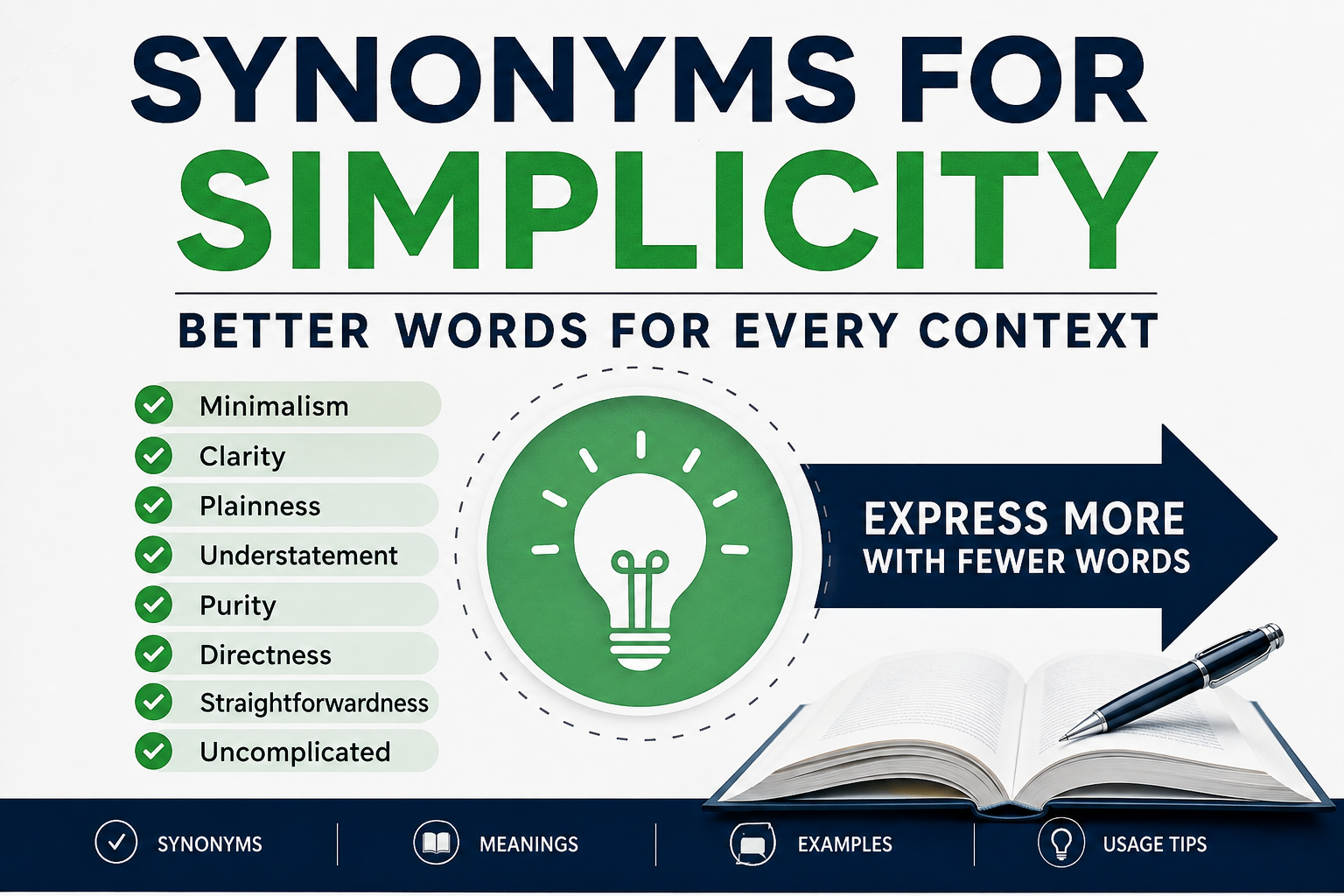
Looking for synonyms for simplicity? The best alternative depends on what kind of simplicity you mean. You might be talking about something that is easy to understand, free from unnecessary decoration, uncomplicated in structure, direct in communication, or natural and unpretentious.
Common alternatives include plainness, clarity, ease, straightforwardness, directness, naturalness, restraint, and simplicity itself. However, these words are not interchangeable in every sentence. For example, clarity emphasizes understandable expression, while plainness can emphasize a lack of decoration or complexity.
This guide explains the most useful alternatives to simplicity, how they differ, and which one to choose in real-world writing.
Quick Answer: What Are the Best Synonyms for Simplicity?
The closest general alternatives to simplicity include plainness, straightforwardness, clarity, ease, directness, and simpleness. Depending on context, minimalism, restraint, naturalness, austerity, and unpretentiousness can also work.
The important distinction is meaning: use clarity when the emphasis is on understandable communication, ease when something is easy to do, plainness when it lacks decoration or complexity, and straightforwardness when something is direct and uncomplicated.
Core Synonyms for Simplicity
| Word | Relationship | Main Meaning | Strength | Best Context |
|---|---|---|---|---|
| Plainness | Near synonym | Lack of complexity or decoration | Similar | Design, appearance, style |
| Straightforwardness | Near synonym | Directness without complications | Similar | Instructions, communication, processes |
| Clarity | Contextual alternative | Ease of understanding | Similar | Writing, explanations, ideas |
| Ease | Contextual alternative | Lack of difficulty | Similar | Tasks, use, processes |
| Directness | Contextual alternative | Clear, uncomplicated expression | Similar | Speech, writing, communication |
| Simpleness | Close synonym | The quality of being simple | Similar | General or literary contexts |
| Naturalness | Contextual alternative | Lack of artificiality or affectation | Similar in some contexts | Style, behavior, expression |
| Restraint | Contextual alternative | Avoidance of excess | Narrower | Design, decoration, style |
| Austerity | Contextual alternative | Severe or deliberately plain simplicity | Stronger/specific | Architecture, lifestyle, design |
| Unpretentiousness | Contextual alternative | Lack of showiness or affectation | Narrower | People, style, behavior |
| Purity | Context-dependent | Freedom from unnecessary elements or mixture | Different emphasis | Design, artistic style |
| Minimalism | Related/contextual | Deliberate use of very few elements | More specific | Design, art, lifestyle |
These distinctions matter because major dictionaries group simplicity under several different senses rather than treating all related words as interchangeable. Merriam-Webster, for example, identifies senses involving uncomplicated structure, clarity of expression, restraint in ornamentation, and freedom from pretense.
What Does “Simplicity” Mean?
Simplicity is a noun describing the quality or state of being simple, uncomplicated, plain, or easy to understand or do.
Cambridge identifies several important senses. Simplicity can refer to something being easy to understand or do, something ordinary or natural rather than complicated, or something plain without unnecessary decoration.
For example:
- The simplicity of the instructions made them easy to follow.
- I admire the simplicity of the building’s design.
- She prefers a life of simplicity.
Because the word has multiple senses, there is no single synonym that works perfectly everywhere.
1. Plainness
Plainness is one of the closest alternatives when simplicity means having few decorative or unnecessary elements.
Use plainness for appearance, design, language, or style.
Example:
The plainness of the room gives it a calm and welcoming atmosphere.
Choose “plainness” when: the emphasis is on being plain rather than elaborate.
It is not always positive. Depending on context, plainness can suggest a lack of ornament, excitement, or sophistication.
2. Straightforwardness
Straightforwardness describes something direct, uncomplicated, and easy to understand.
It works especially well for:
- instructions
- procedures
- explanations
- communication
- decision-making
Example:
The straightforwardness of the instructions helped new employees learn the process quickly.
Choose “straightforwardness” when: you want to emphasize that something is direct and free of unnecessary complications.
It is usually more natural than simplicity when discussing someone’s communication style.
3. Clarity
Clarity is an excellent alternative when simplicity means ease of understanding.
Example:
The clarity of the report made the complex findings easy to understand.
But clarity is not a universal synonym. Something can be complicated while still being clear.
For example:
The professor explained the complicated theory with remarkable clarity.
The theory itself is not necessarily simple. The explanation is clear.
Choose “clarity” when: the focus is understandable communication, writing, instructions, or ideas.
Cambridge specifically recognizes simplicity in the sense of something being easy to understand, while Merriam-Webster lists clarity and related terms under its sense of directness of expression.
4. Ease
Ease works when simplicity means lack of difficulty or effort.
Example:
The simplicity of the software allows users to complete tasks with ease.
Or:
The ease of the new system impressed the staff.
These words overlap, but they focus on different things:
- simplicity → the uncomplicated nature of something
- ease → how little difficulty or effort is involved
Choose “ease” when: talking about usability, effort, difficulty, or convenience.
5. Directness
Directness emphasizes communication that is clear, immediate, and not indirect.
Example:
I appreciated the directness of her explanation.
It is particularly useful for:
- speech
- writing
- feedback
- communication
- instructions
Choose “directness” when: simplicity comes from saying something plainly and without unnecessary detours.
6. Simpleness
Simpleness is a genuine noun related closely to simplicity, although it is less common in ordinary modern prose.
It can refer to the quality of being simple, and in some contexts it can also carry associations with innocence or lack of sophistication. Merriam-Webster lists simpleness as a noun related to both simplicity and qualities such as naturalness, innocence, sincerity, and straightforwardness.
Example:
The simpleness of the design makes it easy to reproduce.
For most professional writing, however, simplicity will usually sound more natural.
7. Naturalness
Naturalness can replace simplicity when the intended meaning is a lack of artificiality, affectation, or unnecessary sophistication.
Example:
The naturalness of her writing makes the story feel authentic.
This is not a direct synonym in every context.
Choose “naturalness” when: you mean something feels genuine, spontaneous, or unaffected.
8. Restraint
Restraint is useful when simplicity results from deliberately avoiding excess.
Example:
The designer used restraint to create an elegant interior.
Here, restraint does not simply mean “simple.” It means that the designer deliberately avoided excessive decoration.
Choose “restraint” when: discussing controlled use of color, decoration, language, or visual elements.
9. Austerity
Austerity refers to a particularly severe, plain, or stripped-down form of simplicity.
Example:
The building’s austerity gives it a powerful visual presence.
It can describe:
- architecture
- design
- lifestyle
- artistic style
It often carries a stronger or more severe connotation than simplicity.
Choose “austerity” when: the simplicity is deliberately stark, severe, or highly restrained.
10. Unpretentiousness
Unpretentiousness means a lack of artificial sophistication, showiness, or desire to impress.
Example:
The restaurant’s unpretentiousness is part of its appeal.
This is especially useful for describing:
- people
- places
- writing
- lifestyles
- design
Choose “unpretentiousness” when: you want to emphasize that something is modest and not showy.
11. Minimalism
It is strongly associated with simplicity, but it is better treated as a contextual alternative or related concept rather than a universal synonym.
Minimalism usually involves a deliberate reduction to essential elements.
Example:
The website uses minimalism to keep the interface clean and focused.
The difference is important:
- simplicity can happen naturally.
- minimalism often describes a deliberate design or philosophical approach.
Use minimalism particularly for design, architecture, art, fashion, and lifestyle.
Which Word Should I Use?
Choose “clarity” when:
You mean that something is easy to understand.
The clarity of the explanation was impressive.
Choose “ease” when:
You mean that something is easy to do or use.
The ease of use is the product’s biggest advantage.
Choose “plainness” when:
You mean a lack of decoration or complexity.
The plainness of the design gives it a timeless quality.
Choose “straightforwardness” when:
You mean direct, uncomplicated communication or procedure.
The straightforwardness of the process saved everyone time.
Choose “directness” when:
You are emphasizing how someone communicates.
Her directness made the conversation much easier.
Choose “minimalism” when:
You mean deliberate reduction to essential elements.
The designer embraced minimalism throughout the apartment.
Choose “unpretentiousness” when:
You mean modesty and a lack of showiness.
His unpretentiousness made him easy to talk to.
Choose “austerity” when:
You mean a severe or stark form of simplicity.
The room’s austerity created a solemn atmosphere.
Simplicity vs. Clarity
These words overlap, but they are not identical.
| Simplicity | Clarity |
|---|---|
| Focuses on being uncomplicated | Focuses on being understandable |
| Can describe structure or design | Often describes communication or ideas |
| Can involve few elements | Can exist even in complex material |
| “The simplicity of the design” | “The clarity of the explanation” |
A complicated subject can have clarity without having simplicity.
The professor’s explanation was remarkably clear despite the complexity of the subject.
So, use clarity when understanding is the main idea.
Simplicity vs. Ease
Simplicity describes the uncomplicated nature of something; ease describes the absence of difficulty.
Compare:
The simplicity of the software makes it attractive.
with:
The software allows users to complete tasks with ease.
The first emphasizes the design or structure. The second emphasizes the user’s experience.
Simplicity vs. Minimalism
These concepts are especially easy to confuse in design writing.
Simplicity means something is uncomplicated or free from unnecessary complexity.
Minimalism usually implies an intentional design philosophy centered on reducing elements to what is essential.
A simple website does not necessarily follow strict minimalism.
Example:
The website’s simplicity makes navigation easy.
The website follows a minimalist design with very few visual elements.
The second sentence communicates a more specific design philosophy.
Simplicity vs. Straightforwardness
Straightforwardness is narrower than simplicity.
It works particularly well when something is:
- direct
- uncomplicated
- easy to follow
- free from ambiguity
For example:
The straightforwardness of the instructions helped everyone understand the procedure.
But simplicity can also describe visual appearance, lifestyle, or lack of decoration, where straightforwardness would sound unnatural.
Synonyms for Simplicity in Different Contexts
In Design
Best choices:
- simplicity
- minimalism
- plainness
- restraint
- austerity
Example:
The designer achieved elegance through simplicity and restraint.
In Writing
Best choices:
- clarity
- directness
- straightforwardness
- plainness
Example:
The article’s clarity makes the technical subject accessible.
In Instructions
Best choices:
- straightforwardness
- clarity
- ease
Example:
The clarity of the instructions prevented confusion.
In Lifestyle
Best choices:
- simplicity
- naturalness
- unpretentiousness
- plainness
- austerity
Example:
He values the simplicity of living with fewer possessions.
In Communication
Best choices:
- directness
- clarity
- straightforwardness
- candor
Example:
Her directness made her expectations clear.
Common Mistakes With Synonyms for Simplicity
Mistake 1: Treating “minimalism” as an exact synonym
Minimalism is more specific. It usually suggests a deliberate approach of reducing elements to essentials.
Mistake 2: Using “clarity” for every kind of simplicity
Clarity concerns understanding. It does not necessarily mean something has few parts or little decoration.
Mistake 3: Using “ease” to describe appearance
You can naturally say:
The ease of use is excellent.
But if you mean a plain visual appearance, plainness or simplicity is more appropriate.
Mistake 4: Assuming “austerity” is always positive
Austerity can suggest severity, harshness, or deprivation as well as elegant restraint.
Mistake 5: Confusing simplicity with innocence
Simplicity has historical and dictionary-recognized senses related to innocence, naïveté, and lack of sophistication, but those meanings are different from the common modern sense of uncomplicated design or easy understanding.
Related Words That Are Not Always Exact Synonyms
Some words are closely associated with simplicity but should not automatically replace it:
- efficiency — emphasizes achieving results with minimal waste
- convenience — emphasizes ease or suitability
- accessibility — emphasizes how easy something is to access or understand
- elegance — can involve simplicity but also implies refined beauty
- purity — may describe freedom from unwanted elements
- modesty — emphasizes lack of extravagance or self-importance
- sophistication — often contrasts with simplicity, although sophisticated design can deliberately use simplicity
These words belong in the broader semantic field of simplicity, but context determines whether substitution is appropriate.
Antonyms of Simplicity
The main antonyms of simplicity include:
- complexity
- complication
- intricacy
- elaborateness
- difficulty
- ornateness
- decoration
- sophistication
The correct opposite depends on the sense.
For example:
simplicity ↔ complexity
describes structure, while:
simplicity ↔ ornateness
can describe visual decoration.
Cambridge and Merriam-Webster both list complexity and related terms among the important opposites of simplicity.
Frequently Asked Questions
What is the closest synonym for simplicity?
The closest synonym depends on the intended sense. Plainness is close when simplicity means lack of decoration or complexity; straightforwardness works for uncomplicated processes or communication; clarity works for understandable expression; and ease works when the meaning is lack of difficulty.
What is another word for simplicity in writing?
Clarity, directness, and straightforwardness are often the most natural choices. Clarity emphasizes ease of understanding, while directness emphasizes an uncomplicated style of expression.
What is a formal synonym for simplicity?
Simplicity itself is already appropriate in formal writing. Depending on context, straightforwardness, clarity, restraint, plainness, or austerity may work. The best choice depends on the exact meaning rather than formality alone.
What is a synonym for simplicity in design?
Minimalism, plainness, restraint, and austerity can work in design contexts. Minimalism is especially appropriate when the design deliberately reduces visual elements to the essentials.
Is “clarity” the same as “simplicity”?
No. They overlap but are not identical. Simplicity concerns being uncomplicated or having few unnecessary elements, while clarity concerns being easy to understand. A complex idea can still be presented with great clarity.
Is “minimalism” a synonym for simplicity?
It can function as a contextual alternative, particularly in design and lifestyle discussions, but it is not a universal synonym. Minimalism generally describes a deliberate philosophy or approach of reducing something to essential elements.
What is the opposite of simplicity?
The most general opposite is complexity. Depending on context, alternatives include complication, intricacy, elaborateness, difficulty, and ornateness.
Can simplicity mean innocence?
Yes. Simplicity has a less common sense associated with innocence, naïveté, or lack of worldly sophistication. This is distinct from the common sense involving uncomplicated structure or ease of understanding.
Conclusion
The best synonym for simplicity depends on what you are trying to emphasize.
Use plainness for a lack of decoration, clarity for understandable communication, ease for lack of difficulty, straightforwardness for uncomplicated processes or expression, and directness for clear communication. For design, minimalism and restraint can be stronger contextual choices, while naturalness and unpretentiousness work when simplicity means authenticity or a lack of showiness.

Emily Johnson is a linguistics graduate and vocabulary specialist. She writes detailed synonym explanations and helps readers understand subtle differences between words, improving both writing and speaking skills. Synonyms help express ideas more clearly and precisely in English.