The word bounce can describe several different kinds of movement and behavior. A ball can bounce after hitting the ground, a person can bounce into a room energetically, a market can bounce after falling, and an email can bounce when it cannot be delivered. Because these meanings are different, the best synonym depends heavily on context. Cambridge defines bounce among other things as moving up or away after hitting a surface, while also recognizing meanings involving energetic movement, failed checks or payments, email delivery, and a rise or recovery.
This guide separates the most useful alternatives so you can choose a word that actually fits your sentence.
Quick Answer: What Are the Best Synonyms for Bounce?
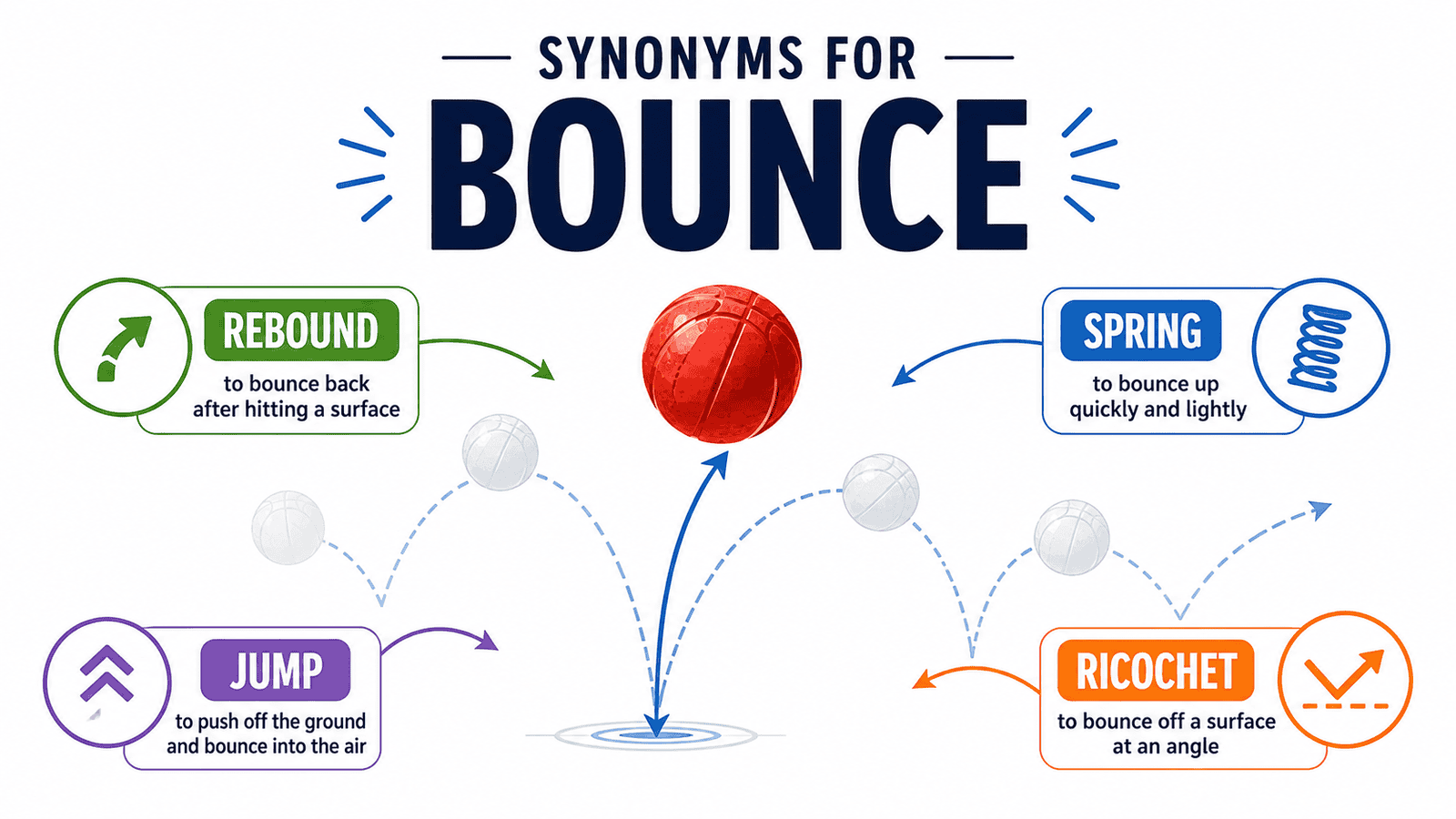
The closest synonyms for bounce in its physical-movement sense include rebound, spring, leap, jump, hop, bound, ricochet, carom, recoil, and bob. However, they are not interchangeable in every sentence. Rebound is especially useful when something returns after hitting a surface, spring emphasizes sudden or elastic movement, and ricochet describes an object striking a surface and changing direction. For the informal sense of forcing someone out, alternatives include eject, expel, dismiss, and oust.
Core Synonyms for Bounce
| Word | Relationship | Meaning | Strength / Nuance | Formality | Best Context |
|---|---|---|---|---|---|
| Rebound | Near/direct synonym | Move back after hitting something | Very close to bounce | Neutral | Balls, objects, recovery |
| Spring | Near synonym | Move suddenly upward or forward | Emphasizes suddenness or elasticity | Neutral | People, objects, movement |
| Leap | Contextual alternative | Jump a considerable distance or height | Usually stronger than bounce | Neutral | People, animals |
| Jump | Near synonym | Push yourself off a surface | Broader than bounce | Neutral | People, animals |
| Hop | Contextual alternative | Make a small jump | Usually smaller than bounce | Neutral | People, animals |
| Bound | Contextual alternative | Move with energetic leaps | More graceful or powerful | Neutral/literary | People, animals |
| Ricochet | Contextual alternative | Hit a surface and fly off in another direction | Strong directional emphasis | Neutral | Bullets, balls, objects |
| Carom | Contextual alternative | Rebound after striking something | Often used in sports or billiards | Neutral | Balls, sports |
| Recoil | Near synonym | Move backward after impact | Often implies force or reaction | Neutral/formal | Weapons, machines, reactions |
| Bob | Near synonym | Move gently up and down | Softer and less forceful | Neutral | Water, heads, objects |
| Jounce | Contextual alternative | Move with repeated jolts | Rough, jerky movement | Neutral | Vehicles, roads |
| Eject | Different sense | Force someone or something out | Strong, deliberate removal | Neutral/formal | People, objects |
| Expel | Different sense | Force someone out | Formal and deliberate | Formal | Institutions, groups |
| Dismiss | Different sense | Order someone to leave or remove them | Often less physical | Neutral/formal | Employees, students |
| Oust | Different sense | Remove someone from a position | Emphasizes removal from power | Formal | Leaders, officials |
The important point is that not all of these words are direct replacements for every meaning of bounce. Dictionaries and thesauruses list alternatives across different senses, so context matters.
What Does “Bounce” Mean?
As a verb, bounce commonly means to move upward or away after hitting a surface, or to cause something to do so.
The basketball bounced off the rim.
It can also mean jumping repeatedly, moving energetically, recovering after a decline, failing to clear a check, or being returned as an undeliverable email. Cambridge specifically identifies the physical, energetic, banking, email, and financial senses.
As a noun, bounce can refer to the act or quality of bouncing, as in the ball has plenty of bounce, or to a rise or improvement, as in the market received a bounce.
1. Rebound
Rebound is one of the closest alternatives to bounce when something hits a surface and moves back or away.
Example:
The tennis ball rebounded off the wall.
Bounce vs. rebound
Bounce is the broader everyday word. Rebound places more emphasis on the return movement after impact.
Use rebound when you want to emphasize that something comes back after striking a surface.
Best for: balls, objects, sports, physical impacts, and recovery.
2. Spring
Spring can mean moving suddenly upward, forward, or outward. It often suggests stored energy or elasticity.
Example:
The cat sprang onto the table.
It can replace bounce when the movement is sudden and energetic, but it does not always imply repeated contact with a surface.
Best for: people, animals, elastic objects, and sudden movements.
3. Jump
Jump is a broader and more common word than bounce. It describes pushing yourself off the ground or another surface.
Example:
The children jumped on the trampoline.
However, jump does not necessarily suggest the repeated up-and-down motion associated with bounce.
Choose “jump” when the main idea is leaving the surface.
Choose “bounce” when repeated upward movement or springiness is important.
4. Leap
Leap usually describes a larger or more deliberate jump.
Example:
The deer leaped over the fence.
It is not a perfect synonym for bounce, because a leap normally emphasizes distance or height rather than repeated contact with a surface.
Best for: people, animals, dramatic movement, and longer jumps.
5. Hop
Hop generally describes a small jump, often on one foot.
Example:
She hopped across the puddle.
Because a hop is usually smaller and more specific than a bounce, it should be treated as a contextual alternative, not a universal synonym.
6. Bound
Bound means to move with energetic leaps.
Example:
The puppy bounded across the yard.
It gives movement a lively, energetic quality. It is especially natural for animals and people.
Bounce → repeated or springing movement
Bound → energetic movement involving leaps
7. Ricochet
Ricochet is a specialized alternative for something that strikes a surface and changes direction.
Example:
The ball ricocheted off the wall and rolled across the floor.
It is more specific than bounce. The key idea is deflection.
Use ricochet when the object strikes something and shoots away, often in a different direction.
8. Carom
Carom means to rebound or move off a surface after striking it. It is particularly common in sports contexts.
Example:
The puck caromed off the boards.
Compared with bounce, carom often sounds more technical or sports-oriented.
Best for: billiards, hockey, balls, and other objects that change direction after impact.
9. Recoil
Recoil means to move backward suddenly, usually because of impact, force, or an emotional reaction.
Example:
The machine recoiled after the sudden impact.
It is not a general synonym for bounce. It is better when the movement is backward and forceful.
10. Bob
Bob describes gentle movement up and down or backward and forward.
Example:
The boat bobbed on the waves.
Compared with bounce, bob usually suggests slower, softer, or more floating movement.
11. Jounce
Jounce describes repeated jolting or rough movement.
Example:
The truck jounced along the uneven road.
It is useful when something moves up and down because of bumps or an uneven surface.
It is much less common in everyday speech than bounce, so choose it mainly when its specific meaning is useful.
Synonyms for “Bounce” by Context
For a Ball or Object
When a ball hits a surface and moves away, the strongest alternatives are:
- rebound
- ricochet
- carom
- spring
- recoil
Example
The ball bounced off the wall.
Possible alternatives:
The ball rebounded off the wall.
The ball ricocheted off the wall.
The second version emphasizes a change in direction, while rebounded focuses more generally on returning from the surface.
For Jumping Up and Down
When someone repeatedly moves upward and downward, consider:
- jump
- hop
- spring
- leap
Example
The children were bouncing on the trampoline.
A natural alternative is:
The children were jumping on the trampoline.
Here, jumping is often more natural than forcing a specialized synonym into the sentence.
For Energetic Movement
When bounce describes someone entering or moving around energetically, alternatives include:
- bound
- spring
- leap
Example
She bounced into the room with excitement.
A natural alternative is:
She bounded into the room with excitement.
Here, bounce is not describing literal impact with a surface. It describes lively movement. Cambridge explicitly recognizes this energetic sense.
For Recovery After a Setback
In phrases such as bounce back, the meaning changes again.
Useful alternatives include:
- recover
- rebound
- rally
- regain strength
- recover quickly
Example
The company bounced back after a difficult year.
You could write:
The company recovered after a difficult year.
Or:
The company rebounded after a difficult year.
Here, recover is usually more neutral, while rebound can suggest a noticeable return after a decline.
Synonyms for “Bounce” in the Sense of Ejecting Someone
In informal English, bounce can mean to force someone to leave.
For example:
The security guard bounced him from the club.
In this sense, physical-movement synonyms such as rebound and spring are completely wrong.
Better alternatives include:
- eject
- expel
- remove
- dismiss
- oust
- kick out — informal
- throw out — informal
Merriam-Webster lists eject, dismiss, banish, expel, sack, boot out, and other removal-related terms for this sense of bounce.
Which word should you use?
Eject — force someone out of a place.
The bouncer ejected the disruptive customer.
Expel — formally force someone out of an institution or group.
The school expelled the student.
Dismiss — officially send someone away or remove them from a job or duty.
The manager dismissed the employee.
Oust — remove someone from a position of power or authority.
The board ousted the chairman.
These are related alternatives, but they are not synonyms of the physical sense of bounce.
Bounce vs. Rebound
These words overlap strongly when describing physical movement.
| Bounce | Rebound |
|---|---|
| Broad everyday term | More specific return movement |
| Often implies movement after impact | Strongly emphasizes returning after impact |
| Common with balls and jumping | Common with balls, objects, and recovery |
| Can have many other meanings | Often more focused |
Example:
The basketball bounced off the rim.
The basketball rebounded off the rim.
Both can work, but rebound highlights the ball’s return after impact.
Bounce vs. Ricochet
Bounce is broader.
Ricochet specifically suggests striking a surface and then moving away, often at an angle or in a new direction.
The ball bounced off the wall.
The ball ricocheted off the wall and flew toward the window.
The second sentence gives a stronger sense of directional deflection.
Bounce vs. Spring
Bounce often describes repeated movement after impact or repeated up-and-down motion.
Spring emphasizes sudden movement, elasticity, or stored energy.
The ball bounced across the floor.
The cat sprang from the chair.
The two overlap, but spring is generally more sudden and energetic.
Bounce vs. Jump
These words are closely related but not identical.
Jump emphasizes the act of leaving the ground.
Bounce emphasizes repeated upward movement, springiness, or movement after impact.
The athlete jumped over the hurdle.
The ball bounced over the line.
A person can jump without bouncing, and an object can bounce without literally jumping.
Common Mistakes With Bounce Synonyms
Mistake 1: Treating every thesaurus entry as interchangeable
Words such as rebound, ricochet, hop, and eject can all appear in synonym resources for different meanings of bounce, but they cannot replace bounce in the same sentence.
Mistake 2: Using “ricochet” for every bounce
A ball can bounce without changing direction dramatically. Ricochet is better when impact causes a noticeable deflection.
Mistake 3: Using “leap” for repeated bouncing
A leap usually describes a larger jump. It does not naturally replace bounce in every sentence about repeated up-and-down movement.
Mistake 4: Confusing “bounce back” with physical bouncing
The economy bounced back.
Here, bounce back means recover, not physically rebound from a surface. Cambridge recognizes this broader financial and recovery-related usage.
Mistake 5: Using “eject” for physical bouncing
The ball ejected off the wall. ❌
That is not a natural replacement.
The ball rebounded off the wall. ✓
Eject belongs to the separate meaning of forcing something or someone out.
Frequently Asked Questions
What is the closest synonym for bounce?
Rebound is one of the closest synonyms when bounce means moving back or away after hitting a surface. However, the best choice depends on context. Spring emphasizes sudden movement, jump emphasizes leaving the ground, and ricochet emphasizes deflection after impact.
What is another word for bounce up and down?
Depending on the context, jump, bob, hop, spring, or jounce may work. Jump is the most common general alternative, while bob suggests gentle movement and jounce suggests rough, repeated jolting.
Is “rebound” the same as “bounce”?
Not always. The words overlap when something moves back after hitting a surface, but rebound more strongly emphasizes the return movement. Bounce has many additional meanings, including energetic movement, recovery, failed checks, and undeliverable emails.
What is a formal synonym for bounce?
There is no single formal synonym that works in every context. Rebound can work in physical or financial contexts, while recover can replace bounce back in formal writing. For the “force someone out” sense, eject, expel, or dismiss may be appropriate depending on context.
What is a synonym for “bounce back”?
Common alternatives include recover, rebound, return, regain strength, and rally. Recover is especially versatile, while rebound often emphasizes a noticeable return after a decline.
What is a synonym for bouncing a ball?
Depending on the sentence, you can use rebounding, springing, or throwing against a surface, but bounce is often the most natural verb. English does not require a more sophisticated synonym when bounce is already precise.
What is another word for bounce in sports?
The best alternative depends on the sport. Rebound is common for balls returning after impact, while carom is useful when a ball or puck strikes something and changes direction. Ricochet can also describe deflection.
Can “jump” replace “bounce”?
Sometimes. Jump is appropriate when the main idea is moving off the ground. Bounce is better when repeated up-and-down movement, impact, or springiness is central.
Conclusion
The best synonym for bounce depends on what kind of movement or meaning you intend. For physical movement, rebound is often the closest alternative. Use spring for sudden or elastic movement, jump for leaving the ground, hop for a small jump, bound for energetic movement, and ricochet or carom when an object deflects after striking a surface.
For bounce back, choose words such as recover or rebound. For the informal sense of forcing someone out, use eject, expel, dismiss, or oust.
The key is not to choose the most complicated synonym. Choose the word that expresses the exact type of movement, direction, force, or context you mean.

Emily Johnson is a linguistics graduate and vocabulary specialist. She writes detailed synonym explanations and helps readers understand subtle differences between words, improving both writing and speaking skills. Synonyms help express ideas more clearly and precisely in English.