If someone is jaded, they have usually experienced, consumed, or dealt with so much of something that it no longer feels exciting or interesting. The word can also suggest tiredness or emotional weariness, especially after prolonged work or repeated exposure. Oxford defines jaded as tired and bored because you have had too much of something, while Merriam-Webster also recognizes a sense of being fatigued by overwork.
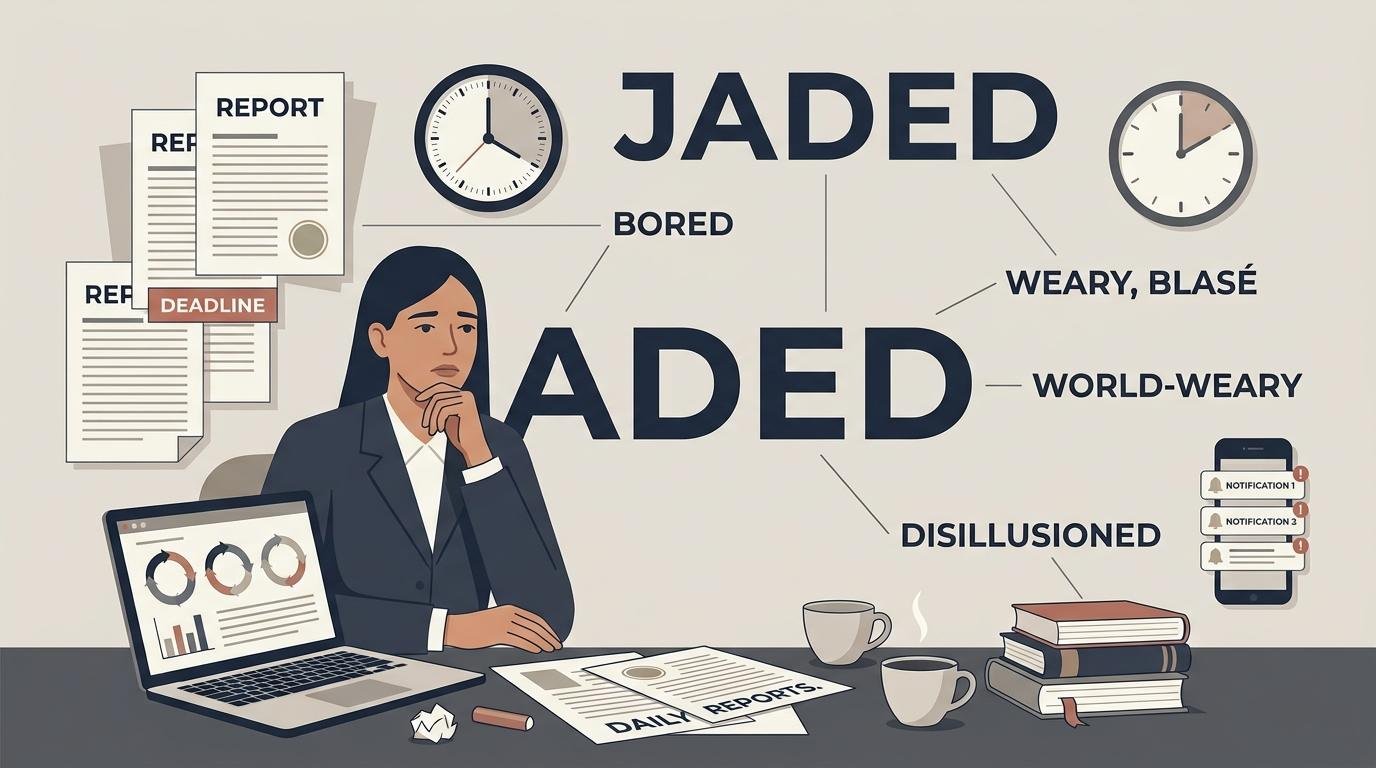
The best synonym depends on which part of that meaning you want to emphasize. Bored is simpler and more general; weary emphasizes tiredness; blasé suggests sophisticated indifference; world-weary conveys weariness with life or experience; and disillusioned focuses on losing an earlier belief or idealism.
Quick Answer
The closest synonyms of jaded include bored, weary, tired, exhausted, world-weary, blasé, disillusioned, fed up, apathetic, and burned-out. However, they are not interchangeable in every sentence. Use bored for lack of interest, weary for tiredness, blasé for over-familiar indifference, and world-weary for a deeper weariness with life or experience.
Table of Contents
- What Does “Jaded” Mean?
- The Closest Synonyms of Jaded
- Strongest and Most Useful Alternatives
- Formal and Context-Specific Alternatives
- Jaded vs. Similar Words
- Which Word Should I Use?
- Natural Collocations
- Common Mistakes
- Real-World Examples
- Antonyms of Jaded
- Frequently Asked Questions
- Conclusion
What Does “Jaded” Mean?
Jaded is an adjective meaning tired, bored, or less enthusiastic because of too much experience, repetition, work, or exposure to something.
For example:
After years of covering political scandals, the reporter had become jaded.
This does not simply mean that the reporter was physically tired. It suggests that repeated exposure had reduced the person’s excitement, optimism, or emotional responsiveness.
The word can also describe physical or mental exhaustion:
She felt jaded after working twelve-hour shifts for several weeks.
Merriam-Webster recognizes both meanings: lack of interest or excitement caused by excessive experience, and fatigue caused by overwork.
Part of speech
Jaded is an adjective.
Pronunciation
- US: /ˈdʒeɪ.dɪd/
- UK: /ˈdʒeɪ.dɪd/
Oxford and Cambridge both give essentially the same pronunciation.
Word origin
Jaded comes from the past participle of jade, a verb meaning to make weary or exhaust. Merriam-Webster gives the first known use of jaded in its modern fatigue-related sense as 1600, while Oxford traces the word to jade and records an earlier sense connected with something disreputable.
The Closest Synonyms of Jaded
Not every thesaurus entry is an equally good replacement. The table below separates close synonyms from words that capture only one aspect of jaded.
| Word | Relationship | Strength | Formality | Best Context |
|---|---|---|---|---|
| Bored | Near synonym | Moderate | Neutral | Lack of interest |
| Weary | Near synonym | Moderate–strong | Neutral/formal | Emotional or physical tiredness |
| Tired | Contextual alternative | Moderate | Neutral | General fatigue |
| Exhausted | Contextual alternative | Strong | Neutral | Severe physical/mental fatigue |
| Blasé | Near synonym | Strong | Neutral/formal | Indifference from over-familiarity |
| World-weary | Near synonym | Strong | Literary/formal | Weariness with life or experience |
| Fed up | Contextual alternative | Strong | Informal | Annoyance and frustration |
| Apathetic | Near synonym | Strong | Neutral/formal | Lack of emotional interest |
| Disillusioned | Contextual alternative | Strong | Neutral/formal | Loss of faith or idealism |
| Burned-out | Contextual alternative | Strong | Neutral | Prolonged work-related exhaustion |
| Disinterested | Near synonym | Moderate | Formal/neutral | Lack of personal interest |
| Wearied | Near synonym | Strong | Formal/literary | Being made tired or discouraged |
Merriam-Webster lists tired, exhausted, and weary among the primary synonyms of jaded, while its thesaurus also includes words such as bored, fed up, apathetic, blasé, burned-out, and world-weary for particular senses.
The Most Useful Synonyms Explained
1. Bored
Meaning: Not interested because something fails to hold your attention.
How it differs:
Bored is usually simpler and broader than jaded. It does not necessarily imply that someone has experienced too much of something.
Example:
After watching the same type of movie every weekend, he became bored.
Use bored when lack of interest is the main idea.
2. Weary
Meaning: Tired, especially after prolonged effort, difficulty, or unpleasant experience.
How it differs:
Weary can convey a deeper or more sustained tiredness than ordinary tired. It is often appropriate for emotional as well as physical fatigue.
Example:
Years of dealing with complaints had left her weary.
Use weary when you want to emphasize tiredness rather than simple boredom.
3. Tired
Meaning: Having reduced energy or interest.
How it differs:
Tired is much more general. It can describe ordinary physical fatigue and does not necessarily imply overexposure or emotional dullness.
Example:
I’m tired after working all day.
Calling someone jaded suggests more than ordinary tiredness.
4. Exhausted
Meaning: Extremely tired or depleted.
How it differs:
Exhausted is stronger than jaded when physical or mental fatigue is the focus. It does not inherently mean that someone has become bored or cynical.
Example:
After three consecutive night shifts, the nurses were exhausted.
5. Blasé
Meaning: Unimpressed or unconcerned because something has become too familiar or ordinary.
How it differs:
This is one of the more precise alternatives when jaded means no longer impressed by experiences that once seemed exciting.
Example:
The wealthy travelers were blasé about the luxury resort.
Blasé is particularly useful when the person has become difficult to impress.
6. World-weary
Meaning: No longer excited by life and showing a tired, often pessimistic attitude toward the world.
How it differs:
World-weary is narrower and more literary than jaded. Oxford explicitly gives jaded as a synonym and describes world-weary as literary.
Example:
The novel’s protagonist has a world-weary view of modern society.
Choose this word when the weariness is broad and existential rather than tied to one repetitive activity.
7. Fed up
Meaning: Annoyed, frustrated, or tired of dealing with something.
How it differs:
Fed up is more conversational and usually carries stronger irritation than jaded.
Example:
I’m fed up with hearing the same excuses every week.
It is excellent for informal speech but less suitable for formal academic writing.
8. Apathetic
Meaning: Showing little interest, concern, or emotional involvement.
How it differs:
Apathetic focuses on a lack of emotional response. It does not necessarily imply that excessive experience caused the attitude.
Example:
Years of political disappointment had left some voters apathetic.
Use apathetic when emotional indifference is more important than fatigue.
9. Disillusioned
Meaning: Having lost a previous belief, hope, or idealized view because reality was disappointing.
How it differs:
Someone can be disillusioned without being bored. The essential idea is loss of belief or idealism.
Example:
She became disillusioned after discovering how the organization actually operated.
This is often a better word than jaded when disappointment has destroyed someone’s earlier optimism.
10. Burned-out
Meaning: Extremely tired and mentally or emotionally depleted, usually because of prolonged stress or work.
How it differs:
Burned-out points strongly toward sustained stress and exhaustion. Jaded can result from overexposure even when there is no severe burnout.
Example:
After years of demanding deadlines, the editor felt burned-out.
11. Disinterested
Meaning: Not interested or not personally concerned with something.
How it differs:
Disinterested can describe a neutral lack of personal interest, whereas jaded often suggests that previous exposure has dulled enthusiasm.
Example:
The audience seemed disinterested in another long presentation.
Use this carefully because disinterested can also mean impartial or unbiased in formal English.
12. Wearied
Meaning: Made tired, discouraged, or weary.
How it differs:
Wearied is more formal or literary than tired and often appears in writing.
Example:
The constant delays wearied the travelers.
Synonyms by Meaning
The most important distinction is that jaded has more than one shade of meaning.
When you mean “no longer interested”
Use:
- bored
- uninterested
- apathetic
- blasé
- disinterested
Example:
The audience had become jaded by years of predictable performances.
Here, blasé may work especially well if the audience has seen so many impressive performances that they are difficult to impress.
When you mean “physically or mentally tired”
Use:
- tired
- weary
- fatigued
- exhausted
- drained
- spent
Merriam-Webster’s thesaurus places jaded alongside these fatigue-related words for its exhaustion sense.
When you mean “tired of life or experience”
Use:
- world-weary
- jaded
- disillusioned
- cynical
- embittered
These words are related, but they are not interchangeable. Cynical, for example, specifically suggests distrust of people’s motives or sincerity.
When you mean “tired because of excessive work”
Use:
- burned-out
- exhausted
- overworked
- drained
- fatigued
Here, burned-out is often more precise than jaded when prolonged occupational stress is the central idea.
Which Word Should I Use?
Use jaded when:
Repeated experience has made someone less enthusiastic, impressed, or emotionally responsive.
Years in the entertainment industry had made him jaded.
Use bored when:
You simply mean that something is uninteresting.
The students were bored by the repetitive lecture.
Use weary when:
You want to emphasize prolonged tiredness.
She was weary after months of difficult negotiations.
Use blasé when:
Someone is unimpressed because they have become accustomed to extraordinary experiences.
He was surprisingly blasé about meeting famous actors.
Use world-weary when:
The person’s weariness extends to life or the world generally.
His world-weary attitude made him skeptical of every new promise.
Use disillusioned when:
Someone has lost faith in an ideal, person, institution, or system.
She became disillusioned with the political process.
Use fed up when:
You want an informal expression of annoyance.
I’m fed up with these constant delays.
Use burned-out when:
Long-term stress or overwork has depleted someone’s energy.
The manager was burned-out after years of excessive workloads.
Jaded vs. Similar Words
| Word | Main Idea | How It Differs from Jaded |
| Jaded | Dulled by excessive experience | Combines weariness with reduced enthusiasm |
| Bored | Lack of interest | Does not imply repeated exposure |
| Tired | Low energy | Much broader and less psychologically specific |
| Weary | Deep or prolonged tiredness | Emphasizes fatigue |
| Blasé | Unimpressed through familiarity | Stronger emphasis on sophistication or indifference |
| Apathetic | Lack of concern | Does not necessarily result from overexposure |
| Disillusioned | Lost belief or idealism | Focuses on disappointment rather than boredom |
| Cynical | Distrustful of motives | Adds suspicion or negative judgment |
| World-weary | Tired of life or the world | More literary and broader in scope |
| Burned-out | Depleted by prolonged stress | Especially associated with work or sustained pressure |
Jaded vs. bored
These are close, but jaded is more specific.
I was bored during the lecture.
This only says that the lecture was uninteresting.
After teaching the same course for twenty years, he felt jaded.
This suggests that prolonged repetition had gradually reduced his enthusiasm.
Jaded vs. cynical
A person can be both, but the meanings differ.
Jaded = emotionally dulled or no longer excited.
Cynical = inclined to believe that people are motivated by selfish or dishonest reasons.
Years of political reporting had made her jaded.
Years of political reporting had made her cynical.
The first emphasizes emotional weariness; the second emphasizes distrust.
Jaded vs. disillusioned
Disillusioned involves losing an ideal or belief.
He became disillusioned with the company after discovering its unethical practices.
The focus is disappointment and loss of faith, not merely overexposure.
Natural Collocations with “Jaded”
Some combinations are particularly natural:
- jaded attitude
- jaded view
- jaded outlook
- jaded palate
- jaded audience
- jaded public
- jaded traveler
- jaded fan
- jaded celebrity
- jaded professional
- jaded eye
- jaded cynicism
The expression jaded palate is especially established. Cambridge explains it as a palate that no longer enjoys food because it has experienced similar things too often.
Choosing a synonym in a phrase
1. jaded audience → weary audience changes the meaning toward tiredness.
2. jaded audience → bored audience is simpler but loses the implication of excessive prior exposure.
3. jaded audience → blasé audience works when the audience is difficult to impress.
4. jaded professional → burned-out professional works when workplace exhaustion is the cause.
Common Mistakes
Mistake 1: Treating “jaded” as exactly the same as “tired”
Not always.
I’m tired after my flight.
This is ordinary physical fatigue.
I’m jaded after years of doing the same job.
This suggests that repetition has reduced enthusiasm as well as energy.
Mistake 2: Using “cynical” as a universal synonym
Cynical adds distrust or suspicion.
She became jaded by years of disappointing campaigns.
does not necessarily mean:
She believed everyone was dishonest.
Mistake 3: Using “apathetic” when you mean physically exhausted
Apathetic describes lack of interest or concern, not ordinary physical tiredness.
For physical exhaustion, use exhausted, fatigued, weary, or drained.
Mistake 4: Assuming “disillusioned” simply means bored
Disillusionment involves the collapse of a belief or expectation.
He was disillusioned with the industry.
is different from:
He was bored with the industry.
Mistake 5: Calling every thesaurus entry a perfect synonym
Words such as tired, bored, weary, blasé, cynical, and burned-out overlap with jaded, but each highlights a different semantic feature. A good synonym list should explain those differences rather than presenting every related word as interchangeable.
Real-World Examples
Workplace
After fifteen years in the same role, she had become jaded by repetitive meetings.
Better alternatives:
- burned-out if stress and exhaustion are central
- weary if prolonged tiredness is central
- disillusioned if she has lost faith in the organization
Everyday conversation
I’m getting jaded with all these reality shows.
More casual:
I’m getting bored with all these reality shows.
More emphatic:
I’m fed up with all these reality shows.
Professional writing
Years of regulatory work had left him jaded about proposed reforms.
Possible alternative:
Years of regulatory work had left him disillusioned about proposed reforms.
Choose disillusioned if the meaning involves lost confidence rather than simple emotional fatigue.
Creative writing
She gave him a world-weary smile.
This creates a more literary effect than:
She gave him a tired smile.
World-weary suggests accumulated life experience, not merely a lack of sleep. Oxford specifically labels this word literary.
Antonyms of Jaded
The opposite of jaded depends on the sense intended.
For lack of interest:
- interested
- engaged
- enthusiastic
- excited
- fascinated
- intrigued
- absorbed
- captivated
For tiredness:
- energetic
- refreshed
- rested
- invigorated
- rejuvenated
- lively
Merriam-Webster’s thesaurus lists words such as interested, engaged, absorbed, intrigued, stimulated, excited, energized, and invigorated among the antonyms and near-antonyms of jaded.
Frequently Asked Questions
What is the closest synonym for “jaded”?
Weary, bored, or tired can be close depending on the intended sense. If the emphasis is on losing interest after too much exposure, bored or blasé may be more precise. If the emphasis is on fatigue, weary is often closer.
What is a strong word for “jaded”?
World-weary is strong when someone seems tired of life or experience. Blasé is strong when someone has become difficult to impress through over-familiarity.
What is a formal synonym for “jaded”?
Depending on context, weary, apathetic, disillusioned, world-weary, or blasé can work. The best choice depends on the exact meaning.
Is “bored” the same as “jaded”?
No. Bored simply means lacking interest. Jaded usually suggests that repeated experience, overexposure, or prolonged involvement has contributed to that loss of interest.
What is another word for feeling jaded?
Depending on the situation, you could say weary, burned-out, bored, disillusioned, world-weary, apathetic, or fed up.
Is “cynical” a synonym for “jaded”?
It can overlap with jaded, especially when repeated experience has made someone distrustful. However, cynical specifically conveys skepticism about people’s motives or sincerity, so it is not a universal substitute.
What is the difference between “jaded” and “weary”?
Jaded often combines tiredness with reduced enthusiasm caused by too much experience. Weary primarily emphasizes prolonged tiredness or discouragement.
What is the opposite of “jaded”?
Depending on the meaning, opposites include enthusiastic, excited, interested, engaged, refreshed, energetic, and invigorated.
Conclusion
The best synonym for jaded depends on what you want to emphasize. Use bored for ordinary lack of interest, weary for prolonged tiredness, blasé for indifference caused by familiarity, world-weary for a deeper weariness with life, disillusioned for lost faith, and burned-out for prolonged work-related exhaustion.
The central idea behind jaded is not simply being tired or bored. It is often the loss of freshness, enthusiasm, or responsiveness after too much experience. Choosing a synonym that preserves that distinction will make your writing more precise and natural.

Daniel Carter is a professional content strategist and language enthusiast. He focuses on semantic SEO, keyword research, and creating structured vocabulary content that ranks well on search engines while remaining user-friendly.