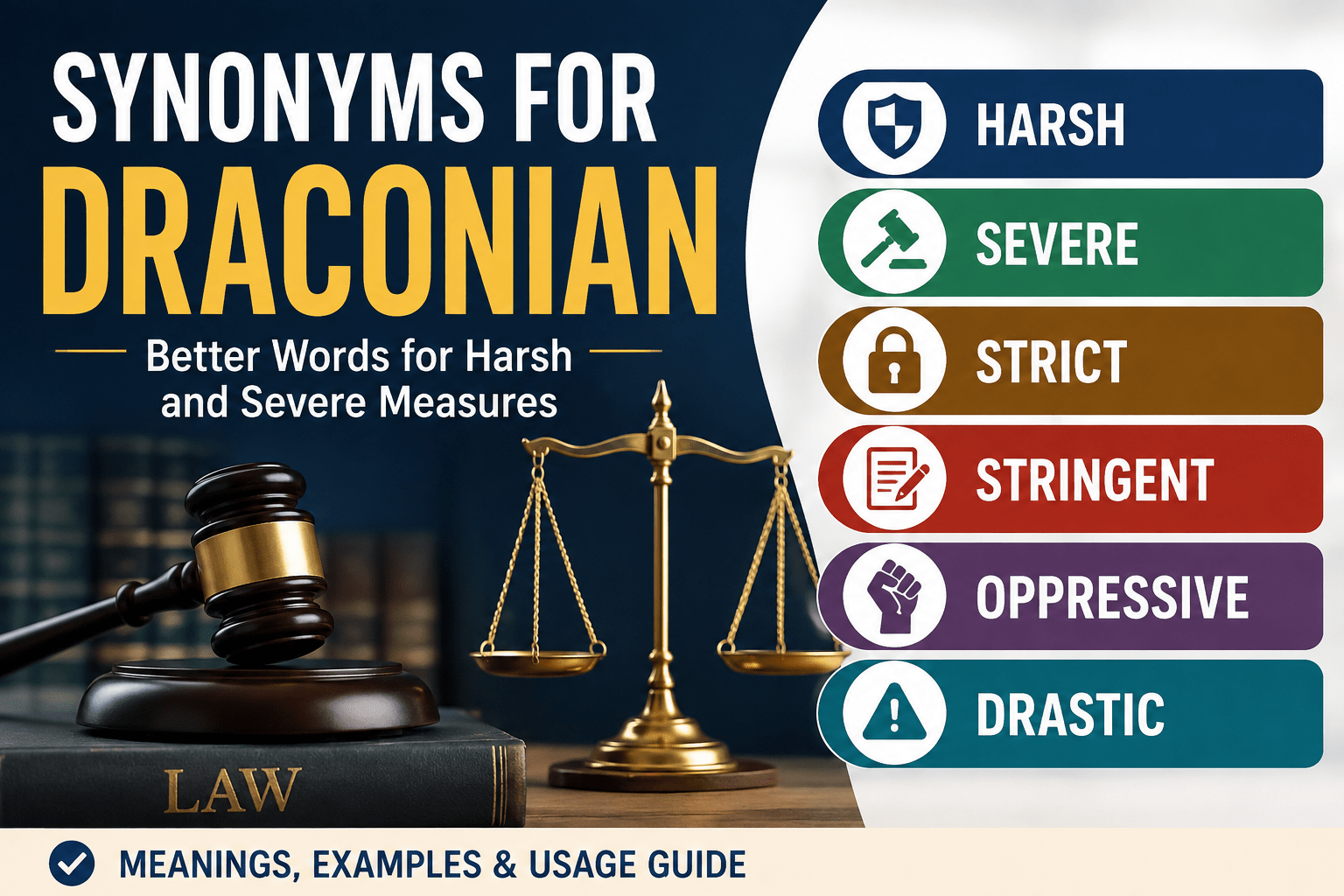
If you’re looking for synonyms for draconian, the closest choices are harsh, severe, strict, stringent, oppressive, heavy-handed, cruel, and drastic. However, these words are not interchangeable in every situation. Draconian usually describes a law, rule, punishment, policy, or measure that is extremely severe and often considered unnecessarily harsh or cruel. The best alternative depends on whether you want to emphasize strictness, cruelty, excessive punishment, oppression, or simply an extreme response.
Quick Answer: What Are the Best Synonyms for Draconian?
The closest everyday synonyms for draconian are harsh and severe. For rules or regulations, strict and stringent may work, although they can sound more neutral. Oppressive and heavy-handed are better when the focus is on excessive control, while cruel, brutal, or ruthless emphasize inhuman severity. Drastic works for extreme measures but does not necessarily imply cruelty.
Best alternatives at a glance
| Word | Relationship | Main idea | Tone | Best context |
|---|---|---|---|---|
| harsh | Direct synonym | Very severe or unpleasant | Negative | Laws, criticism, treatment |
| severe | Direct synonym | Extremely serious or strict | Neutral–negative | Punishments, penalties, measures |
| strict | Near synonym | Firmly limiting behavior | Neutral | Rules, regulations, standards |
| stringent | Near synonym | Very demanding or restrictive | Formal, often neutral | Regulations, requirements |
| oppressive | Contextual alternative | Excessively controlling or burdensome | Strongly negative | Governments, systems, rules |
| heavy-handed | Contextual alternative | Excessively forceful or insensitive | Negative | Policies, enforcement, management |
| cruel | Near synonym | Causing suffering without compassion | Strongly negative | Punishments, treatment |
| brutal | Near synonym | Extremely harsh or violent | Very strong | Punishment, repression, treatment |
| ruthless | Contextual alternative | Showing no mercy | Strongly negative | Leaders, enforcement, actions |
| merciless | Contextual alternative | Showing no pity | Strongly negative | Punishment, treatment |
| punitive | Contextual alternative | Intended to punish | Formal | Policies, taxes, measures |
| drastic | Contextual alternative | Extreme and far-reaching | Negative/neutral | Cuts, measures, action |
| stern | Near synonym | Firm and uncompromising | Neutral–negative | Warnings, authorities, responses |
| rigorous | Related, not exact | Extremely thorough or demanding | Usually neutral/positive | Standards, testing, procedures |
| authoritarian | Related, not exact | Favoring strong centralized control | Negative | Governments, leadership, systems |
Cambridge groups draconian with words such as strict, authoritarian, stringent, tough, harsh, severe, and drastic, while Merriam-Webster highlights harsh, brutal, ruthless, oppressive, and cruel. The important distinction is that a dictionary thesaurus shows semantic relationships, not a guarantee that every word can replace draconian in every sentence.
What Does Draconian Mean?
Draconian is an adjective used especially for laws, punishments, rules, government actions, and other measures that are extremely severe, harsh, or cruel.
Cambridge defines it as extremely severe, particularly when describing a rule, law, or punishment. Oxford similarly uses it for laws and punishments that are extremely cruel and severe. Both sources also mark the word as formal, and Cambridge notes its usually disapproving character.
For example:
The government introduced draconian measures to restrict illegal imports.
The word does more than mean “strict.” It normally suggests that the severity has gone too far or is viewed as excessive.
That negative judgment is one of the most important parts of the word’s meaning.
The Closest Synonyms for Draconian
1. Harsh
Harsh is probably the most useful general substitute for draconian.
It describes something severe, unpleasant, or difficult to endure.
Example:
The company faced criticism for its harsh disciplinary policies.
Best for: laws, punishments, criticism, treatment, conditions, policies, and decisions.
Difference: Harsh is broader and more common than draconian. It does not always imply that a rule or punishment is excessively severe.
2. Severe
Severe is another very close synonym, especially when discussing punishments, penalties, restrictions, or measures.
Example:
The new law imposes severe penalties for repeated violations.
Best for: penalties, punishments, restrictions, consequences, measures, and cuts.
Difference: Severe focuses on the degree of seriousness. Draconian more strongly suggests excessive harshness or cruelty.
3. Strict
Strict means firmly enforcing rules or limits.
Example:
The school has strict rules regarding attendance.
Best for: rules, policies, regulations, standards, and requirements.
Difference: This is an important distinction. A rule can be strict without being draconian. Calling a policy draconian suggests that its severity is excessive or unreasonable.
So:
The university has strict attendance requirements.
sounds neutral.
The university has draconian attendance requirements.
suggests that the requirements are excessively harsh.
4. Stringent
Stringent describes rules, standards, requirements, or controls that are very strict and demanding.
Example:
The laboratory operates under stringent safety regulations.
Best for: regulations, standards, controls, requirements, testing, and procedures.
Difference: Stringent can be neutral or even positive. A stringent safety standard may be demanding but entirely reasonable. Draconian normally carries a negative judgment.
This is one of the most useful distinctions for professional writing. Cambridge lists stringent among words related to draconian, but that does not make them perfect substitutes.
5. Oppressive
Oppressive emphasizes excessive control, domination, or burdens placed on people.
Example:
Citizens protested against the government’s oppressive restrictions.
Best for: governments, political systems, social conditions, regulations, and controlling environments.
Difference: Oppressive focuses more strongly on the effect of control on people. Draconian focuses more directly on the extreme severity of the measure itself.
6. Heavy-handed
Heavy-handed describes an approach that is excessively forceful, insensitive, or lacking in judgment.
Example:
Critics called the agency’s response heavy-handed.
Best for: enforcement, management, government action, censorship, disciplinary action, and responses to problems.
Difference: Heavy-handed often criticizes how something is handled, whereas draconian more often describes the severity of a rule, law, punishment, or measure.
Collins specifically connects heavy-handed with oppressive and harsh behavior, making it a useful contextual alternative rather than a universal replacement.
7. Cruel
Cruel emphasizes deliberate or careless infliction of suffering.
Example:
Human rights groups condemned the cruel punishment.
Best for: punishments, treatment, laws, actions, and conditions that cause suffering.
Difference: Cruel is stronger when the key issue is lack of compassion or unnecessary suffering. Draconian can describe a policy without necessarily implying that the people enforcing it personally intend cruelty.
8. Brutal
Brutal is a very strong alternative when something is extremely harsh, violent, or merciless.
Example:
The regime imposed brutal restrictions on political opposition.
Best for: repression, punishment, treatment, crackdowns, and violent or highly severe actions.
Difference: Brutal often carries a stronger association with violence or physical suffering than draconian.
Use it carefully in formal writing when the evidence supports that stronger meaning.
9. Ruthless
Ruthless means showing no pity or mercy.
Example:
The administration took a ruthless approach to anyone who violated the policy.
Best for: people, leaders, organizations, enforcement strategies, and actions.
Difference: Ruthless is especially natural for people or agents. Draconian is especially natural for rules, laws, punishments, and measures.
You can say:
a draconian law
but:
a ruthless leader
is generally more natural than a draconian leader when the intended meaning is lack of mercy.
10. Merciless
Merciless emphasizes an absence of pity or forgiveness.
Example:
The government launched a merciless crackdown on dissent.
Best for: crackdowns, punishments, attacks, enforcement, and treatment.
Difference: Like ruthless, it emphasizes lack of mercy rather than the formal severity of a rule.
11. Punitive
Punitive means intended to punish.
Example:
The company introduced punitive measures against repeated misconduct.
Best for: taxes, policies, disciplinary measures, penalties, and regulations.
Difference: Punitive tells the reader about the purpose of the measure: punishment. It does not necessarily mean the measure is excessively harsh.
A punitive policy can be reasonable; a draconian policy is generally characterized as excessively severe.
12. Drastic
Drastic describes action that is extreme, substantial, or far-reaching.
Example:
The company announced drastic cost-cutting measures.
Best for: cuts, reforms, changes, interventions, and emergency measures.
Difference: Drastic emphasizes extremeness or magnitude, not necessarily cruelty or injustice.
That makes it a contextual alternative rather than a direct synonym.
13. Stern
Stern means strict, firm, or uncompromising.
Example:
The judge issued a stern warning to the defendant.
Best for: warnings, responses, authorities, punishments, and attitudes.
Difference: Stern can be firm without being excessively cruel. It is therefore usually weaker than draconian.
14. Rigorous
Rigorous means extremely thorough, demanding, or exact.
Example:
Applicants must meet rigorous safety standards.
Best for: testing, research, procedures, standards, education, and professional requirements.
Difference: This is not normally a direct synonym for draconian. Rigorous can be positive: a rigorous scientific method is desirable.
Use rigorous when you mean demanding or thorough, not when you mean oppressively severe.
15. Authoritarian
Authoritarian describes a system, government, or leader that strongly restricts individual freedom and expects obedience to authority.
Example:
The country became increasingly authoritarian after the constitutional changes.
Best for: governments, political systems, leaders, and institutions.
Difference: Authoritarian describes the nature of authority or political control. Draconian describes the extreme severity of a law, policy, punishment, or measure.
A government can be authoritarian without every law being draconian.
Which Word Should You Use Instead of Draconian?
The best choice depends on what you want to emphasize.
Choose harsh when:
You want a natural, broadly applicable word for something unpleasantly severe.
The criticism of the new policy was harsh.
Choose severe when:
You want to emphasize the seriousness or intensity of a punishment or measure.
The law carries severe penalties.
Choose strict when:
You mean that rules are firmly enforced but do not necessarily want to imply injustice.
The company has strict security procedures.
Choose stringent when:
You are writing formally about demanding rules, requirements, or standards.
The industry must meet stringent safety requirements.
Choose oppressive when:
You want to emphasize excessive control or the burden imposed on people.
Residents described the restrictions as oppressive.
Choose heavy-handed when:
You are criticizing the way an authority handled a situation.
The government’s response was heavy-handed.
Choose cruel when:
The central idea is unnecessary suffering or lack of compassion.
The punishment was cruel and disproportionate.
Choose drastic when:
The measure is extreme or far-reaching, but cruelty is not necessarily involved.
The company took drastic steps to reduce costs.
Draconian vs. Harsh
These words are very close, but draconian is usually more specific and more strongly negative.
| Draconian | Harsh | |
|---|---|---|
| Core idea | Extremely severe, often excessively so | Severe or unpleasant |
| Negative judgment | Strong | Usually present but variable |
| Common with laws | Very common | Very common |
| Common with conditions | Less common | Very common |
| Formality | Formal | Neutral |
| Example | draconian regulations | harsh regulations |
If you simply mean “very severe,” harsh is often the more natural everyday choice. If you want to suggest that a rule or punishment goes unreasonably far, draconian is more precise.
Draconian vs. Stringent
This is one of the most important distinctions.
Stringent means very strict or demanding.
Draconian means extremely severe, often to an excessive or unacceptable degree.
Compare:
The hospital has stringent safety standards.
This sounds professional and reasonable.
The hospital has draconian safety standards.
This suggests that the standards are excessively restrictive.
In other words, stringent can be neutral; draconian is normally critical. This distinction is also reflected in current dictionary and usage resources.
Draconian vs. Severe
These are often interchangeable when describing punishments or penalties.
The court imposed a severe sentence.
The court imposed a draconian sentence.
The second sentence carries a stronger suggestion that the sentence is excessively harsh or disproportionate.
Oxford specifically defines draconian in connection with extremely cruel and severe laws or punishments.
Draconian vs. Oppressive
Draconian focuses on extreme severity.
Oppressive focuses on domination, control, or burdensome restrictions.
Compare:
The government introduced draconian censorship laws.
The laws are extremely severe.
The government imposed oppressive censorship.
The emphasis is on the way censorship controls or burdens people.
These meanings overlap, but they are not identical.
Natural Collocations With Draconian
Some combinations are particularly natural:
- draconian laws
- draconian measures
- draconian regulations
- draconian rules
- draconian penalties
- draconian punishment
- draconian legislation
- draconian restrictions
- draconian cuts
- draconian policies
- draconian censorship
- draconian controls
Oxford specifically lists collocations such as cuts, measures, and penalties, while Collins gives examples including cuts, law, and legislation.
Examples
The government introduced draconian restrictions on public demonstrations.
Critics opposed the draconian penalties proposed by lawmakers.
The company was forced to make draconian cuts to its budget.
Journalists condemned the country’s draconian censorship laws.
Common Mistakes With Draconian Synonyms
Mistake 1: Treating “strict” as an exact synonym
Not every strict rule is draconian.
Strict can be completely reasonable.
Draconian usually implies excessive severity.
Mistake 2: Using “rigorous” to mean cruel
A rigorous process can be demanding but beneficial.
The researchers followed a rigorous testing procedure.
Calling the procedure draconian would change the meaning considerably.
Mistake 3: Using “drastic” when cruelty is important
A drastic measure is extreme, but it does not necessarily harm people or violate their rights.
The company made drastic budget cuts.
This does not automatically mean the cuts were cruel or oppressive.
Mistake 4: Using “ruthless” for every rule
Ruthless is particularly natural for people, organizations, or actions that show no mercy.
a ruthless leader
a ruthless campaign
For rules, harsh, severe, or draconian may be more natural depending on the intended meaning.
Mistake 5: Assuming every thesaurus entry is interchangeable
Large thesaurus lists often include words that share only part of the meaning. Cambridge and Merriam-Webster both organize draconian around several related semantic areas, including strictness, harshness, severity, and cruelty.
The safest approach is to choose the synonym based on the specific meaning you want to preserve.
Antonyms of Draconian
The opposite of draconian depends on the context, but useful antonyms include:
- lenient
- mild
- merciful
- permissive
- moderate
- flexible
- tolerant
- reasonable
For example:
The original regulations were draconian, but the revised rules are much more lenient.
Cambridge lists lax as an antonym in its thesaurus, while its American thesaurus also gives alternatives such as kind, gentle, merciful, and lenient in the relevant semantic field.
Pronunciation of Draconian
US: /drəˈkoʊ.ni.ən/
UK: /drəˈkəʊ.ni.ən/
The word is usually pronounced with the main stress on the second syllable.
Where Does the Word Draconian Come From?
Draconian comes from Draco, the name of an ancient Athenian lawgiver associated with an exceptionally severe written legal code.
The word entered English in the late nineteenth century. Its modern meaning developed from the reputation for severity associated with Draco’s laws. Oxford traces the word to Draco, a seventh-century-BCE Athenian legislator, while Merriam-Webster likewise explains its connection with Draco and his severe legal code.
That history helps explain why draconian is especially common with laws, punishments, penalties, regulations, and government measures.
FAQ About Synonyms for Draconian
What is the closest synonym for draconian?
Harsh and severe are generally the closest broad synonyms. However, the best replacement depends on context. Use stringent for demanding regulations, oppressive for excessive control, and heavy-handed for an excessively forceful approach.
What is a simpler word for draconian?
Harsh or very strict are usually the simplest alternatives. Harsh is especially useful because it preserves much of the negative meaning without sounding as formal as draconian.
Is stringent the same as draconian?
No. Stringent means very strict or demanding, while draconian usually suggests extreme and excessive severity. A stringent regulation can be reasonable; a draconian regulation is generally being criticized as too harsh.
Is harsh stronger than severe?
Not necessarily. Both can describe serious severity, and their relative strength depends on context. Draconian often adds a stronger implication that the severity is excessive or unreasonable.
Can oppressive be a synonym for draconian?
Yes, in some contexts. Oppressive is particularly appropriate when a law, policy, or system places excessive control or burdens on people. It is a contextual synonym rather than a universal replacement.
What is the opposite of draconian?
Common opposites include lenient, mild, merciful, moderate, permissive, flexible, and reasonable. The best antonym depends on whether you are describing a law, punishment, policy, or general approach.
Is draconian a negative word?
Yes. Draconian normally has a negative or disapproving connotation because it suggests that something is excessively severe, harsh, or cruel. Cambridge explicitly labels the word as formal and usually disapproving.
What is another word for draconian laws?
Depending on the intended meaning, good alternatives include harsh laws, severe laws, oppressive laws, stringent laws, or strict laws. If the laws are being criticized as excessively cruel or severe, harsh or oppressive may preserve the meaning better than the more neutral strict.
Final Takeaway
The best synonym for draconian depends on the exact kind of severity you want to express.
- Choose harsh for a broad, natural alternative.
- Choose severe when emphasizing seriousness or punishment.
- Choose strict for firmly enforced rules.
- Choose stringent for demanding regulations or requirements.
- Choose oppressive when excessive control is the focus.
- Choose heavy-handed when criticizing an overly forceful approach.
- Choose cruel when unnecessary suffering matters.
- Choose drastic when emphasizing an extreme measure.
- Choose punitive when the purpose is punishment.
The key point is that draconian does not simply mean “strict.” It normally carries the stronger idea that a rule, punishment, law, or measure is extremely severe and often excessively harsh. Understanding that distinction will help you choose a synonym that sounds natural and preserves the meaning you actually intend.

Michael Thompson is an English language specialist and experienced editor who focuses on vocabulary development and clear communication. He creates high-quality synonym guides, word comparisons, and writing tips to help students and professionals express their ideas more effectively. His work combines linguistic knowledge with practical SEO strategies to make learning both useful and engaging.