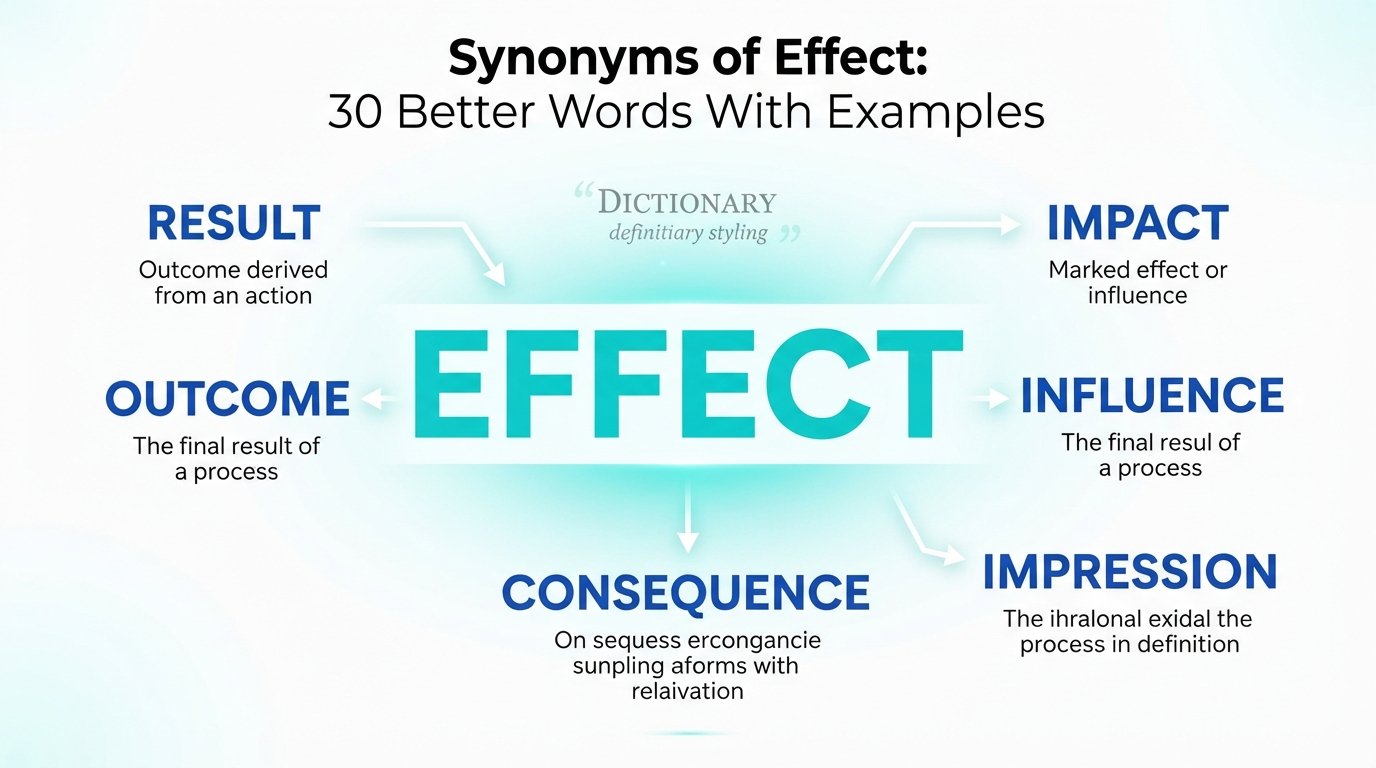
The word effect is useful, but it can mean several different things. Most often, it refers to a result or change caused by something, as in “the effect of exercise on health.” Depending on context, however, you may need a more precise word such as result, impact, consequence, outcome, influence, impression, aftermath, or repercussion. The best synonym depends on what you mean and the tone you want.
Quick Answer
The closest common synonyms of effect include result, outcome, consequence, impact, influence, impression, aftermath, repercussion, and ramification. However, they are not interchangeable in every sentence. Result is a broad neutral choice, impact emphasizes a strong effect, consequence often focuses on what follows an action, and outcome usually refers to the final result of a process or event.
30 Synonyms and Alternativ30 Synonyms and Alternatives for Effect
Direct Synonyms for Effect
| Word | Relationship | Meaning / Difference | Best Context |
|---|---|---|---|
| result | Close synonym | Something that happens because of a cause | General writing |
| outcome | Close synonym | The final result of an event or process | Decisions, studies, events |
| consequence | Near synonym | A result that follows an action, often with emphasis on its significance | Actions, decisions |
| impact | Near synonym | A noticeable or significant effect | Social, professional, personal |
| influence | Near synonym | The power to affect someone or something | People, behavior, decisions |
| impression | Contextual alternative | The feeling or perception produced by something | People, writing, art |
Negative and Continuing Effects
| Word | Relationship | Meaning / Difference | Best Context |
|---|---|---|---|
| aftermath | Contextual alternative | The situation or effects following an important event | Disasters, conflict, crises |
| repercussion | Near synonym | An often negative effect that develops after an action or event | Decisions, controversies |
| ramification | Near synonym | A further consequence arising from an action or decision | Formal and analytical writing |
| upshot | Contextual alternative | The final result or conclusion | Informal or conversational writing |
| fallout | Contextual alternative | Unpleasant consequences, especially after a major event | Politics, conflict, controversy |
| aftereffect | Close contextual alternative | An effect that continues after the original cause | Medicine, events, experiences |
Reactions, Responses, and Changes
| Word | Relationship | Meaning / Difference | Best Context |
|---|---|---|---|
| reaction | Related alternative | A response produced by an event, action, or stimulus | People, systems, science |
| response | Related alternative | A reaction to something | Communication, organizations |
| change | Contextual alternative | A difference produced by an event or action | General and educational writing |
| development | Contextual alternative | A change or result occurring over time | Research, events, situations |
| implication | Near synonym | A possible consequence or meaning suggested by something | Analysis and argument |
| significance | Contextual alternative | Importance or meaning produced by something | Academic writing |
Influence, Power, and Effectiveness
| Word | Relationship | Meaning / Difference | Best Context |
|---|---|---|---|
| bearing | Contextual alternative | Relevance or influence on a situation | Formal writing |
| force | Contextual alternative | Power or effectiveness producing an effect | Laws, arguments, ideas |
| power | Contextual alternative | Ability to influence or produce a result | People, institutions, ideas |
| efficacy | Contextual alternative | Ability to produce the intended result | Medicine, science, policy |
| performance | Contextual alternative | How effectively something operates or produces results | Technology, business |
| operation | Contextual alternative | The process or functioning through which something produces an effect | Systems, laws, mechanisms |
Final Results and Specific Outcomes
| Word | Relationship | Meaning / Difference | Best Context |
|---|---|---|---|
| conclusion | Contextual alternative | The final result reached after thought or analysis | Arguments, research |
| sequel | Contextual alternative | Something that follows an earlier event | Events, narratives |
| fruit | Contextual alternative | A beneficial or productive result | Effort, research, work |
| payoff | Contextual alternative | A final benefit or result, often after effort | Informal writing |
| end result | Close synonym | The eventual result after a process | General writing |
| issue | Context-dependent alternative | The result or outcome of an action or event in some formal uses | Formal contexts |
Important: These words should not all be treated as exact synonyms. The relationship changes according to which meaning of effect is intended. Collins, for example, separates effect into senses including result, impression, operation, and the verb bring about.
What Does “Effect” Mean?
As a noun, effect most commonly means a result, change, or consequence produced by an influence or cause.
For example:
The new policy had a significant effect on local businesses.
Here, effect means the result or change caused by the policy.
Cambridge defines this common noun sense as the result of a particular influence. It also gives related uses such as in effect, come into effect, and take effect, where the word refers to use or becoming operative.
The word also has other meanings. For example, special effects refers to visual, sound, or other techniques used in films and theater, while personal effects means someone’s possessions.
Therefore, the correct synonym depends heavily on the sentence.
The Closest Synonyms of Effect
1. Result
Result is usually the safest general alternative to effect when you mean something that happens because of a cause.
- The new training program had a positive effect on productivity.
- The new training program had a positive result on productivity.
However, the second sentence is less natural in some contexts. More naturally, you might say:
The new training program produced positive results.
This shows an important point: a dictionary synonym does not automatically work in every grammatical construction.
Best for: general writing, academic writing, explanations, and everyday English.
2. OutcomeOutcome refers especially to the final result of an event, process, decision, or situation.
The outcome of the experiment was unexpected.
This word works especially well when something develops toward a final result.
Best for: research, decisions, negotiations, competitions, projects, and processes.
3. Consequence
Consequence is a result that follows from an action or situation. It often draws attention to what happens afterward and can carry a negative implication.
The decision had serious consequences.
Unlike the neutral result, consequence often makes the relationship between an action and what follows more prominent.
Best for: decisions, behavior, mistakes, policies, risks, and actions.
4. Impact
Impact emphasizes the strength, importance, or noticeable nature of an effect.
The new technology had a major impact on the industry.
It is especially common in professional, academic, social, and business writing.
However, impact is not always a perfect replacement. If you simply mean a neutral result, result may be more precise.
Best for: significant changes, social issues, business, technology, education, and professional writing.
5. Influence
Influence focuses on the ability of one person, thing, or factor to affect another.
Her teacher had a strong influence on her career choice.
This differs from effect because influence often describes an ongoing power to affect behavior, decisions, or development rather than a single resulting change.
Best for: people, ideas, culture, decisions, behavior, and relationships.
6. Impression
Use impression when effect refers to the feeling, perception, or appearance produced in someone’s mind.
The speech had a powerful effect on the audience.
can become:
The speech made a powerful impression on the audience.
But impression would not normally replace effect in:
The medicine had a strong effect on blood pressure.
That is a result, not an impression.
7. Aftermath
Aftermath describes the situation or effects that remain after a major or often damaging event.
The city struggled in the aftermath of the storm.
It is therefore more specific than effect.
Best for: disasters, wars, crises, accidents, scandals, and major disruptions.
8. Repercussion
A repercussion is a consequence that follows an action or event, usually an unwanted or negative one.
The decision could have serious repercussions for the company.
It is particularly useful when discussing secondary consequences.
9. Ramification
A ramification is a further consequence or development resulting from a decision, event, or situation.
The researchers considered the legal ramifications of the discovery.
This word is more formal and is especially useful in analytical writing.
10. Upshot
Upshot means the final result or conclusion of a situation.
The upshot of the meeting was that the project would continue.
It is more conversational than ramification or consequence.
Synonyms of Effect by Context
For a General Result
Use:
- result
- outcome
- consequence
- end result
Example:
The policy had an unexpected effect.
Possible alternatives:
The policy had an unexpected result.
The policy produced an unexpected outcome.
For a Strong or Significant Effect
Use:
- impact
- influence
- force
- power
Example:
The discovery had a profound effect on medical research.
A natural alternative is:
The discovery had a profound impact on medical research.
For Negative Consequences
Use:
- consequence
- repercussion
- fallout
- ramification
- aftermath
The choice depends on the situation.
The decision had serious consequences.
The announcement caused political fallout.
The company considered the legal ramifications.
For a Mental or Emotional Effect
Use:
- impression
- influence
- impact
- reaction
Example:
Her words had a lasting effect on me.
Possible alternatives include:
Her words made a lasting impression on me.
or:
Her words had a lasting impact on me.
The exact choice changes the emphasis.
For Research or Academic Writing
Useful alternatives include:
- result
- outcome
- consequence
- impact
- implication
- significance
For example:
The study examined the effects of sleep deprivation.
Depending on the intended meaning, this could become:
The study examined the impact of sleep deprivation.
or:
The study examined the consequences of sleep deprivation.
Which Word Should I Use Instead of “Effect”?
Choose result when:
You mean what happened because of something.
The result of the experiment was surprising.
Choose outcome when:
You mean the final result of a process or event.
We are waiting for the outcome of the negotiations.
Choose consequence when:
You want to emphasize what follows from an action or decision.
The decision could have serious consequences.
Choose impact when:
You want to emphasize a noticeable or important effect.
The program had a significant impact on student achievement.
Choose influence when:
You mean the power to affect behavior, decisions, or development.
Parents can have a strong influence on their children’s choices.
Choose impression when:
You mean the feeling or perception created in someone’s mind.
The interview made a positive impression on the employer.
Choose aftermath when:
You mean the situation that follows a major event, especially a damaging one.
The region faced serious problems in the aftermath of the earthquake.
Choose repercussion when:
You mean an often negative consequence that follows an action.
The decision had unexpected repercussions.
Choose ramification when:
You are discussing further consequences, particularly in formal or analytical writing.
The proposal could have significant financial ramifications.
Effect vs. Result
Effect and result overlap strongly when both refer to something caused by another event.
The medicine had an unexpected effect.
The medicine produced an unexpected result.
However, effect often emphasizes the change caused by something, while result is a broader term for what happens afterward.
Compare:
The treatment had a calming effect.
The treatment produced positive results.
The first emphasizes the change produced by the treatment. The second emphasizes the overall results of the treatment.
Effect vs. Impact
These words are often interchangeable, but they have different emphases.
| Effect | Impact |
|---|---|
| Broad and neutral | Often emphasizes significance or strength |
| Can describe small or large changes | Often suggests a noticeable effect |
| Very common in general English | Common in professional and analytical writing |
Compare:
The new schedule had little effect on productivity.
The new technology had a major impact on the industry.
Impact is particularly natural when the effect is substantial or important.
Effect vs. Consequence
Both describe what follows something, but consequence more strongly connects the result to an action or decision.
The policy had several effects.
The policy had several consequences.
The first is neutral. The second may suggest that the policy produced outcomes that need to be considered, particularly unfavorable ones.
Effect vs. Outcome
Outcome usually describes the final result of a process, event, or situation.
The outcome of the trial was positive.
By contrast, effect can describe a specific change produced during or after an event.
The treatment had a positive effect on the patient.
Therefore, outcome is especially useful for final results, while effect is broader.
Effect vs. Influence
Influence describes the power to affect someone or something.
Social media can influence consumer behavior.
The resulting change can be described as an effect:
Social media can have a significant effect on consumer behavior.
A useful distinction is:
Influence = the power or process of affecting something
Effect = the resulting change or result
Common Mistakes With “Effect”
Mistake 1: Treating every related word as an exact synonym
Words such as impact, influence, consequence, and outcome overlap with effect, but they have different meanings and typical contexts.
Mistake 2: Using “aftermath” for every effect
Aftermath normally describes what follows a significant event, especially a difficult or destructive one.
The aftermath of the hurricane was severe.
It would be unnatural to use aftermath for an ordinary sentence such as:
The vitamin had a positive aftermath.
Mistake 3: Using “impression” for a physical or measurable result
The medicine had an effect on blood pressure.
Here, impression is not a suitable replacement because the sentence describes a physical result rather than a perception.
Mistake 4: Confusing “effect” and “affect”
This is one of the most important distinctions.
Affect is commonly used as a verb meaning to influence or cause a change:
Lack of sleep can affect concentration.
Effect is commonly used as a noun meaning the result or change:
Lack of sleep can have an effect on concentration.
The formal verb effect also exists. It means to bring about or cause something to happen, as in “effect a change.” Cambridge identifies this verb as formal.
Collins likewise notes that the verb effect is relatively formal and means something like bring about, while the noun effect is commonly confused with affect.
The Verb “Effect”: Another Meaning
Most searches for synonyms of effect are about the noun. However, effect can also function as a verb.
As a verb, effect means to cause something to happen or bring about a result.
The new policy effected significant changes in the organization.
Useful alternatives in this sense include:
- bring about
- cause
- produce
- achieve
- accomplish
- carry out
- implement
- execute
However, these are not interchangeable in every sentence.
For example:
The reforms effected major changes.
can be expressed as:
The reforms brought about major changes.
But achieved or executed would change the meaning because those words emphasize accomplishment or carrying out an action.
Collins lists bring about, accomplish, achieve, complete, execute, fulfill, and perform among alternatives associated with the formal verb sense of effect.
Common Phrases With “Effect”
Some expressions containing effect should not simply be replaced with a synonym.
Have an effect on
Exercise can have a positive effect on health.
Take effect
Means to begin producing the intended result or to become operative.
The new rules will take effect next month.
Come into effect
Often used for laws, rules, agreements, and official measures.
The regulation will come into effect in January.
In effect
Can mean essentially or, in some contexts, officially operative.
The agreement is now in effect.
Cambridge specifically records these uses of effect, including take effect, come into effect, and in effect.
Frequently Asked Questions
What is the closest synonym for effect?
The closest general synonym is usually result when effect means something caused by an action or event. Depending on context, outcome, consequence, or impact may be more natural. No single synonym replaces effect in every situation.
What is another word for effect in an essay?
Useful choices include result, impact, consequence, outcome, implication, and influence. The best choice depends on the sentence. Impact works well for significant effects, while result is more neutral and implication focuses on what something may mean or lead to.
Is impact a synonym for effect?
Yes, in many contexts. Both can describe the influence or change produced by something. However, impact often emphasizes the strength or significance of that effect, so it is not always an exact replacement.
Is result the same as effect?
They overlap, but they are not identical in every context. Result generally refers to what happens because of something, while effect often emphasizes the change produced by a cause or influence.
What is a formal synonym for effect?
Depending on the intended meaning, formal alternatives include consequence, implication, ramifications, significance, outcome, and impact. The correct choice depends on context rather than formality alone.
What is the difference between effect and affect?
Effect is commonly a noun meaning a result or change, while affect is commonly a verb meaning to influence or change something. For example: “The noise affected my concentration” and “The noise had an effect on my concentration.”
What is a synonym for negative effect?
Depending on context, you can use harm, consequence, repercussion, fallout, adverse impact, or aftereffect. These are not exact equivalents: fallout often suggests widespread unpleasant consequences, while aftereffect emphasizes an effect that continues afterward.
What is a synonym for positive effect?
Common alternatives include benefit, advantage, improvement, positive impact, and favorable result. The best option depends on whether you want to emphasize a useful outcome, an improvement, or a broader influence.
Conclusion
The best synonym for effect depends on the meaning you want to express. Result is a broad, neutral choice; outcome emphasizes a final result; consequence focuses on what follows an action; impact highlights significance; influence emphasizes the power to affect something; and impression describes an effect on perception.
For precise writing, do not replace effect automatically. First identify the relationship you mean—result, influence, perception, consequence, or continuing aftermath—and then choose the word that expresses that relationship most naturally.

Emily Johnson is a linguistics graduate and vocabulary specialist. She writes detailed synonym explanations and helps readers understand subtle differences between words, improving both writing and speaking skills. Synonyms help express ideas more clearly and precisely in English.