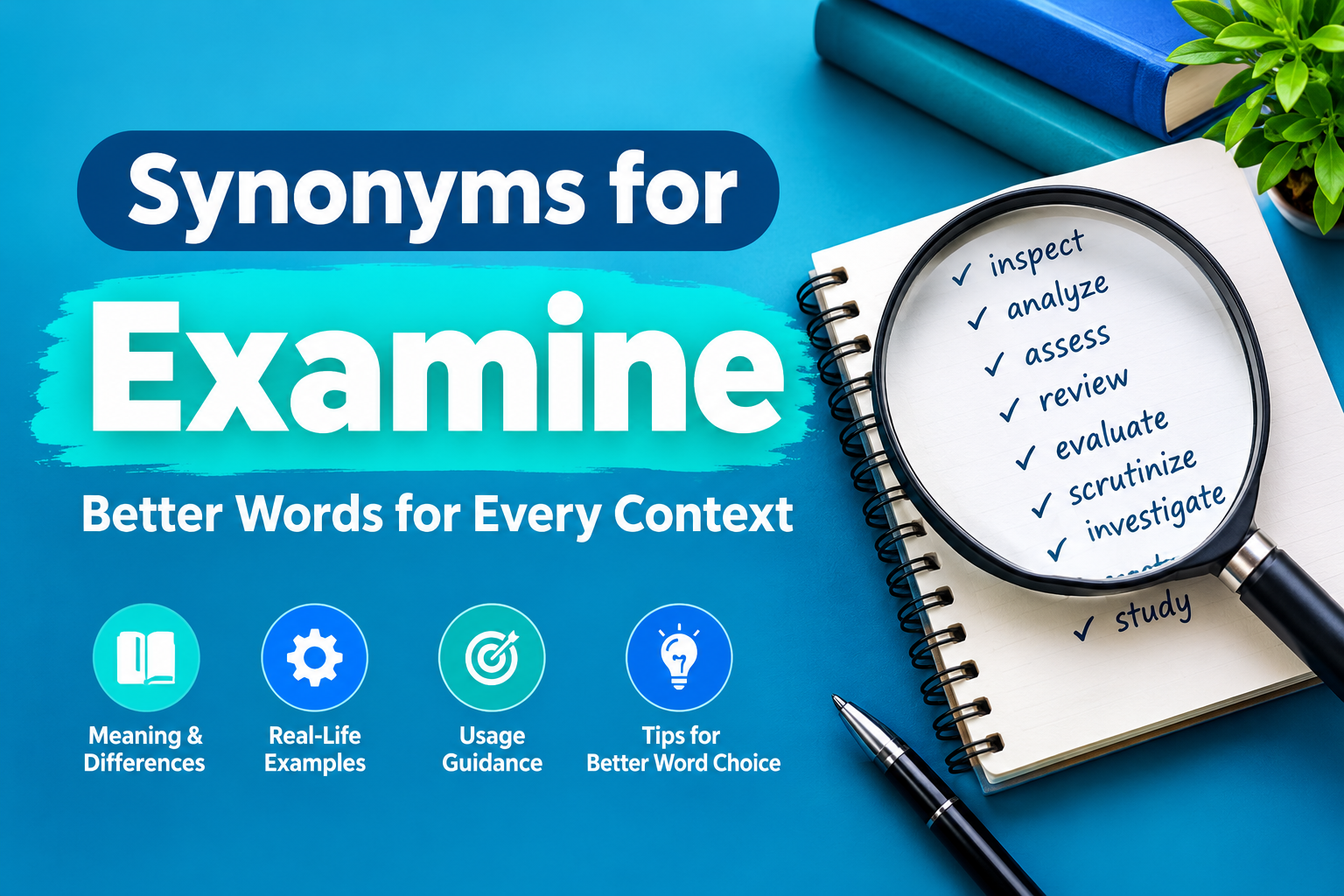
When you need another word for examine, the best choice depends on what you are actually doing. You might inspect an object for problems, analyze information to understand its parts, investigate a situation to discover facts, or scrutinize something for small details. In academic writing, study and review are often natural alternatives, while question, quiz, and interrogate apply when examine means testing or questioning a person. The distinctions matter because many related words cannot replace examine in every sentence. This guide explains 30 useful alternatives, their meanings, contexts, and differences so you can choose the most natural word.
Quick Answer
The closest synonyms for examine include inspect, study, analyze, scrutinize, investigate, review, survey, assess, explore, and probe. However, each emphasizes something different. Inspect focuses on checking something carefully, analyze emphasizes detailed study, investigate suggests finding facts, and scrutinize stresses extremely close attention. When examine means testing or questioning someone, test, quiz, question, or interrogate may be more appropriate.
Closest Synonyms for Examine
| Word | Relationship | Meaning | Formality | Best Context |
|---|---|---|---|---|
| Inspect | Direct / near synonym | Look at carefully to check condition | Neutral | Objects, documents, places |
| Study | Direct / near synonym | Examine carefully to understand | Neutral | Subjects, research, information |
| Analyze | Near synonym | Examine parts, structure, or relationships | Neutral/Formal | Data, arguments, results |
| Scrutinize | Near synonym | Examine with very close attention | Formal | Details, records, claims |
| Explore | Near synonym | Examine a subject or possibility broadly | Neutral | Ideas, options, topics |
| Probe | Near synonym | Investigate deeply or search for information | Formal | Issues, causes, questions |
| Consider | Near synonym | Think carefully about something | Neutral | Ideas, options, evidence |
| Check | Contextual alternative | Examine to verify or identify problems | Neutral | Facts, equipment, details |
| Scan | Near synonym | Examine quickly or broadly | Neutral | Documents, lists, screens |
| Peruse | Near synonym | Read or examine carefully | Formal | Texts, documents |
Synonyms for Investigating or Researching
| Word | Relationship | Meaning | Formality | Best Context |
|---|---|---|---|---|
| Investigate | Contextual alternative | Examine to discover facts or causes | Neutral/Formal | Problems, crimes, events |
| Research | Related / contextual | Examine a subject systematically to gain knowledge | Formal | Academic topics, questions |
| Delve into | Contextual alternative | Investigate something deeply | Neutral | Topics, issues |
| Look into | Contextual alternative | Investigate or examine informally | Informal/Neutral | Problems, complaints |
| Question | Context-specific | Ask someone questions to obtain information | Neutral | Witnesses, decisions |
| Interrogate | Context-specific | Question someone closely or intensely | Formal | Investigations, witnesses |
| Cross-examine | Context-specific | Question a witness systematically | Formal/Legal | Courtrooms |
Synonyms for Reviewing and Assessing
| Word | Relationship | Meaning | Formality | Best Context |
|---|---|---|---|---|
| Review | Contextual alternative | Examine or reconsider information | Neutral/Formal | Documents, policies, work |
| Survey | Contextual alternative | Examine or assess broadly | Formal | Areas, conditions, opinions |
| Assess | Contextual alternative | Examine to determine quality, value, or condition | Formal | Risk, performance, needs |
| Evaluate | Contextual alternative | Examine and judge value or effectiveness | Formal | Plans, evidence, performance |
| Appraise | Contextual alternative | Examine and judge value or quality | Formal | Property, performance |
| View | Contextual alternative | Look at or consider something | Neutral | Objects, evidence, material |
| Observe | Contextual alternative | Watch or notice carefully | Neutral/Formal | Behavior, events |
| Audit | Context-specific | Officially examine records or accounts | Formal | Finances, systems |
Informal Alternatives for Examine
| Word | Relationship | Meaning | Formality | Best Context |
|---|---|---|---|---|
| Go over | Contextual alternative | Examine or review carefully | Informal | Notes, documents, work |
| Check over | Contextual alternative | Examine to find problems or errors | Informal | Objects, work, equipment |
| Word | Relationship | Meaning | Formality | Best Context |
|---|---|---|---|---|
| Inspect | Direct / near synonym | Look at carefully to check condition | Neutral | Objects, documents, places |
| Study | Direct / near synonym | Examine carefully to understand | Neutral | Subjects, research, information |
| Analyze | Near synonym | Examine parts, structure, or relationships | Neutral/Formal | Data, arguments, results |
| Scrutinize | Near synonym | Examine with very close attention | Formal | Details, records, claims |
| Explore | Near synonym | Examine a subject or possibility broadly | Neutral | Ideas, options, topics |
| Consider | Near synonym | Think carefully about something | Neutral | Ideas, options, evidence |
| Scan | Near synonym | Examine quickly or broadly | Neutral | Documents, lists, screens |
| Peruse | Near synonym | Read or examine carefully | Formal | Texts, documents |
Note: Peruse appears twice in broad thesaurus resources because it can overlap with different examination contexts; for a clean published list, count it once. Cambridge specifically lists inspect, peruse, scan, study, and survey among alternatives to examine.
What Does “Examine” Mean?
Examine is a verb meaning to look at or consider a person or thing carefully and in detail, usually to discover something about it. For example:
The researchers examined the evidence carefully.
The verb also has other established meanings. It can refer to testing someone’s knowledge or skill, as in Students were examined on European history. It can also describe questioning someone, particularly in formal or legal contexts.
US and UK pronunciation is generally represented as /ɪɡˈzæmɪn/.
Closest Synonyms for Examine
1. Inspect
Inspect is one of the closest alternatives when you carefully look at something to check its condition, quality, or possible problems.
- The mechanic inspected the car for damage.
- The officer inspected the documents.
Choose “inspect” when the purpose is checking for defects, errors, damage, or compliance.
Merriam-Webster notes that inspect particularly suggests scrutiny for errors or defects.
2. Study
Study means examining something carefully to understand it or learn more about it.
- The scientists studied the effects of the treatment.
- She studied the document before signing it.
It works especially well in academic, scientific, and research contexts.
3. Analyze
Analyze emphasizes examining something by breaking it down into components or considering how its parts relate.
- The researchers analyzed the survey results.
- We need to analyze the argument carefully.
Use analyze when the goal is understanding structure, patterns, causes, or relationships.
4. Scrutinize
Scrutinize is stronger than ordinary examine. It emphasizes extremely close attention to detail.
- The editor scrutinized every sentence.
- The committee scrutinized the financial records.
Merriam-Webster specifically distinguishes scrutinize from examine by noting its emphasis on minute detail.
5. Investigate
Investigate means examining something systematically to discover facts, causes, or information.
- Police investigated the incident.
- Researchers investigated the cause of the decline.
It is particularly natural for problems, crimes, incidents, complaints, causes, and unexplained events.
Synonyms for Examine in Different Contexts
For Documents and Written Material
Use:
- inspect
- review
- study
- peruse
- scan
- go over
Example:
Please review the contract before signing it.
Here, review often sounds more natural than examine in professional communication.
For Data and Research
Use:
- analyze
- study
- investigate
- evaluate
- explore
- assess
Example:
The researchers analyzed the data to identify significant patterns.
Analyze is generally preferable when the process involves breaking information down or identifying relationships.
For Problems and Causes
Use:
- investigate
- probe
- explore
- look into
- delve into
Example:
The committee investigated the cause of the failure.
Here, investigate communicates a search for facts or an explanation more clearly than inspect.
For Quality, Value, or Performance
Use:
- assess
- evaluate
- appraise
- review
Example:
The manager evaluated the team’s performance.
These words involve not merely looking at something but often forming a judgment about its quality, effectiveness, or value.
For a Quick Examination
Use:
- scan
- check
- look over
- check over
- view
Example:
I scanned the report before the meeting.
Merriam-Webster distinguishes scan from examine by emphasizing a more cursory, point-to-point survey.
Synonyms for “Examine Closely”
When the emphasis is on careful or detailed inspection, the strongest choices include:
- scrutinize
- inspect
- study
- analyze
- probe
- peruse
However, they are not interchangeable in every situation.
- Scrutinize → focus intensely on details
- Inspect → check condition or detect problems
- Analyze → break information down
- Probe → investigate deeply
- Study → examine carefully to understand
- Peruse → read or examine written material carefully
Synonyms for “Examine” in Academic Writing
For academic writing, these alternatives are especially useful:
Analyze
Best when breaking down data, arguments, or evidence.
Investigate
Best when conducting systematic inquiry into a question or problem.
Examine
A broad, neutral academic choice.
Explore
Useful when considering a topic, possibility, or relationship without implying a fixed conclusion.
Assess
Best when determining significance, quality, effectiveness, or risk.
Evaluate
Best when examining something and judging its value or effectiveness.
For example:
This study examines the relationship between sleep and academic performance.
Could become:
This study investigates the relationship between sleep and academic performance.
Or:
This study analyzes the relationship between sleep and academic performance.
The best choice depends on the precise research activity.
Examine vs. Inspect
Examine and inspect overlap, but inspect more strongly suggests checking something for condition, defects, or problems.
| Examine | Inspect |
|---|---|
| Broad examination | Careful checking |
| Can involve ideas and information | Usually concrete or verifiable things |
| Can mean study or investigation | Often focuses on condition |
| Examine the evidence | Inspect the equipment |
Example:
The scientist examined the specimen.
The technician inspected the machine for damage.
Both are grammatical, but inspect makes the checking purpose clearer.
Examine vs. Scrutinize
Both words indicate careful attention, but scrutinize is more intense.
The lawyer examined the evidence.
This simply says the lawyer looked at it carefully.
The lawyer scrutinized the evidence.
This suggests an exceptionally close search for details, weaknesses, or inconsistencies.
Choose scrutinize when you want to emphasize intensity and meticulous attention.
Examine vs. Analyze
These words overlap in research and academic writing.
Examine is broader. It can simply mean studying something carefully.
Analyze normally suggests breaking something into parts or examining its structure, relationships, or patterns.
Researchers examined the survey responses.
Researchers analyzed the survey responses.
The second sentence more strongly suggests systematic analysis of the data.
Examine vs. Investigate
Use investigate when the purpose is to discover facts, causes, or explanations.
The committee examined the complaint.
The committee investigated the complaint.
The first statement is broader. The second implies a more systematic inquiry.
Therefore, investigate is especially appropriate for:
- crimes
- accidents
- complaints
- allegations
- causes
- unexplained events
- problems
Examine vs. Review
Review often means examining something again or considering it systematically.
The manager reviewed the report.
The manager examined the report.
Both work, but review is especially natural for documents, reports, policies, applications, and previous work.
It can also imply reconsideration rather than detailed inspection.
Examine vs. Assess vs. Evaluate
These three words are particularly important in professional and academic writing.
| Word | Main emphasis |
|---|---|
| Examine | Look at or consider carefully |
| Assess | Determine condition, level, risk, or significance |
| Evaluate | Judge quality, value, effectiveness, or performance |
For example:
The doctor examined the patient.
The doctor assessed the patient’s condition.
The committee evaluated the treatment’s effectiveness.
The words overlap, but their purposes differ.
Words for the “Test” Meaning of Examine
Examine can also mean to test someone’s knowledge or ability. Cambridge specifically identifies this as a separate meaning.
In this context, appropriate alternatives include:
Test
The teacher tested the students on vocabulary.
Quiz
The instructor quizzed the class on the previous lesson.
Question
The lawyer questioned the witness.
Interrogate
Investigators interrogated the suspect.
Cross-examine
The attorney cross-examined the witness.
These are context-specific alternatives, not universal synonyms for examine.
Common Mistakes With Examine Synonyms
Using “inspect” for abstract ideas
Less natural:
We inspected the theory.
Better:
We examined the theory.
Inspect is much more naturally associated with things that can be checked for condition or defects.
Using “scrutinize” when a casual look is intended
Scrutinize implies close attention. If someone only looked briefly, scan, glance over, or look over may be better.
Treating “analyze” and “examine” as identical
They overlap, but analyze usually implies a more structured examination of components, relationships, or patterns.
Using “investigate” for every type of examination
Investigate suggests an inquiry intended to discover facts or causes. It is not the natural choice for every simple visual inspection.
Confusing “question” with general examination
Question is appropriate when examine means asking someone for information. It does not normally replace examine when you mean looking carefully at an object.
Which Word Should You Use?
| If you mean… | Best choice |
|---|---|
| Look carefully at something | Examine |
| Check for damage or defects | Inspect |
| Study something to understand it | Study |
| Break information into parts | Analyze |
| Look at extremely closely | Scrutinize |
| Search for facts or causes | Investigate |
| Reconsider a document or report | Review |
| Explore a topic or possibility | Explore |
| Determine quality or condition | Assess |
| Judge effectiveness or value | Evaluate |
| Examine financial records officially | Audit |
| Examine something quickly | Scan |
| Investigate deeply | Probe |
| Test someone’s knowledge | Test |
| Ask someone questions | Question |
| Question someone intensely | Interrogate |
| Question a witness in court | Cross-examine |
FAQ
What is the closest synonym for examine?
Inspect is one of the closest synonyms when examine means looking carefully at something, while study is a strong alternative when the purpose is understanding. Scrutinize is closer when the examination is extremely detailed. The best synonym therefore depends on context.
What is a formal synonym for examine?
Formal alternatives include scrutinize, investigate, analyze, assess, evaluate, inspect, and probe. The appropriate choice depends on meaning. For example, analyze suits data, while investigate suits a problem or incident.
What is another word for examine carefully?
Scrutinize is an especially strong choice for examine carefully because it emphasizes close attention to small details. Inspect and study are also useful, depending on what is being examined.
What is a synonym for examine in academic writing?
Analyze, study, investigate, explore, assess, and evaluate are common academic alternatives. However, each conveys a slightly different research activity, so replacing examine mechanically is not always appropriate.
Is inspect the same as examine?
Not exactly. Inspect generally emphasizes checking something carefully, often for defects, condition, or compliance. Examine is broader and can refer to studying objects, information, ideas, situations, or people.
Is scrutinize stronger than examine?
Yes. Scrutinize generally conveys more intense and detailed attention than the neutral verb examine. Merriam-Webster specifically identifies close attention to minute detail as a defining distinction.
What is the difference between examine and investigate?
Examine broadly means to look at or consider something carefully. Investigate usually implies a systematic effort to discover facts, causes, or explanations. Thus, you can examine a document without investigating anything.
Conclusion
The best synonym for examine depends on the kind of examination you mean. Choose inspect for careful checking, analyze for detailed study of parts and relationships, scrutinize for intense attention to detail, and investigate when searching for facts or causes. Review works well for documents, while assess and evaluate are better when judgment is involved. For the testing or questioning sense, use words such as test, quiz, question, or interrogate. Understanding these distinctions will help you choose a word that is not only technically related to examine but also natural in context.

Michael Thompson is an English language specialist and experienced editor who focuses on vocabulary development and clear communication. He creates high-quality synonym guides, word comparisons, and writing tips to help students and professionals express their ideas more effectively. His work combines linguistic knowledge with practical SEO strategies to make learning both useful and engaging.