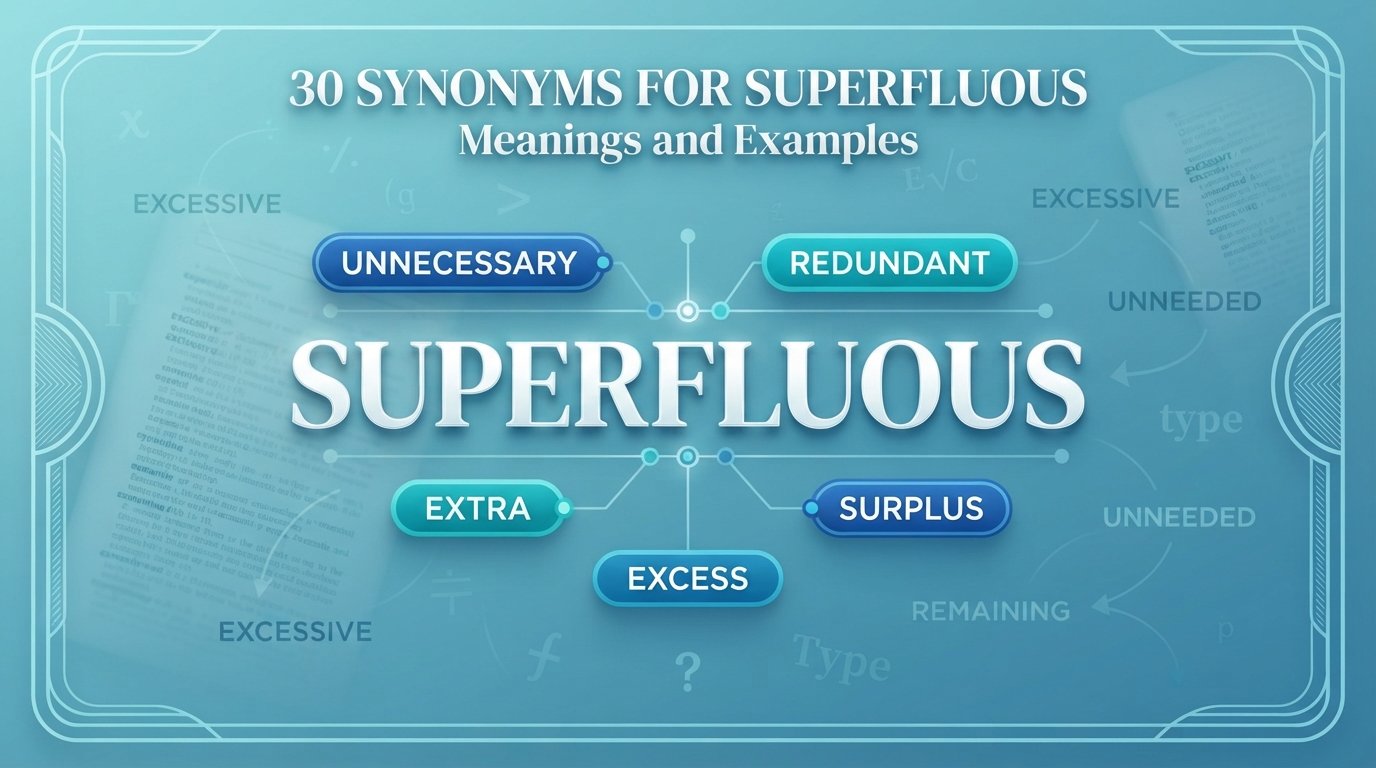
If you need a better word for superfluous, the best choice depends on what you mean by “more than necessary.” You might need unnecessary for something you do not need, redundant for something repeated or no longer useful, extraneous for information that does not belong, or surplus for an amount beyond what you require. This guide explains 30 useful synonyms and related alternatives, with clear differences, natural examples, and context-specific recommendations.
Quick Answer: What Are the Best Synonyms for Superfluous?
The closest synonyms for superfluous include unnecessary, extra, redundant, excess, surplus, needless, unneeded, and dispensable. However, they are not always interchangeable. Redundant often suggests repetition or a loss of usefulness, while extraneous emphasizes something irrelevant or outside the main subject. Surplus and excess are especially useful for quantities, while unnecessary is the broadest everyday alternative.
30 Synonyms for Superfluous
| Word | Relationship | Meaning | Best Context |
|---|---|---|---|
| Unnecessary | Direct synonym | Not needed or required | General use |
| Extra | Direct synonym | More than needed or expected | Everyday English |
| Redundant | Near synonym | Unnecessary because something similar already exists | Writing, systems, jobs |
| Excess | Near synonym | More than the required amount | Quantity, material, resources |
| Surplus | Near synonym | An amount left over after requirements are met | Money, goods, supplies |
| Needless | Direct synonym | Not necessary | Actions, words, risks |
| Unneeded | Direct synonym | Not required | General use |
| Unrequired | Direct synonym | Not required | Formal or technical writing |
| Nonessential | Direct synonym | Not essential to the main purpose | Information, features |
| Inessential | Direct synonym | Not essential | Formal writing |
| Dispensable | Near synonym | Able to be removed without serious loss | People, features, resources |
| Extraneous | Contextual alternative | Irrelevant or outside what is needed | Information, details |
| Supernumerary | Contextual alternative | More than the required number | People, parts, positions |
| Supererogatory | Contextual alternative | Going beyond what is required | Formal, ethical, academic |
| Excessive | Near synonym | Greater than reasonable or appropriate | Amount, behavior, detail |
| Uncalled-for | Contextual alternative | Unnecessary or unwarranted | Remarks, criticism, actions |
| Unwarranted | Contextual alternative | Not justified or necessary | Claims, criticism, actions |
| Gratuitous | Contextual alternative | Unnecessary, unjustified, or unprompted | Remarks, criticism, violence |
| Pointless | Contextual alternative | Having no useful purpose | Actions, discussion, effort |
| Wasteful | Contextual alternative | Using more resources than necessary | Spending, energy, materials |
| Unwanted | Near synonym | Not desired or needed | Objects, attention, additions |
| Additional | Related alternative | Added beyond what was already present | Information, features, items |
| Remaining | Contextual alternative | Still left after part has been used | Supplies, quantities |
| Leftover | Contextual alternative | Remaining after use or completion | Food, materials, supplies |
| Unused | Contextual alternative | Not used or put into operation | Resources, equipment |
| Irrelevant | Contextual alternative | Not connected to the matter being considered | Information, details |
| Expendable | Contextual alternative | Able to be sacrificed or removed | Resources, personnel |
| Otiose | Contextual alternative | Serving no useful purpose | Formal/literary writing |
| Pleonastic | Specialized alternative | Using more words than necessary | Grammar, rhetoric |
| Superabundant | Contextual alternative | Excessively abundant | Formal or descriptive writing |
Major dictionaries support the core group of extra, excess, surplus, spare, unnecessary, redundant, needless, unneeded, extraneous, dispensable, supernumerary, and related terms, although their meanings and contexts differ.
What Does Superfluous Mean?
Superfluous is an adjective that means more than you need, want, or consider necessary. The word can describe information, words, objects, details, actions, resources, and other things that exceed a situation’s requirements.Cambridge defines superfluous as something that exceeds what people need or want. Merriam-Webster similarly explains that the word can describe something that goes beyond what people consider sufficient or necessary or simply serves no useful purpose.
For example:
The report contained several superfluous details.
This means the report included details that were not necessary for its purpose.
The word can also describe something that has become unnecessary:
After the software update, several manual procedures became superfluous.
Pronunciation
- US: /suːˈpɝː.flu.əs/
- UK: /suːˈpɜː.flu.əs/
The word comes from Latin superfluus, meaning “overflowing,” which reflects its modern sense of something existing beyond what is required.
The Closest Synonyms for Superfluous
1. Unnecessary
Unnecessary is usually the safest everyday replacement. It means something is not needed or required.
The final paragraph was unnecessary.
Use it when you want a clear, neutral word without implying a particular reason why something is unnecessary.
2. Extra
Extra is more conversational and often refers simply to something additional.
We packed extra clothes for the trip.
Unlike superfluous, extra does not always suggest that something is useless or undesirable.
3. Redundant
Redundant is particularly useful when something duplicates existing information, functionality, or personnel.
The second paragraph was redundant because it repeated the same point.
It is therefore stronger than extra in contexts involving repetition.
4. Excess
Excess emphasizes an amount beyond what is needed.
The machine removes excess moisture.
It works especially well with quantities, materials, and physical substances.
5. Surplus
Surplus refers to something left over because there is more than required.
The company sold its surplus inventory.
It is common in business, economics, agriculture, manufacturing, and resource-related contexts.
6. Needless
Needless means unnecessary and is often used for actions, risks, words, or effort.
There is no reason to take such a needless risk.
It can sound slightly more judgmental than unnecessary.
Superfluous Synonyms by Context
For Information and Details
The strongest choices are:
- unnecessary
- extraneous
- irrelevant
- redundant
- nonessential
- needless
The editor removed several extraneous details from the article.
Use extraneous when the information does not belong to the main subject. Use redundant when information repeats something already stated.
For Writing and Words
Useful alternatives include:
- redundant
- unnecessary
- needless
- extraneous
- pleonastic
- otiose
The editor removed several redundant words.
Pleonastic is much more specialized. It describes unnecessarily repetitive or excessive wording, particularly in grammar and rhetoric.
For Money, Supplies, and Resources
Consider:
- surplus
- excess
- spare
- extra
- remaining
- leftover
The warehouse had a surplus of medical supplies.
Here, surplus is usually more natural than superfluous when discussing inventory or available resources.
For Features or Functions
Useful choices include:
- unnecessary
- redundant
- dispensable
- nonessential
- inessential
- extraneous
The premium version removes several unnecessary features.
Redundant works particularly well when another feature already performs the same function.
For Remarks, Actions, or Behavior
Consider:
- needless
- uncalled-for
- unwarranted
- gratuitous
- pointless
His uncalled-for remarks made the discussion more difficult.
These words can carry stronger judgment than superfluous.
Which Word Should You Use?
Choose “unnecessary” when:
You simply mean that something is not needed.
The meeting included several unnecessary steps.
Choose “redundant” when:
Something repeats information or performs a function that is already covered.
The final sentence was redundant.
Choose “extraneous” when:
Something is outside the main subject or adds irrelevant information.
Remove any extraneous information from the summary.
Choose “surplus” when:
You mean an amount left over after requirements are met.
The farm sold its surplus produce.
Choose “excess” when:
You are emphasizing an amount beyond a desirable or required level.
The treatment removes excess fluid.
Choose “needless” when:
Something is unnecessary and you want to emphasize that it could easily have been avoided.
The argument caused needless confusion.
Choose “dispensable” when:
Something can be removed without seriously affecting the whole.
These decorative elements are dispensable.
Superfluous vs. Unnecessary
Superfluous and unnecessary are very close, but superfluous often emphasizes something being more than necessary, whereas unnecessary simply says that something is not needed.
Compare:
The report contains unnecessary information.
The report contains superfluous information.
Both are natural. The second more strongly suggests that the report contains information beyond what is required.
Superfluous vs. Redundant
Redundant is more specific.
Something can be superfluous because there is simply too much of it. Something is redundant when it is unnecessary because it duplicates or repeats something else.
The report included superfluous background information.
The report repeated the same statistic twice, making the second reference redundant.
Not everything superfluous is redundant.
Superfluous vs. Extraneous
Extraneous focuses on relevance.
The essay contains superfluous detail.
This means there is more detail than needed.
The essay contains extraneous detail.
This suggests the detail is outside the main subject or purpose.
The two words overlap strongly when discussing writing and information, but extraneous places greater emphasis on irrelevance or being outside the central matter.
Superfluous vs. Excessive
Excessive means more than is reasonable, acceptable, or appropriate. Superfluous means more than is needed or necessary.
The article contains superfluous explanations.
The article contains excessive explanations.
The first emphasizes unnecessary material; the second can also suggest that the amount is unreasonably large.
Common Mistakes
Treating “extra” as always meaning “superfluous”
Extra can simply mean additional.
Bring an extra jacket.
The jacket is additional, but it is not necessarily unnecessary.
Using “redundant” for every unnecessary thing
Redundant usually implies duplication or loss of functional necessity.
The second explanation was redundant.
For a completely unrelated unnecessary object, unnecessary may be better.
Using “irrelevant” as a general synonym
Irrelevant means not relevant to the subject or issue. Something can be superfluous without being irrelevant.
The additional evidence was superfluous but still relevant.
Confusing “surplus” with “useless”
A surplus is simply more than required. It may still be valuable.
The company had a surplus of products.
Those products are not necessarily useless.
Antonyms of Superfluous
The opposite of superfluous is something that is needed, necessary, or essential.
Useful antonyms include:
- necessary
- essential
- needed
- required
- indispensable
- vital
- requisite
- essential
Remove the superfluous details but keep the essential information.
Frequently Asked Questions
What is the closest synonym for superfluous?
Unnecessary is generally the closest everyday synonym. Depending on context, extra, redundant, excess, surplus, needless, and unneeded can also be highly accurate alternatives. The best choice depends on whether you mean simply “not needed,” “repeated,” or “more than the required amount.”
Is redundant the same as superfluous?
Not exactly. Redundant is more specific because it often means unnecessary through repetition, duplication, or replacement by something else. Superfluous has a broader meaning: something can be superfluous simply because there is more of it than necessary.
What is a formal synonym for superfluous?
Unnecessary, extraneous, inessential, dispensable, supernumerary, and supererogatory can work in formal writing, depending on context. Among these, unnecessary is the most broadly natural, while supererogatory is highly specialized.
What is another word for superfluous information?
Good choices include unnecessary information, extraneous information, redundant information, irrelevant information, and nonessential information. Choose redundant when the information repeats something already stated and irrelevant when it does not relate to the subject.
What is another word for superfluous words?
Redundant words, unnecessary words, needless words, and extraneous words are natural choices. In specialized linguistic or rhetorical discussion, pleonastic may also be appropriate.
Is “excessive” a synonym for superfluous?
It can be a near-synonym, but the meanings are not identical. Excessive describes something that goes beyond what seems reasonable, acceptable, or appropriate. Superfluous refers to something unnecessary or more than the situation requires.. An amount can be excessive because of its size and superfluous because it serves no necessary purpose.
What is the difference between surplus and superfluous?
Surplus usually describes an amount remaining beyond requirements and is common for goods, money, supplies, and resources. Superfluous is broader and often describes things that are unnecessary, including information, words, actions, and details.
Conclusion
The best synonym for superfluous depends on why something is unnecessary. Unnecessary serves as the safest general alternative, while redundant fits repetition or duplication. Extraneous works well for irrelevant information, surplus describes quantities left over, and excess emphasizes an amount beyond what you need.. Choosing the right alternative is more useful than simply replacing superfluous with any word found in a thesaurus.

Michael Thompson is an English language specialist and experienced editor who focuses on vocabulary development and clear communication. He creates high-quality synonym guides, word comparisons, and writing tips to help students and professionals express their ideas more effectively. His work combines linguistic knowledge with practical SEO strategies to make learning both useful and engaging.