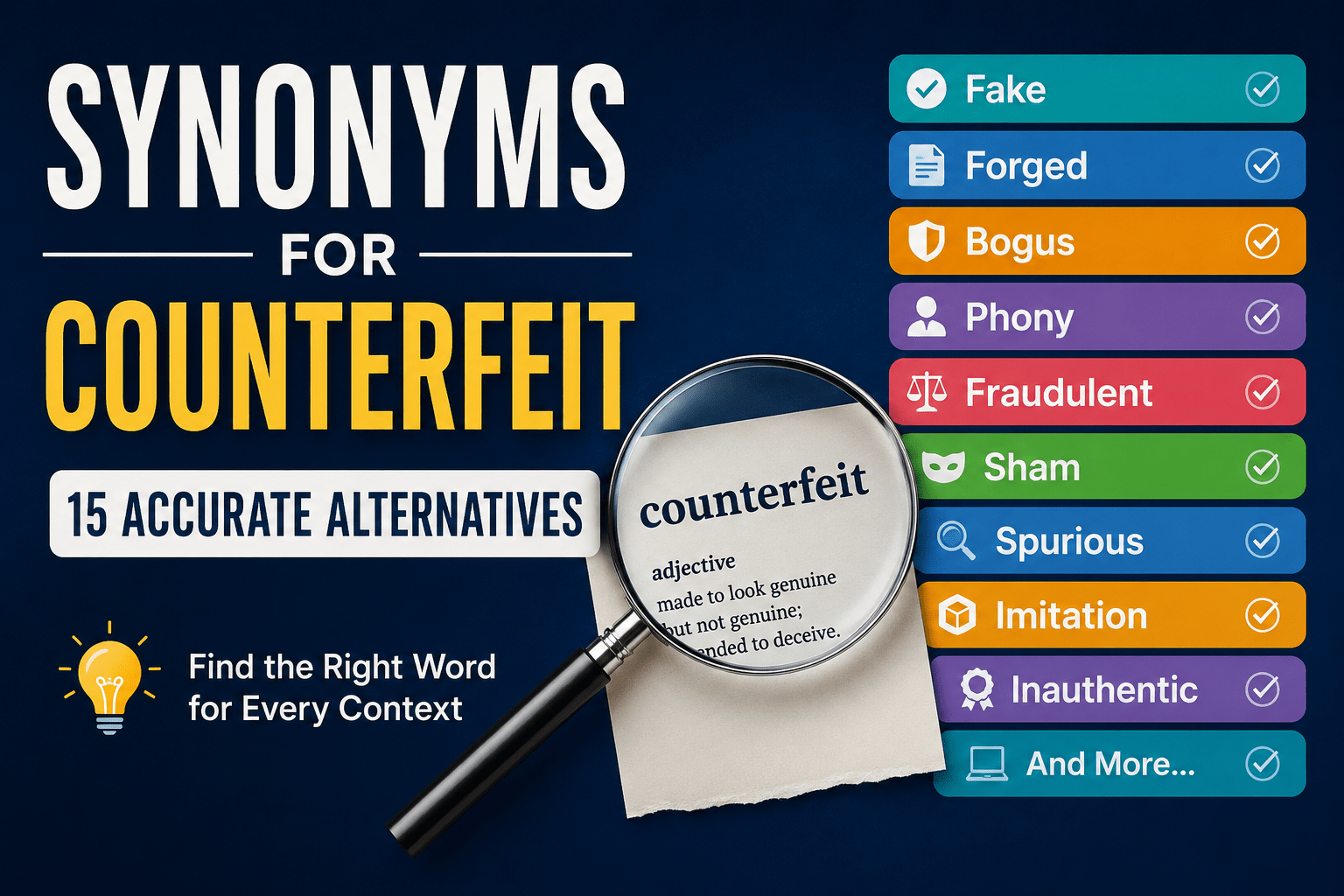
Finding the right synonym for counterfeit depends on what you are describing. Fake is the broadest everyday alternative, while forged is especially appropriate for documents, signatures, currency, and official records. Bogus emphasizes that something is false or not legitimate, phony often describes people, claims, or behavior, and imitation focuses on something made to resemble an original.
The important distinction is that counterfeit often suggests an imitation made or presented with an intention to deceive. That nuance is stronger than simply saying that something is a copy.
Quick Answer: What Are the Best Synonyms for Counterfeit?
The closest synonyms for counterfeit include fake, forged, bogus, phony, fraudulent, sham, spurious, imitation, inauthentic, and simulated. The best choice depends on context: use forged for unauthorized documents or currency, fake as a general everyday alternative, phony for insincere people or claims, and imitation when emphasizing resemblance rather than deception.
What Does “Counterfeit” Mean?
Counterfeit can function as an adjective, noun, or verb.
1 As an adjective, it describes something made to look genuine even though it is not genuine, particularly when the imitation is intended to deceive.
- counterfeit money
- counterfeit jewelry
- counterfeit passport
- counterfeit designer goods
2 As a noun, a counterfeit is the fake item itself:
The expert discovered that the painting was a counterfeit.
3 As a verb, to counterfeit means to make a fraudulent imitation or to imitate something with deceptive intent:
Criminals attempted to counterfeit the banknotes.
Merriam-Webster also records a figurative use in which counterfeit can mean insincere or feigned, as in counterfeit sympathy.
Pronunciation
- US: /ˈkaʊn.t̬ɚ.fɪt/
- UK: /ˈkaʊn.tə.fɪt/
Cambridge gives these pronunciations for the word in contemporary English.
The 15 Best Synonyms for Counterfeit
Not every word below is a perfect substitute in every sentence. Some are direct synonyms, while others are near synonyms or contextual alternatives.
| Word | Relationship | Strength | Formality | Best Context |
|---|---|---|---|---|
| Fake | Direct/near synonym | Strong | Neutral | General everyday use |
| Forged | Contextual alternative | Very strong | Neutral–formal | Documents, money, signatures |
| Bogus | Near synonym | Strong | Informal–neutral | Claims, credentials, offers |
| Phony | Near synonym | Strong | Informal | People, claims, emotions |
| Fraudulent | Near synonym | Very strong | Formal | Transactions, documents, claims |
| Sham | Near synonym | Strong | Neutral–formal | Systems, organizations, appearances |
| Spurious | Near synonym | Strong | Formal | Claims, arguments, evidence |
| Imitation | Contextual alternative | Moderate | Neutral | Products, art, objects |
| Inauthentic | Near synonym | Moderate–strong | Formal | Products, behavior, experiences |
| Simulated | Contextual alternative | Moderate | Neutral–formal | Conditions, behavior, experiences |
| Fabricated | Contextual alternative | Strong | Neutral–formal | Stories, evidence, information |
| Knockoff | Contextual alternative | Strong | Informal | Branded consumer products |
| Bootleg | Contextual alternative | Strong | Informal–neutral | Unauthorized recordings or goods |
| Ersatz | Near synonym | Strong | Literary/formal | Inferior substitutes |
| False | Near synonym | Variable | Neutral | Claims, information, appearances |
Cambridge and Merriam-Webster both include several of these words among the semantic alternatives associated with counterfeit, while their dictionary definitions show why the words are not interchangeable in every context.
1. Fake
Fake is usually the safest and most natural everyday synonym for counterfeit.
Meaning: Not genuine or real; made to appear genuine.
Example:
The store was selling fake designer handbags.
How it differs: Fake is broader and more conversational than counterfeit. It does not always emphasize the specific process of unauthorized imitation or the intention to defraud.
Best for: Everyday speech and general writing.
Compare:
counterfeit currency
fake currency
Both are natural, but counterfeit currency sounds more precise and official.
2. Forged
Forged is one of the strongest alternatives when something has been deliberately falsified.
Best for:
- documents
- signatures
- passports
- certificates
- banknotes
- official records
Example:
The company discovered that the certificate was forged.
How it differs: Forged often focuses on the act of creating a false document, signature, or official object. It is therefore more specific than fake.
Natural collocations:
- forged signature
- forged document
- forged passport
- forged banknote
- forged certificate
3. Bogus
Bogus means false, fake, or not legitimate.
Example:
The website was advertising bogus investment opportunities.
How it differs: Bogus is especially natural for things that are falsely presented as legitimate, such as claims, credentials, offers, websites, or organizations.
It is generally less technical than counterfeit.
4. Phony
Phony is an informal word for something or someone that is fake, insincere, or deceptive.
Examples:
He gave me a phony excuse for missing the meeting.
The company received complaints about a phony customer-support website.
How it differs: Phony can describe people, behavior, emotions, and claims, whereas counterfeit is particularly associated with manufactured or represented imitations.
For emotional or interpersonal contexts, phony is often much more natural:
phony smile
phony apology
phony friend
5. Fraudulent
Fraudulent emphasizes deception, dishonesty, or unlawful conduct.
Example:
The bank detected several fraudulent transactions.
How it differs: Fraudulent focuses more strongly on deception or fraud than on the physical imitation itself.
This makes it particularly useful in:
- legal writing
- financial writing
- business communication
- formal reports
Compare:
counterfeit banknotes
focuses on fake money.
fraudulent transactions
focuses on deceptive financial activity.
6. Sham
A sham is something presented as genuine, legitimate, or meaningful when it is not.
Examples:
The investigation revealed that the organization was a sham.
The agreement was nothing more than a sham.
How it differs: Sham is often used for systems, institutions, relationships, procedures, or appearances, rather than physical counterfeit products.
Common expressions include:
- sham marriage
- sham organization
- sham process
- sham transaction
7. Spurious
Spurious is a formal word meaning false, invalid, or apparently genuine but actually lacking a legitimate basis.
Example:
The report was based on spurious claims.
How it differs: Spurious is particularly useful for arguments, claims, evidence, reasoning, or conclusions.
It is not normally the best replacement for counterfeit watch or counterfeit handbag.
This is an important distinction: a dictionary may list spurious among related synonyms, but natural context determines whether it is an appropriate replacement.
8. Imitation
Imitation describes something made to resemble another thing.
Example:
The necklace was made from imitation gold.
How it differs: Imitation does not necessarily imply deception.
Someone can openly sell an imitation product without claiming that it is the original.
That makes imitation broader and sometimes less negative than counterfeit.
Counterfeit vs imitation
- Counterfeit: imitation presented or made in a deceptive or unauthorized way.
- Imitation: something designed to resemble another thing, potentially without deception.
9. Inauthentic
Inauthentic means not genuine, authentic, or true to the claimed identity or nature.
Example:
The reviewer questioned whether the artwork was authentic or inauthentic.
How it differs: Inauthentic is broader than counterfeit. It can describe products, experiences, behavior, communication, or cultural expressions without necessarily suggesting a deliberate fraudulent copy.
10. Simulated
Simulated means produced or represented to resemble a real situation, process, or experience.
Example:
The students practiced in a simulated emergency environment.
How it differs: Simulated is not automatically deceptive or dishonest.
A simulated environment may be deliberately created for training.
Therefore:
counterfeit emergency document
does not normally mean the same thing as:
simulated emergency document
The first implies falsification; the second suggests representation or reproduction.
11. Fabricated
Fabricated means invented, manufactured, or deliberately created rather than genuine.
Example:
The journalist discovered that the source had fabricated the evidence.
Best contexts:
- fabricated evidence
- fabricated story
- fabricated data
- fabricated documents
- fabricated claim
How it differs: Fabricated often concerns something invented or deliberately constructed, especially information or evidence, rather than a commercial product copied from an original.
12. Knockoff
Knockoff is an informal term for an inexpensive or unauthorized imitation, particularly of a branded product.
Example:
He bought a knockoff version of the designer watch.
How it differs: Knockoff is strongly associated with consumer products and brands.
It is conversational and should generally be avoided in highly formal writing.
Also, not every knockoff necessarily carries exactly the same legal or semantic implications as counterfeit; the terms overlap, but they are not perfectly interchangeable.
13. Bootleg
Bootleg describes something produced, copied, or distributed without authorization.
Examples:
They were selling bootleg concert recordings.
The website offered bootleg copies of films.
How it differs: Bootleg emphasizes unauthorized production or distribution, especially in entertainment and media.
It is therefore a contextual alternative rather than a universal synonym for counterfeit.
14. Ersatz
Ersatz refers to an artificial or inferior substitute used in place of something genuine or better.
Example:
The wartime shortage forced manufacturers to use ersatz materials.
How it differs: Ersatz often emphasizes substitution or inferior quality, not necessarily deception.
It is also less common in everyday modern English than fake, imitation, or counterfeit.
15. False
False is a broad term that can mean not true, not genuine, or misleading.
Examples:
The company was accused of making false claims.
The document contained false information.
How it differs: False is much broader than counterfeit. It can describe statements, information, beliefs, appearances, or objects.
For a physical fake product, counterfeit is usually more precise.
Closest Synonyms for Counterfeit
If you need the closest everyday alternatives, start with these:
- Fake — the broadest and most natural alternative.
- Forged — best for documents, money, signatures, and official records.
- Bogus — useful for false or illegitimate claims, offers, and credentials.
- Phony — especially natural for people, behavior, claims, and emotions.
- Fraudulent — emphasizes deception or dishonest activity.
- Imitation — emphasizes resemblance rather than deception.
- Spurious — formal; especially useful for claims, arguments, or evidence.
Formal Synonyms for Counterfeit
For formal, academic, legal, or professional writing, consider:
- forged
- fraudulent
- spurious
- inauthentic
- fabricated
- simulated
However, the best formal word depends on the noun.
| Phrase | Best Choice |
| counterfeit document | forged document |
| counterfeit signature | forged signature |
| counterfeit transaction | fraudulent transaction |
| counterfeit claim | spurious claim |
| counterfeit evidence | fabricated evidence |
| counterfeit product | counterfeit product / inauthentic product |
Casual Synonyms for Counterfeit
In everyday conversation, these are usually more natural:
- fake
- phony
- bogus
- knockoff
Examples:
That’s a fake watch.
The website looks phony.
They gave me a bogus receipt.
She bought a knockoff handbag.
Counterfeit Synonyms by Context
For counterfeit money
Use:
- forged
- fake
- fraudulent
Best choice: forged is especially precise when referring to banknotes or other documents created through falsification.
For counterfeit products
Use:
- fake
- imitation
- knockoff
- inauthentic
Best choice: counterfeit remains particularly precise when the product is presented as genuine.
For counterfeit documents
Use:
- forged
- fabricated
- fraudulent
Best choice: forged.
For counterfeit claims
Use:
- false
- bogus
- spurious
- fraudulent
Best choice: depends on the problem. Spurious works well for an apparently plausible but invalid claim; fraudulent emphasizes deliberate deception.
For counterfeit emotions
Use:
- phony
- feigned
- insincere
- simulated
Example:
Her sympathy seemed phony.
Here, forged would sound unnatural.
Counterfeit vs Fake
Fake is broader and more conversational than counterfeit.
The watch is fake.
This simply says that the watch is not genuine.
The watch is counterfeit.
This more strongly suggests that the watch was made or presented as an imitation of a genuine product, potentially with deceptive intent.
For everyday conversation, fake is usually the easier choice. For precise descriptions of fraudulent imitation, counterfeit is stronger.
Difference Between Counterfeit and Forged
Counterfeit and forged overlap, but they are not identical.
Counterfeit is commonly used for things manufactured or represented as genuine:
counterfeit money
counterfeit jewelry
counterfeit goods
Forged is especially associated with documents, signatures, records, currency, and other things deliberately falsified:
forged signature
forged passport
forged document
So if someone asks for a synonym for counterfeit document, forged is usually better than the general word fake.
Counterfeit vs Imitation
These words are particularly easy to confuse.
Counterfeit usually carries a stronger implication of deceptive or unauthorized imitation.
Imitation simply means that something resembles another thing.
For example:
The store openly sells imitation leather.
There is no necessary deception.
But:
The company discovered counterfeit leather products carrying its brand name.
The second sentence suggests unauthorized imitation intended to appear genuine.
Counterfeit vs Bogus
Bogus means false or not genuine, especially something presented as legitimate.
a bogus certificate
a bogus investment scheme
a bogus claim
Counterfeit is more strongly associated with an imitation of a genuine object or article.
Thus, bogus works well for claims and schemes where counterfeit may sound too physical or product-focused.
Counterfeit vs Phony
Phony is especially useful for things that appear sincere or genuine but are actually deceptive.
a phony excuse
a phony smile
a phony friend
Counterfeit can have a figurative meaning involving insincerity, but it is much less natural than phony in many everyday interpersonal contexts. Merriam-Webster specifically records counterfeit in the sense of something insincere or feigned.
Which Word Should I Use?
Use this quick decision guide:
Use “fake” when:
You need a simple, general word for something that is not genuine.
Use “forged” when:
You are describing a falsified document, signature, record, passport, or banknote.
Use “fraudulent” when:
The main idea is deception, fraud, or dishonest activity.
Use “bogus” when:
Something is falsely presented as legitimate.
Use “phony” when:
You are describing an insincere person, excuse, emotion, claim, or behavior.
Use “imitation” when:
You want to emphasize resemblance without necessarily implying deception.
Use “spurious” when:
You are describing a false or invalid claim, argument, or piece of evidence in formal writing.
Use “knockoff” when:
You are talking informally about an imitation branded product.
Common Mistakes
Mistake 1: Treating every copy as counterfeit
Not every copy is counterfeit.
A legal reproduction, openly marketed imitation, or authorized replica may be a copy without being a counterfeit.
Mistake 2: Using “forged” for every fake product
a forged handbag
This is generally unnatural.
Better:
a counterfeit handbag
Use forged primarily for things such as documents, signatures, records, and currency.
Mistake 3: Using “spurious” for physical products
a spurious handbag
This sounds unnatural in ordinary English.
Better:
a counterfeit handbag
Spurious is more natural with claims, arguments, evidence, and similar abstract nouns.
Mistake 4: Assuming “imitation” always means dishonest
An imitation can be openly sold as an imitation.
Therefore, imitation does not automatically communicate the deception implied by counterfeit.
Mistake 5: Using “phony” in highly technical writing
Phony is natural and useful, but it is generally more conversational than fraudulent, forged, or inauthentic.
Natural Collocations with Counterfeit
Common expressions include:
- counterfeit money
- counterfeit currency
- counterfeit goods
- counterfeit products
- counterfeit jewelry
- counterfeit watches
- counterfeit documents
- counterfeit passports
- counterfeit banknotes
- counterfeit coins
- counterfeit merchandise
- counterfeit designer goods
- counterfeit brand
- counterfeit signature
The most natural synonym changes with the noun.
For example:
counterfeit money → forged money
counterfeit designer bag → fake / knockoff designer bag
counterfeit document → forged document
counterfeit claim → bogus / spurious claim
counterfeit sympathy → phony / feigned sympathy
This is why choosing synonyms by context and collocation is more reliable than simply replacing one word with another from a thesaurus.
Antonyms of Counterfeit
The clearest antonyms include:
- genuine
- authentic
- real
- legitimate
- original
Cambridge specifically lists genuine and real as opposites of counterfeit.
Examples:
counterfeit jewelry ↔ genuine jewelry
counterfeit document ↔ authentic document
counterfeit product ↔ legitimate product
A Brief Look at the Word’s Origin
Counterfeit has a long history connected with the idea of imitation. Merriam-Webster traces the word through Middle English and Anglo-French to a form related to Old French contrefaire, meaning “to imitate,” ultimately involving Latin facere, “to make” or “to do.” Its English use dates back to the medieval period.
The historical connection to making an imitation helps explain why the modern word is particularly associated with objects made to resemble genuine originals.
FAQ: Synonyms for Counterfeit
What is the closest synonym for counterfeit?
Fake is usually the closest broad, everyday synonym. In specific contexts, forged, fraudulent, or imitation may be more precise.
What is a formal synonym for counterfeit?
Depending on context, forged, fraudulent, spurious, or inauthentic can work. Forged is particularly useful for documents and signatures.
What is another word for counterfeit goods?
Common alternatives include fake goods, inauthentic goods, imitation goods, and, informally, knockoffs. Counterfeit goods is usually the most precise term when the products are intended to pass as genuine.
Is “fake” the same as “counterfeit”?
Not exactly. Fake is broader and can describe anything that is not genuine. Counterfeit more specifically suggests an imitation of something genuine, often involving deceptive or unauthorized reproduction.
Is “forged” a synonym for counterfeit?
It can be a contextual synonym, particularly for documents, signatures, records, currency, and certificates. It is not a universal replacement for counterfeit.
What is the difference between counterfeit and imitation?
Counterfeit generally carries a stronger implication of deceptive or unauthorized imitation. Imitation simply emphasizes resemblance and does not necessarily imply deception.
What is the opposite of counterfeit?
The clearest opposites are genuine, authentic, and real. Legitimate and original can also work in appropriate contexts.
What is a synonym for counterfeit when describing a person?
Depending on the meaning, phony, fake, insincere, or fraudulent may be appropriate. For a person who pretends to be something they are not, phony is often the most natural everyday choice.
Conclusion
The best synonym for counterfeit depends on the kind of falseness you want to emphasize. Fake is the broadest everyday alternative; forged is especially precise for documents and currency; fraudulent highlights deception; phony works well for insincere people or behavior; bogus suits false claims and supposedly legitimate offers; and imitation emphasizes resemblance without necessarily implying fraud.
The key is not to choose the most impressive-looking synonym. Choose the word that matches the object, context, degree of deception, and level of formality you actually mean.

Sarah Williams is an ESL teacher and content writer with a passion for simplifying English vocabulary. She creates easy-to-understand synonym guides and learning resources that help beginners and intermediate learners build strong language skills.