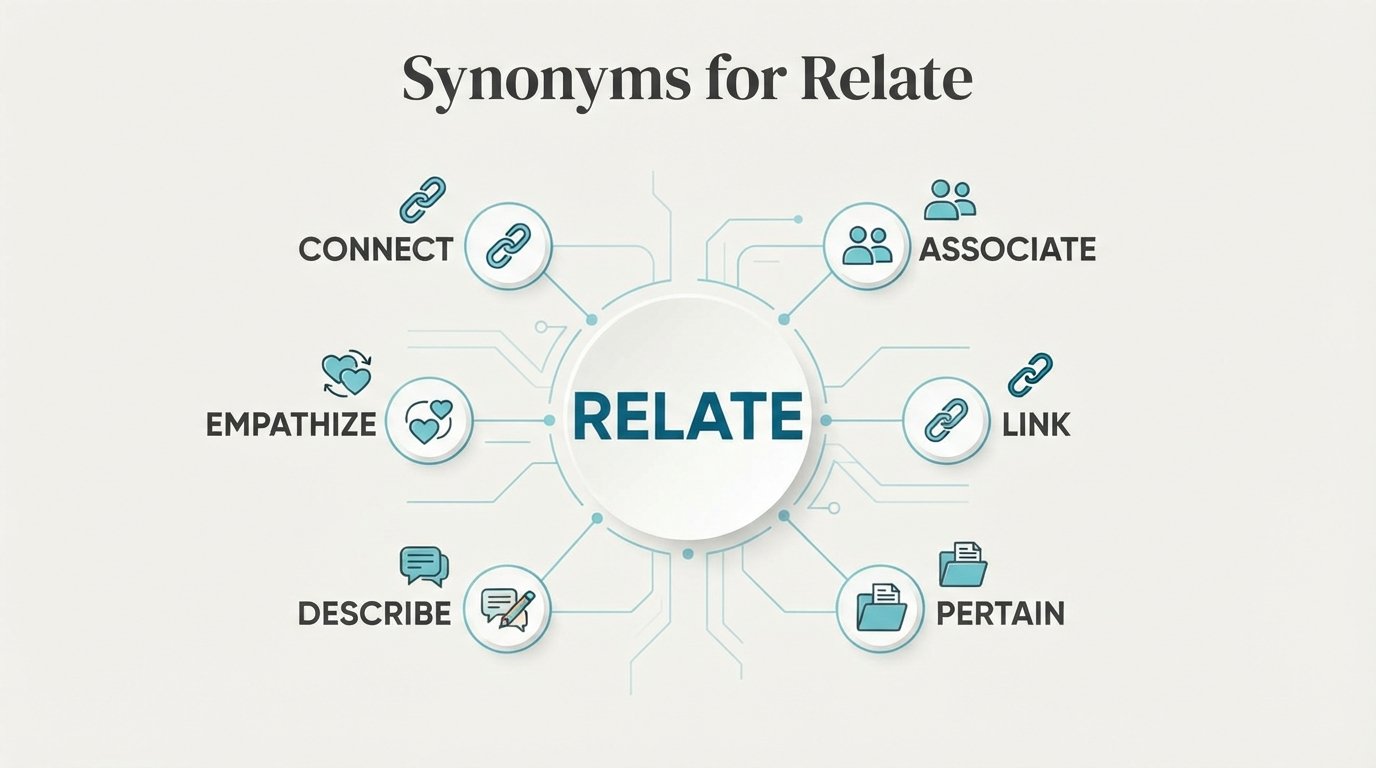
If you are looking for synonyms for relate, the best replacement depends on what relate means in your sentence. Connect, associate, link, and pertain work for different kinds of relationships, while describe, recount, narrate, and report can replace relate when it means “tell.” When relate to means understanding someone’s experience, alternatives such as empathize, identify with, or connect with may be more natural.
Quick Answer: What Are the Best Synonyms for Relate?
The closest synonym for relate depends on its meaning. For a connection between things, use connect, associate, link, or interrelate. For something that concerns a subject, use pertain, concern, apply to, or refer to. When relate means “tell,” use describe, recount, narrate, or report. For emotional connection with a person, empathize, identify with, and connect with are useful alternatives.
Core Synonyms for Relate
| Word | Relationship | Meaning | Best Context | Formality |
|---|---|---|---|---|
| connect | Direct/near synonym | Have a connection | Ideas, people, things | Neutral |
| associate | Near synonym | Link mentally or logically | Ideas, people, concepts | Neutral |
| link | Near synonym | Show or create a connection | Facts, events, ideas | Neutral |
| pertain | Contextual synonym | Be relevant or related to | Formal writing | Formal |
| concern | Contextual synonym | Be about or affect | Topics, issues, people | Neutral/Formal |
| refer to | Contextual synonym | Point or relate to something | Writing, speech, information | Neutral |
| apply to | Contextual synonym | Be relevant to | Rules, situations, conditions | Neutral/Formal |
| describe | Sense-specific synonym | Give an account of | Events, people, experiences | Neutral |
| recount | Sense-specific synonym | Tell something that happened | Stories, events, experiences | Formal |
| narrate | Sense-specific synonym | Tell a story or sequence | Stories, books, films | Formal |
| report | Sense-specific synonym | Give information about an event | News, findings, incidents | Neutral/Formal |
| tell | Direct synonym in one sense | Give someone information | Stories, events, facts | Neutral |
| detail | Near synonym | Give specific information | Reports, events, explanations | Neutral/Formal |
| communicate | Contextual synonym | Convey information or feelings | People, ideas, messages | Neutral/Formal |
| empathize | Sense-specific alternative | Understand another person’s feelings | Personal experiences | Neutral |
| identify with | Sense-specific alternative | See yourself in someone/something | People, experiences | Neutral |
| sympathize | Near synonym | Share or acknowledge someone’s feelings | Difficult experiences | Neutral |
| bond | Related alternative | Form a close relationship | People | Neutral |
| have rapport | Contextual alternative | Have a comfortable mutual understanding | People, professional relationships | Neutral/Formal |
| interrelate | Near synonym | Have relationships with one another | Systems, ideas, factors | Formal |
These distinctions matter because dictionaries group relate under several meanings rather than treating all alternatives as interchangeable. Merriam-Webster, for example, lists separate synonym groups for forming a personal relationship, giving an account, and having a relation or connection.
What Does “Relate” Mean?
Relate is a versatile verb with several important meanings.
It can mean to establish or have a connection, as in:
The two events relate to each other.
It can also mean to tell or describe something, especially an event or experience:
She related the story to her friends.
A third use means to concern, involve, or be relevant to something:
These rules relate to workplace safety.
Finally, relate to someone can mean to understand or identify with that person’s feelings or experience:
I can relate to what you’re going through.
This range of meanings explains why there is no single synonym that works perfectly in every sentence.
Synonyms for Relate When It Means “Connect”
When relate means that two things have a logical, conceptual, or other connection, these are the most useful alternatives.
1. Connect
Connect is one of the closest everyday alternatives to relate when discussing a relationship between people, ideas, events, or things.
The study connects sleep quality with academic performance.
Choose “connect” when you want clear, natural language describing a relationship.
2. Associate
Associate means to link one thing with another, often mentally or conceptually.
Many people associate success with hard work.
Unlike connect, associate can emphasize a mental or habitual relationship rather than a direct connection.
3. Link
Link emphasizes a connection between separate things.
Researchers linked the symptoms to environmental factors.
It is particularly natural in analytical, journalistic, and academic contexts.
4. Interrelate
Interrelate means that two or more things have relationships with one another.
Economic growth and employment interrelate in complex ways.
It is more formal and less common in everyday conversation.
5. Correlate
Correlate is useful when two variables or patterns show a relationship, particularly in analytical or scientific contexts.
Exercise levels correlate with several measures of health.
Do not use correlate as a universal replacement for relate. It normally implies a particular kind of relationship between variables.
Synonyms for “Relate To” When It Means “Be About” or “Concern”
This is one of the most common meanings behind searches for synonyms for relate.
6. Pertain to
Pertain to means to relate to, concern, or be relevant to something. It is especially useful in formal writing.
The regulations pertain to workplace safety.
It sounds considerably more formal than relate to.
7. Concern
Concern can mean to be about or involve a particular subject.
The report concerns changes in consumer behavior.
Cambridge lists concern, cover, deal with, treat, and refer to among alternatives for relate to in the sense of being about something.
8. Apply to
Use apply to when a rule, condition, statement, or principle is relevant to a person or situation.
This policy applies to all employees.
It is not interchangeable with relate to in every sentence.
9. Refer to
Refer to works when something points to, mentions, or concerns another subject.
The final paragraph refers to the earlier study.
Use it when the relationship involves a reference or mention rather than simply a general connection.
10. Have to do with
This is a natural conversational alternative to relate to.
What does this have to do with the problem?
It is much less formal than pertain to.
11. Be relevant to
Use be relevant to when you want to emphasize usefulness, applicability, or importance to a particular subject.
These findings are relevant to modern education.
Synonyms for Relate When It Means “Tell” or “Describe”
Another important meaning of relate is to tell an account of something that happened.
For example:
He related the events of the previous evening.
In this sense, the best alternatives include tell, describe, recount, narrate, report, and detail. Cambridge and Collins both group these words with this sense of relate.
12. Describe
Describe means to give an account of something in words.
She described what she had seen.
It is usually more natural than relate when explaining someone’s appearance, a scene, object, or experience.
13. Recount
Recount means to tell someone about events in detail, usually events that have already happened.
He recounted his experience during the interview.
It is somewhat more formal and literary than tell.
14. Narrate
Narrate means to tell a story or describe a sequence of events.
The documentary is narrated by an award-winning journalist.
It is especially common in books, films, documentaries, and formal storytelling.
15. Report
Report emphasizes communicating information about an event, observation, or situation.
The witness reported what she had seen.
It is especially appropriate in journalism, business, research, and official contexts.
16. Tell
Tell is the simplest and most natural everyday alternative.
She told us what happened.
Use tell when you want plain, conversational English.
17. Detail
Detail emphasizes giving specific information.
The report detailed the problems found during the inspection.
It works particularly well when the information is thorough or specific.
Synonyms for “Relate to Someone”
When relate to means being able to understand or identify with another person’s feelings or experience, the synonym set changes.
18. Empathize
Empathize means to understand and share, to some degree, another person’s feelings or experience.
I can empathize with her frustration.
This is stronger and more specifically emotional than simply saying relate to.
19. Identify With
Identify with means to see similarities between yourself and another person, character, group, or experience.
Many readers identify with the main character.
This is one of the most useful alternatives when relate to means “see yourself in.”
20. Connect With
Connect with suggests feeling an emotional, personal, or intellectual bond.
The audience connected with the speaker’s message.
It can also describe understanding or responding positively to someone’s experience.
21. Sympathize
Sympathize means to feel or express sympathy for someone.
I sympathize with your situation.
Do not treat sympathize and relate as exact synonyms. You can relate to someone’s experience without necessarily feeling sorry for them.
22. Communicate
Communicate can work when relate to refers to interacting successfully with another person.
She communicates well with younger students.
However, it focuses on exchanging information rather than necessarily sharing an experience.
23. Have Rapport
Have rapport means to have a comfortable, positive relationship characterized by mutual understanding.
The teacher has excellent rapport with her students.
This is particularly useful in professional or interpersonal contexts.
24. Bond
Bond means to develop a close relationship or emotional connection.
The two teammates bonded over their shared experience.
It suggests a developing or established relationship rather than simple understanding.
Which Synonym for Relate Should You Use?
The easiest way to choose the right word is to identify what relate means in your sentence.
Choose “connect” when:
You mean that two people, ideas, events, or things have a connection.
The evidence connects the two cases.
Choose “associate” when:
You mean that one thing is mentally or conceptually linked with another.
People often associate the brand with quality.
Choose “pertain to” when:
You need a formal expression meaning “be relevant to” or “concern.”
The regulations pertain to financial reporting.
Choose “describe” when:
You mean “give an account of something.”
She described the accident to the police.
Choose “recount” when:
You are telling the details of something that happened.
He recounted his childhood memories.
Choose “empathize” when:
You mean understanding another person’s feelings or experience.
I can empathize with her concerns.
Choose “identify with” when:
You see yourself or your own experience in another person.
Many young readers identify with the character.
Choose “refer to” when:
Something mentions or points to another subject.
The article refers to several recent studies.
Relate vs. Connect
Relate and connect overlap when they describe a relationship between things.
The two issues relate to each other.
The two issues connect with each other.
However, connect often gives a clearer impression of an actual link or attachment. Relate can emphasize a logical or conceptual relationship.
Merriam-Webster notes that relate suggests a real or presumed logical connection, while connect can suggest a looser or more external attachment.
Quick rule: Use connect when you want to emphasize the link itself; use relate when you are emphasizing the relationship or relevance.
Relate vs. Pertain
These words overlap when something is relevant to a subject.
The rule relates to workplace conduct.
The rule pertains to workplace conduct.
Pertain to is more formal and is particularly common in legal, academic, administrative, and professional writing.
Quick rule: Use relate to for general-purpose English and pertain to when a more formal tone is appropriate.
Relate vs. Describe
These words are not interchangeable in every context.
Relate can mean to tell an account of events:
She related what happened.
Describe focuses on explaining what something or someone is like:
She described the room.
You can describe an object, appearance, or situation, whereas relate in this sense more often introduces an account of events or experiences.
Relate vs. Empathize
These words overlap when talking about personal experiences, but they have different meanings.
I can relate to your experience.
I can empathize with your experience.
Relate to means that you understand because you have experienced something similar or can see the connection.
Empathize specifically emphasizes understanding another person’s feelings.
Therefore, someone may relate to another person’s experience without necessarily empathizing with their emotional response.
Common Mistakes With Relate Synonyms
Mistake 1: Treating every synonym as interchangeable
Words such as describe, connect, pertain, and empathize represent different senses of relate. Replacing relate with any one of them without checking the context can change the meaning.
Mistake 2: Using “pertain” in casual conversation
The rule pertains to you.
This is grammatically correct, but relates to or applies to may sound more natural in everyday English.
Mistake 3: Confusing “sympathize” with “relate”
I can relate to your situation.
This does not necessarily mean:
I feel sorry for you.
Sympathize adds an element of sympathy that relate does not always contain.
Mistake 4: Using “correlate” for every type of relationship
Correlate has a more specific analytical meaning. It is particularly useful for variables, patterns, or measurable relationships.
Exercise levels correlate with sleep quality.
It is not a universal replacement for relate.
Mistake 5: Using “narrate” for ordinary conversation
Narrate is appropriate for storytelling and formal descriptions of events, but tell is usually more natural in casual speech.
Common Phrases With Relate and Better Alternatives
| Original phrase | Natural alternative | Why |
|---|---|---|
| relate to the issue | concern the issue | Emphasizes subject matter |
| relate to the rules | pertain to the rules | More formal |
| relate to the situation | apply to the situation | Emphasizes relevance |
| relate the story | tell the story | More conversational |
| relate the events | recount the events | Emphasizes retelling |
| relate the experience | describe the experience | Emphasizes explanation |
| relate to her feelings | empathize with her feelings | Emphasizes emotional understanding |
| relate to the character | identify with the character | Emphasizes personal similarity |
| relate two ideas | connect two ideas | Emphasizes the link |
Antonyms of Relate
The best antonym for relate depends on the sense in which the word is used.
When relate means connect or link, suitable opposites include:
- disconnect
- separate
- detach
- disassociate
In the sense of being relevant to something, useful opposites are:
- be irrelevant to
- have no bearing on
- be unrelated to
When relate to someone means understand or identify with them emotionally, contrasting expressions include:
- fail to understand
- feel disconnected from
- be unable to identify with
The storytelling sense of relate is more context-dependent, so it does not have one exact opposite. Depending on the situation, conceal, withhold, or hide may express the idea of keeping information or a story from others.he opposite idea when the context is communicating information.
Frequently Asked Questions
What is the closest synonym for “relate”?
There is no single closest synonym for every use of relate. Connect is a strong choice when relate means “have a connection.” Describe, recount, or tell work when it means “give an account,” while pertain to and concern work when it means “be relevant to.”
What is another word for “relate to”?
Depending on context, alternatives include connect with, pertain to, concern, refer to, apply to, be relevant to, have to do with, and be about. The best choice depends on whether you mean connection, relevance, reference, or subject matter.
What is a formal synonym for “relate to”?
Pertain to is one of the clearest formal alternatives. Concern, be relevant to, and refer to can also work depending on the sentence.
What is another word for “relate to someone”?
Depending on the intended meaning, use connect with, identify with, empathize with, sympathize with, or have rapport with. These words differ in whether they emphasize shared experience, emotional understanding, sympathy, or interpersonal connection.
Is “connect” a synonym for “relate”?
Yes, in some contexts. When relate means “have a connection with,” connect is a close synonym. However, relate has additional meanings, including “tell” and “be relevant to,” where connect would not always work.
Is “pertain” a synonym for “relate”?
Yes, when relate to means “be relevant to” or “concern.” Pertain to is more formal and is not a replacement for relate when the verb means “tell a story” or “understand someone’s experience.”
Is “describe” a synonym for “relate”?
Sometimes. Describe can replace relate when relate means “give an account of something.” However, describe generally emphasizes explaining what something is like, while relate can emphasize telling events or experiences.
What is the difference between “relate” and “associate”?
Both can express a connection, but associate often emphasizes mentally linking one thing with another, while relate can emphasize a logical or broader relationship. Merriam-Webster identifies these as overlapping but distinct choices.
Final Takeaway
The best synonym for relate depends on the sense you intend. Use connect, associate, or link for relationships; pertain, concern, or refer to for relevance; describe, recount, narrate, or tell for giving an account; and empathize, identify with, or connect with for personal understanding.
The key is not to choose the word that merely appears in a thesaurus list. Choose the word that preserves the meaning, tone, context, and natural usage of your original sentence.

Emily Johnson is a linguistics graduate and vocabulary specialist. She writes detailed synonym explanations and helps readers understand subtle differences between words, improving both writing and speaking skills. Synonyms help express ideas more clearly and precisely in English.