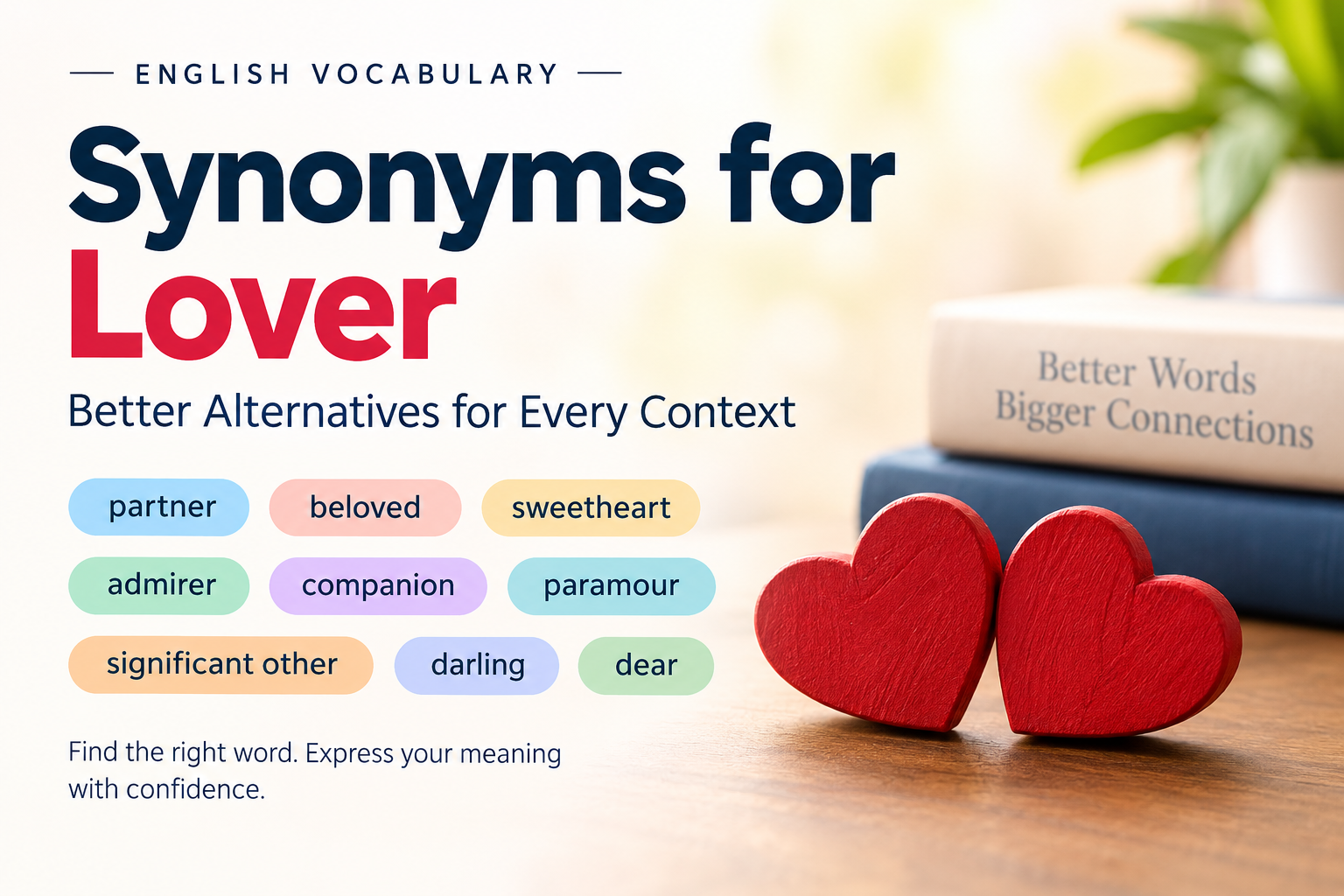
Finding the right synonym for lover depends heavily on context. The word can describe someone in a romantic or sexual relationship, but it can also mean someone who strongly enjoys something, as in a lover of music. In relationship contexts, words such as sweetheart, beloved, significant other, paramour, beau, and boyfriend overlap with lover but are not always interchangeable. Cambridge and Collins both distinguish these meanings and identify several related alternatives.
Quick Answer
The closest alternatives to lover in a romantic context include sweetheart, beloved, loved one, significant other, paramour, beau, boyfriend, girlfriend, and flame. However, they carry different meanings. Sweetheart is affectionate, paramour is literary or formal and often suggests a secret or illicit relationship, while boyfriend and girlfriend identify a romantic partner without necessarily emphasizing sexual intimacy.
25 Synonyms and Alternatives for Lover
Not every word below is a perfect replacement in every sentence. Some are direct synonyms, while others work only in particular contexts.
Direct and Close Synonyms for Lover
| Word | Relationship | Meaning / Difference | Register | Best Context |
|---|---|---|---|---|
| sweetheart | Close synonym | A person you love or have a romantic relationship with | Neutral / affectionate | Romantic relationships |
| beloved | Close synonym | Someone deeply loved | Literary / formal | Writing, poetry, affectionate descriptions |
| loved one | Close synonym | A person who is deeply loved | Neutral | General personal writing |
| significant other | Near synonym | A person’s romantic partner | Neutral / modern | General, professional, social contexts |
| paramour | Contextual synonym | A romantic or sexual partner, often implying secrecy or an affair | Formal / literary | Formal or literary writing |
| partner | Broad alternative | A person in a romantic relationship | Neutral | Modern general usage |
| romantic partner | Broad alternative | A person involved in a romantic relationship | Neutral / explicit | Clear modern writing |
| admirer | Near synonym | Someone attracted to or interested in another person, but not necessarily their lover | Neutral | Early-stage attraction |
| suitor | Near synonym | Someone seeking a romantic relationship or marriage | Formal / traditional | Courtship |
| wooer | Near synonym | Someone attempting to gain another person’s romantic affection | Literary / traditional | Historical or literary writing |
Romantic Terms and Affectionate Alternatives
| Word | Relationship | Meaning / Difference | Register | Best Context |
|---|---|---|---|---|
| beau | Contextual alternative | A boyfriend or romantic companion | Old-fashioned | Literary or historical contexts |
| boyfriend | Contextual alternative | A male romantic partner | Neutral | Modern relationships |
| girlfriend | Contextual alternative | A female romantic partner | Neutral | Modern relationships |
| flame | Contextual alternative | A current or former romantic interest | Informal | Casual conversation |
| inamorato | Contextual alternative | A man who is loved or involved in a romantic relationship | Literary / rare | Literary writing |
| inamorata | Contextual alternative | A woman who is loved or involved in a romantic relationship | Literary / rare | Literary writing |
| truelove | Close / literary | A person who is deeply and truly loved | Literary / old-fashioned | Poetry and literary writing |
| love | Contextual alternative | An affectionate term for a romantic partner | Informal / affectionate | Dialogue and personal speech |
| dear | Related term | An affectionate form of address, not necessarily a romantic partner | Neutral / affectionate | Personal communication |
| darling | Related term | An affectionate name for someone loved | Informal / affectionate | Speech, letters, fiction |
Informal, Traditional, and Specific Alternatives
| Word | Relationship | Meaning / Difference | Register | Best Context |
|---|---|---|---|---|
| sweetie | Related term | An affectionate name for someone | Informal | Casual speech |
| honey | Related term | An affectionate form of address | Informal | Casual conversation |
| mistress | Contextual alternative | A woman involved in a sexual or romantic relationship, traditionally outside marriage | Formal / specific | Affairs and historical contexts |
| lover boy | Contextual alternative | An affectionate or sometimes teasing term for a romantic young man | Informal | Casual speech |
| fancy man | Contextual alternative | A man’s lover or romantic partner; often slang or old-fashioned | Slang / old-fashioned | Historical or informal contexts |
| steady | Contextual alternative | A regular romantic partner, especially in older usage | Informal / old-fashioned | Historical or nostalgic contexts |
Cambridge’s thesaurus lists terms including paramour, mistress, beloved, loved one, inamorata, truelove, significant other, sweetheart, boyfriend, beau, and several informal forms. Collins similarly lists sweetheart, beloved, loved one, beau, flame, mistress, admirer, suitor, paramour, and other context-dependent alternatives.
What Does “Lover” Mean?
As a noun, lover has more than one meaning.
In its relationship sense, it refers to a person involved with another person romantically or sexually. Cambridge defines it as a person someone is having a sexual relationship with, while its American Dictionary also describes a lover as a partner in a romantic or physical relationship.
Collins likewise gives lover a relationship sense and separately defines a lover of something as someone who strongly enjoys or has great affection for it. For example:
- She met her lover after work.
- He is a lover of classical music.
The second meaning is important because words such as enthusiast, devotee, fan, and aficionado can be alternatives for lover when it means someone who greatly enjoys an activity or subject.
The Closest Synonyms for Lover
Sweetheart
Sweetheart is one of the most natural alternatives when lover refers to someone in a romantic relationship. It is warmer and more affectionate than the relatively neutral lover.
Example:
She introduced her childhood sweetheart to her family.
It can describe someone who is loved romantically without emphasizing sexual intimacy.
Beloved
Beloved emphasizes that someone is deeply loved. It is especially common in literary, poetic, ceremonial, or emotionally expressive writing.
Example:
The poet wrote several letters to his beloved.
Unlike lover, beloved focuses more strongly on the person’s emotional importance.
Loved One
Loved one is a broad and respectful term for someone who is deeply loved. It does not necessarily mean a romantic partner; it can also refer to family members or other close people.
Example:
She wanted to spend the holiday with her loved ones.
Therefore, it should not automatically replace lover in a sentence about romance.
Significant Other
Significant other is a modern, gender-neutral way to refer to a romantic partner.
Example:
She invited her significant other to the ceremony.
It is useful in situations where the writer does not want to specify whether the person is a boyfriend, girlfriend, spouse, or another type of romantic partner.
Formal and Literary Alternatives
Paramour
Paramour is one of the most distinctive alternatives to lover. It refers to a romantic or sexual partner and often carries a suggestion of secrecy, an affair, or a socially complicated relationship.
Example:
The novel centers on a wealthy woman and her secret paramour.
It is considerably less common in ordinary conversation than partner or boyfriend/girlfriend.
Beau
Beau traditionally means a boyfriend or male romantic companion. It now sounds somewhat old-fashioned or literary in many contexts.
Example:
She arrived at the party with her new beau.
Collins labels beau as old-fashioned, making it a poor choice for ordinary modern prose when a straightforward term such as boyfriend is intended.
Inamorato and Inamorata
Inamorato refers to a man who is loved or involved romantically, while inamorata refers to a woman.
These are rare and literary terms rather than everyday substitutes.
Example:
The painter portrayed his inamorata in a series of portraits.
They can add a literary tone, but they would sound unnatural in most ordinary conversation.
Informal Alternatives
Flame
Flame is an informal term for a romantic interest, especially someone who was or is a person’s romantic partner.
Example:
She ran into an old flame at the airport.
It works particularly well for a former romantic partner.
Love
In informal British usage and in affectionate speech, love can itself be used as a term for a romantic partner or someone addressed affectionately.
Example:
Come over here, love.
However, love has many other meanings, so context is essential.
Darling, Dear, Sweetie, and Honey
These are primarily terms of affection, not exact synonyms for lover. They can be used when addressing a romantic partner, but they do not necessarily identify the person’s relationship status.
For example:
Darling, I’ll call you tonight.
This does not mean that darling can always replace lover:
She met her lover yesterday.
She met her darling yesterday.
The second sentence changes the meaning and sounds unnatural in many contexts.
Lover vs. Boyfriend or Girlfriend
Lover and boyfriend/girlfriend overlap, but they emphasize different things.
- Lover emphasizes romantic or sexual involvement.
- Boyfriend identifies a male romantic partner.
- Girlfriend identifies a female romantic partner.
For example:
She introduced her boyfriend to her parents.
This simply identifies the relationship.
She secretly met her lover after work.
Here, lover can place more emphasis on the romantic or sexual relationship and, depending on context, may suggest secrecy.
Cambridge specifically distinguishes lover as a romantic or physical relationship term, while Collins also notes its use for sexual relationships and affairs.
Lover vs. Sweetheart
Sweetheart is generally more affectionate and emotionally warm.
Compare:
He was her lover.
He was her sweetheart.
The first focuses more directly on the romantic or sexual relationship. The second emphasizes affection and romantic attachment.
For an affectionate personal tone, sweetheart is often more natural.
Lover vs. Paramour
These words are close, but paramour is much more marked.
| Word | Main implication |
|---|---|
| lover | Romantic or sexual partner |
| paramour | Romantic or sexual partner, often with secrecy or an affair implied |
| sweetheart | Affectionate romantic partner |
| partner | Broad modern romantic relationship term |
Use paramour when the literary, secretive, or affair-related nuance is relevant. Do not use it simply as a fancy replacement for every occurrence of lover.
Lover vs. Admirer
An admirer is not necessarily a lover.
An admirer may have romantic feelings toward someone without being in a relationship with them.
She has several admirers.
This does not mean she has several lovers.
Therefore, admirer is best classified as a near synonym or related relationship term, not a direct replacement.
Lover vs. Suitor
A suitor is someone pursuing a romantic relationship, traditionally with marriage in mind.
She had several suitors before choosing her husband.
A suitor may eventually become a lover, but the two words describe different stages or aspects of a relationship.
Lover vs. Mistress
Mistress is highly specific. It traditionally refers to a woman involved in a sexual or romantic relationship with a man outside marriage.
The novel reveals that he had a mistress.
Because of this specific association, mistress should not be used as a general synonym for girlfriend or lover.
Collins includes mistress among relationship-related alternatives but gives it a distinct context.
Which Word Should You Use?
Choose “sweetheart” when:
You want an affectionate and romantic expression.
Choose “beloved” when:
You want to emphasize deep love, especially in literary or expressive writing.
Choose “significant other” when:
You need a modern, gender-neutral term for a romantic partner.
Choose “paramour” when:
The relationship has a secretive, illicit, or literary quality.
Choose “beau” when:
You want an old-fashioned or literary term for a male romantic companion.
Choose “flame” when:
You are referring to a romantic interest, especially a former one.
Choose “boyfriend” or “girlfriend” when:
You want a clear, ordinary modern term for a romantic partner.
Choose “partner” when:
You want a broad, neutral modern expression.
Choose “admirer” when:
The person has romantic interest but is not necessarily in a relationship.
Choose “suitor” when:
The person is actively pursuing a romantic relationship or courtship.
Common Mistakes With Lover Synonyms
1. Treating “admirer” as an exact synonym
An admirer may simply have feelings for someone. A lover is generally already involved in a romantic or sexual relationship.
2. Using “mistress” for any female partner
Mistress has a specific traditional association with an extramarital relationship. It is not a neutral synonym for girlfriend.
3. Using “beloved” in ordinary casual conversation
Although correct, beloved can sound literary or formal. Partner or sweetheart may sound more natural in everyday contexts.
4. Assuming “beau” is a common modern word
Beau is understood, but it often sounds old-fashioned or literary. Collins explicitly labels it old-fashioned.
5. Confusing “lover” with “admirer”
Someone can admire another person without being romantically involved with them.
6. Treating every term of affection as a synonym
Words such as darling, honey, dear, and sweetie are terms of affection. They may be used for romantic partners, but they do not inherently mean lover.
Synonyms for “Lover” Meaning Someone Who Enjoys Something
There is another important meaning of lover.
When someone says:
She is a lover of classical music.
Lover means someone who greatly enjoys or appreciates something. Cambridge and Collins both recognize this sense.
In this context, useful alternatives include:
- enthusiast
- fan
- devotee
- aficionado
- admirer
- buff
- follower
For example:
A lover of books
A book enthusiast
A book aficionado
A book fan
Collins specifically lists devotee, enthusiast, and fan in this sense, while Cambridge’s thesaurus includes terms such as devotee, enthusiast, aficionado, follower, fan, and buff.
These words should not be mixed with romantic synonyms such as paramour or sweetheart.
Common Collocations With Lover
Some natural expressions include:
- secret lover
- former lover
- old lover
- new lover
- romantic lover
- faithful lover
- young lover
- former lover
- lover of music
- lover of art
- nature lover
- animal lover
- book lover
Collins specifically records secret lover as a collocation.
The phrase lover of + noun is especially important because it represents the separate “enthusiast” meaning:
a lover of literature
a lover of nature
a lover of classical music
Antonyms of Lover
There is no single exact antonym for lover in every context.
For the romantic sense, possible opposites depend on what you mean:
- enemy — someone hostile rather than loving
- hater — someone who strongly dislikes something or someone
- rival — someone competing for the same person’s attention or affection
For the emotional concept of love itself, hatred, dislike, or indifference may provide clearer opposites depending on context.
Frequently Asked Questions
What is another word for lover?
Common alternatives include sweetheart, beloved, loved one, significant other, paramour, beau, boyfriend, girlfriend, and partner. The best choice depends on whether you want an affectionate, neutral, formal, literary, or highly specific expression.
What is a formal word for lover?
Paramour is a formal or literary alternative that can describe a romantic or sexual partner, often with an implication of secrecy or an affair. Beloved is another formal or literary option when the emphasis is on deep affection.
What is a romantic synonym for lover?
Sweetheart, beloved, loved one, significant other, and romantic partner can all work in appropriate contexts. Sweetheart emphasizes affection, while significant other is a modern, neutral relationship term.
Is “partner” the same as “lover”?
Not exactly. Partner is broader and usually refers to someone in a committed romantic relationship without specifying sexual intimacy. Lover places greater emphasis on romantic or sexual involvement.
Is “sweetheart” a synonym for lover?
It can be a close contextual synonym, especially when referring to a romantic partner. However, sweetheart emphasizes affection rather than the sexual aspect that lover can carry.
What is the difference between a lover and a paramour?
Both can refer to a romantic or sexual partner, but paramour often suggests a secret, illicit, or extramarital relationship and has a more formal or literary tone. Lover is more general.
What is another word for “lover” meaning someone who likes something?
When lover means someone who strongly enjoys something, alternatives include enthusiast, devotee, aficionado, fan, and buff. For example, a lover of jazz can become a jazz enthusiast.
What is a word for a former lover?
Ex, former partner, former boyfriend, former girlfriend, and old flame can work depending on the relationship and tone. Old flame is particularly useful for a former romantic interest.
Conclusion
The best synonym for lover depends on the exact relationship and tone you want to express. Sweetheart and beloved emphasize affection, significant other and partner provide neutral modern alternatives, paramour carries a more literary or potentially secretive sense, and boyfriend or girlfriend gives a clear everyday description of a romantic partner. Terms such as admirer, suitor, and mistress should be used carefully because they add meanings that lover does not necessarily contain.
Most importantly, lover has a second meaning: someone who greatly enjoys something. In phrases such as music lover or nature lover, words like enthusiast, devotee, aficionado, and fan are the appropriate alternatives.

Michael Thompson is an English language specialist and experienced editor who focuses on vocabulary development and clear communication. He creates high-quality synonym guides, word comparisons, and writing tips to help students and professionals express their ideas more effectively. His work combines linguistic knowledge with practical SEO strategies to make learning both useful and engaging.