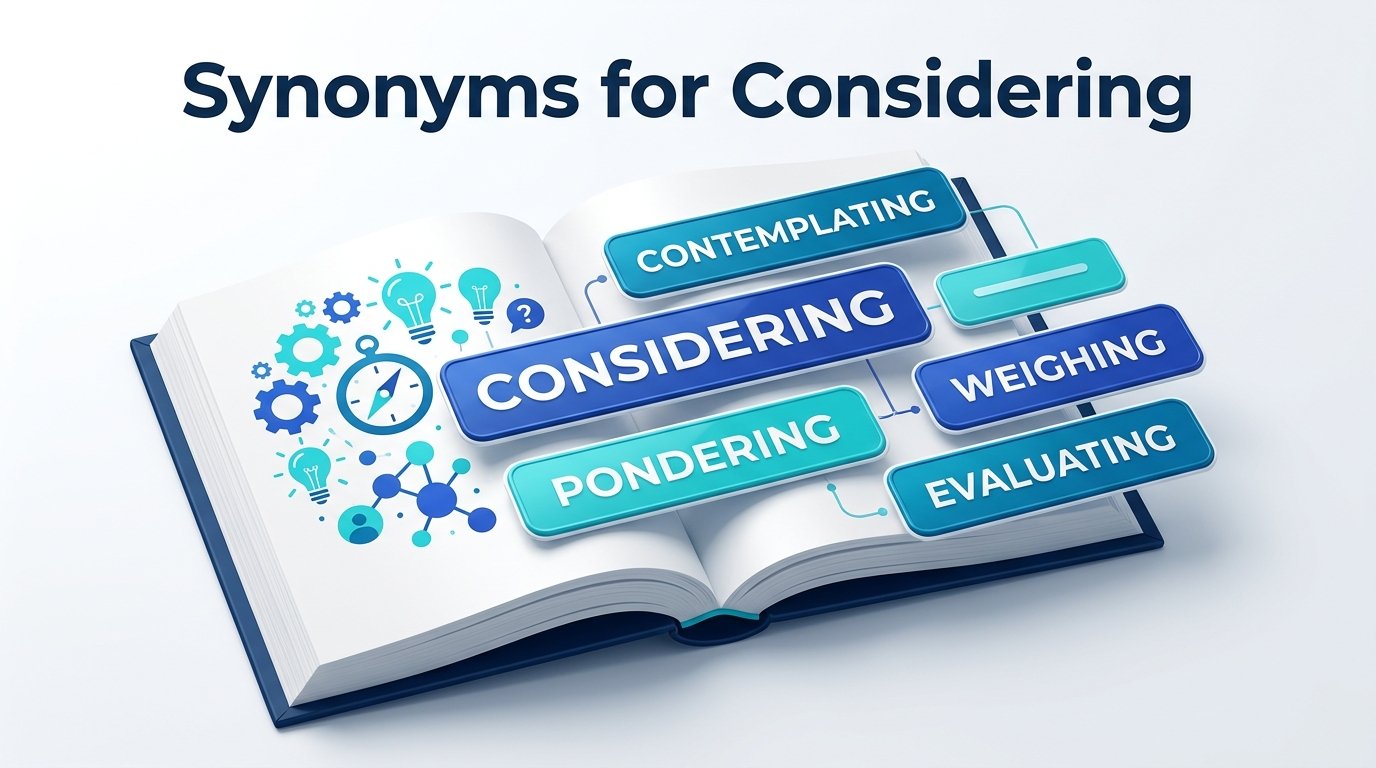
When you need a synonym for considering, the best choice depends on what you mean. If you mean thinking carefully about an idea, contemplating, pondering, weighing, and deliberating can work. If you mean taking something into account, phrases such as taking into account, bearing in mind, allowing for, and factoring in are more precise. In other contexts, regarding, viewing, or thinking about may be the better replacement.
Quick Answer: What Are the Best Synonyms for Considering?
The closest alternatives to considering include contemplating, pondering, thinking about, weighing, deliberating, examining, reviewing, regarding, viewing, and taking into account. However, they are not interchangeable in every sentence. Contemplating suggests sustained thought, weighing often involves comparing options, regarding means viewing something in a particular way, and taking into account emphasizes including a fact in a decision.
Core Synonyms for Considering
| Word or phrase | Relationship | Meaning | Best context | Formality |
|---|---|---|---|---|
| contemplating | Direct/near synonym | Thinking deeply about something | Ideas, possibilities, decisions | Neutral–formal |
| pondering | Near synonym | Thinking carefully and at length | Questions, choices, problems | Neutral |
| thinking about | Direct alternative | Giving thought to something | Everyday conversation | Neutral |
| weighing | Contextual synonym | Comparing factors before deciding | Options, risks, pros and cons | Neutral |
| deliberating | Near synonym | Carefully discussing or thinking before deciding | Decisions, committees, formal settings | Formal |
| examining | Contextual alternative | Looking at something carefully | Evidence, details, proposals | Neutral–formal |
| reviewing | Contextual alternative | Looking over something systematically | Documents, plans, applications | Neutral–formal |
| analyzing | Contextual alternative | Studying something in detail | Data, arguments, problems | Neutral–formal |
| regarding | Context-specific alternative | Thinking of or treating something in a particular way | People, subjects, opinions | Formal |
| viewing | Context-specific alternative | Considering or seeing something from a perspective | Opinions, situations | Neutral |
| taking into account | Contextual alternative | Including a fact in a decision | Circumstances, limitations, risks | Neutral–formal |
| bearing in mind | Contextual alternative | Remembering a relevant fact while judging something | Advice, evaluation | Neutral–formal |
| allowing for | Contextual alternative | Making provision for a factor | Delays, costs, differences | Neutral |
| factoring in | Contextual alternative | Including a factor in calculations or decisions | Business, planning, analysis | Neutral–professional |
| anticipating | Near/contextual synonym | Thinking ahead about something likely to happen | Risks, needs, events | Neutral–formal |
| exploring | Near synonym | Investigating an idea or possibility | Options, solutions, opportunities | Neutral |
| studying | Contextual alternative | Giving sustained attention to something | Evidence, plans, subjects | Neutral |
| questioning | Contextual alternative | Considering whether something is true or appropriate | Assumptions, claims | Neutral |
| entertaining | Contextual alternative | Considering an idea as a possibility | Suggestions, possibilities | Formal |
| reviewing | Contextual alternative | Reconsidering or inspecting something | Decisions, documents, policies | Neutral–formal |
The list above deliberately avoids treating every related word as an exact synonym. Merriam-Webster’s thesaurus separates considering into several senses, including regarding, contemplating, anticipating, and other context-dependent meanings.
What Does “Considering” Mean?
Considering is the present participle of consider, but it also functions as a preposition and conjunction.
As a verb form, considering can mean thinking carefully about something, especially before making a decision.
We are considering moving to a larger office.
Cambridge defines consider in this sense as spending time thinking about a possibility or making a decision.
It can also mean taking something into account:
Considering the weather, we arrived surprisingly early.
In this construction, considering introduces a fact or condition that influences how another situation should be judged. Cambridge specifically identifies this use as mentioning a condition or fact that affects something else.
Merriam-Webster similarly defines the prepositional use as “in view of” or “taking into account.”
1. Considering = Thinking About
When considering means simply giving thought to an idea, possibility, or decision, these are the strongest alternatives.
Contemplating
Contemplating suggests focused or sustained thought, often about something important.
She is contemplating a career change.
Use it when the idea receives serious mental attention.
Pondering
Pondering means thinking carefully and often at length.
He spent the evening pondering the proposal.
It can sound slightly more reflective or literary than thinking about.
Thinking about
This is the simplest everyday alternative.
We’re considering buying a new car.
→ We’re thinking about buying a new car.
It is natural and conversational, but less formal than some alternatives.
Weighing
Weighing is especially useful when a person compares advantages, disadvantages, risks, or alternatives.
We’re considering several options.
→ We’re weighing several options.
It strongly suggests a decision-making process.
Deliberating
Deliberating emphasizes careful thought before reaching a decision.
The committee is deliberating over the proposal.
It is particularly appropriate for formal decisions, committees, legal matters, and institutional contexts.
2. Considering = Taking Something Into Account
Sometimes considering does not mean “thinking about.” Instead, it means including a fact or circumstance when making a judgment.
For example:
Considering his age, he performed remarkably well.
Here, replacing considering with contemplating would completely change the meaning.
Better alternatives include:
- taking into account
- bearing in mind
- in view of
- allowing for
- factoring in
Taking into account
This is one of the clearest formal alternatives.
The committee made its decision considering the financial risks.
→ The committee made its decision taking the financial risks into account.
Bearing in mind
This means keeping a relevant fact in mind while evaluating something.
Bearing in mind the limited budget, the result was impressive.
It is particularly useful in explanatory and professional writing.
Allowing for
Use allowing for when you make provision for a possible factor, difference, delay, or complication.
Allowing for traffic, the journey should take about an hour.
Factoring in
Factoring in is common in business, planning, finance, and analytical contexts.
We need to factor in rising transportation costs.
It emphasizes incorporating a variable into a decision or calculation.
3. Considering = Regarding or Viewing
In some sentences, considering means thinking of someone or something in a particular way.
Merriam-Webster identifies regarding, viewing, thinking, deeming, and similar verbs among alternatives for the relevant sense of consider.
Regarding
Regarding can work when consider means treating or viewing something in a particular way.
She is regarded as one of the team’s best players.
However, be careful: regarding also commonly means about or concerning, so it is not a universal replacement for considering.
Viewing
Viewing emphasizes the perspective from which something is seen.
The policy is viewed as an important step forward.
Deeming
Deeming means judging or considering someone or something to have a particular status or quality.
The court deemed the evidence insufficient.
It is more formal and should not be used simply because it sounds sophisticated.
Which Word Should I Use Instead of “Considering”?
Use the alternative that matches your intended meaning.
Choose “contemplating” when:
You mean thinking deeply about a possibility.
She is contemplating a move abroad.
Choose “pondering” when:
You mean thinking carefully or reflectively.
He was pondering the question.
Choose “weighing” when:
You mean comparing factors before making a choice.
We are weighing our options.
Choose “deliberating” when:
You mean carefully thinking or discussing before reaching a formal decision.
The jury is deliberating.
Choose “taking into account” when:
You mean including a relevant fact in a judgment.
Taking the weather into account, the event was a success.
Choose “bearing in mind” when:
You want to remind the reader about an important circumstance.
Bearing in mind the deadline, we should start today.
Choose “factoring in” when:
You are talking about calculations, planning, or variables.
We need to factor in the additional costs.
Choose “regarding” when:
You mean viewing or treating something in a particular way, not simply thinking about it.
The company is regarded as an industry leader.
Considering vs. Contemplating
Both words can refer to thinking carefully about something.
Considering is broader and more neutral. It can describe anything from casually thinking about an option to seriously evaluating it.
Contemplating usually suggests more sustained, focused, or reflective thought.
Compare:
I’m considering taking a photography course.
She spent months contemplating a major career change.
The first is neutral. The second suggests deeper reflection.
Considering vs. Pondering
Pondering is more reflective than ordinary considering.
I’m considering the proposal.
This simply says that the proposal is under thought or evaluation.
I’m pondering the proposal.
This suggests more deliberate or extended thought.
Both can be correct, but they create a slightly different tone.
Considering vs. Weighing
These words overlap when someone is deciding between alternatives.
We’re considering two candidates.
We’re weighing two candidates.
The second sentence more strongly suggests comparison and evaluation.
Weighing is especially natural with:
- options
- risks
- benefits
- costs
- advantages
- disadvantages
- alternatives
For example:
We are weighing the benefits and risks.
Considering vs. Taking Into Account
These expressions are close when considering means including a relevant factor.
Considering the high cost, we rejected the proposal.
Taking the high cost into account, we rejected the proposal.
The second version is slightly more explicit and often works well in formal or analytical writing.
Considering vs. Regarding
These words should not be treated as interchangeable in every sentence.
Considering can mean thinking carefully about something:
We are considering several proposals.
Regarding can mean viewing or treating someone or something in a particular way:
She is regarded as an expert.
Regarding can also mean about:
Regarding your question, I’ll respond tomorrow.
Therefore, the intended meaning must be checked before substituting one for the other.
Common Mistakes With Synonyms for Considering
Mistake 1: Using “contemplating” for every meaning
Not every use of considering means deep thought.
Incorrect substitution:
Contemplating the weather, we arrived early.
Better:
Considering the weather, we arrived early.
Here considering means taking the weather into account, not thinking deeply about it.
Mistake 2: Treating “regarding” as a universal synonym
Regarding often means about or concerning, and in other contexts it means viewing someone or something in a particular way.
It does not automatically replace considering.
Mistake 3: Using “weighing” when there is no comparison
I’m weighing whether I should call her.
This can work, but weighing is most natural when alternatives, consequences, advantages, or disadvantages are being evaluated.
Mistake 4: Using “pondering” in very casual situations
Pondering is grammatically correct, but it can sound more reflective than everyday thinking about.
I’m thinking about getting pizza.
is more natural in casual conversation than:
I’m pondering getting pizza.
Mistake 5: Confusing “considering” with “considered”
Considering can describe an ongoing process:
They are considering the proposal.
Considered can describe something that has been carefully thought through:
She gave a considered response.
Merriam-Webster defines considered as something matured through extended deliberative thought in this adjectival sense.
Common Collocations With “Considering”
The most useful synonym often depends on what follows the word.
Considering + options
Natural alternatives:
- weighing options
- evaluating options
- reviewing options
- exploring options
- thinking about options
Considering + a proposal
Natural alternatives:
- reviewing a proposal
- evaluating a proposal
- examining a proposal
- deliberating over a proposal
- thinking about a proposal
Considering + a possibility
Natural alternatives:
- contemplating a possibility
- exploring a possibility
- thinking about a possibility
- weighing the possibility
Considering + risks
Natural alternatives:
- assessing risks
- evaluating risks
- weighing risks
- factoring in risks
- taking risks into account
Considering + circumstances
Natural alternatives:
- taking the circumstances into account
- bearing the circumstances in mind
- allowing for the circumstances
- given the circumstances
Formal Synonyms for Considering
For professional, academic, or formal writing, useful alternatives include:
- taking into account
- taking into consideration
- regarding
- evaluating
- examining
- assessing
- deliberating
- factoring in
- allowing for
- bearing in mind
Choose based on meaning rather than formality alone.
For example, assessing is better when you mean judging the quality, importance, or risk of something, while taking into account is better when you mean including a factor in a decision.
Casual Alternatives for Considering
In everyday English, these are often more natural:
- thinking about
- looking at
- thinking over
- mulling over
- weighing up
- keeping in mind
For example:
I’m considering going to the concert.
Casual alternatives include:
I’m thinking about going to the concert.
or:
I’m thinking it over.
The best choice depends on exactly what the speaker means.
Antonyms of Considering
The opposite depends on the sense being used.
When considering means thinking carefully about something, possible opposites include:
- ignoring
- disregarding
- dismissing
- rejecting
- overlooking
When it means taking something into account, possible opposites include:
- disregarding
- discounting
- overlooking
- leaving out
For example:
The manager considered the financial risks.
Opposite:
The manager disregarded the financial risks.
Merriam-Webster lists disregarding, discounting, and related words among antonymic possibilities for relevant senses of considering.
FAQ About Synonyms for Considering
What is the closest synonym for considering?
The closest synonym depends on the meaning. For thinking about something, thinking about is the simplest direct alternative, while contemplating and pondering suggest more deliberate thought. For taking something into account, taking into account is a highly precise alternative.
What is a formal synonym for considering?
Useful formal alternatives include taking into account, taking into consideration, evaluating, examining, deliberating, and regarding. The appropriate choice depends on the sentence and intended meaning.
What is another word for considering options?
Good alternatives include weighing options, evaluating options, reviewing options, exploring options, and thinking about options. Weighing options is particularly natural when comparing advantages and disadvantages.
What is another word for considering a possibility?
Depending on context, use contemplating, pondering, exploring, thinking about, weighing, or entertaining a possibility.
For example:
She is considering moving abroad.
can become:
She is contemplating moving abroad.
Is “contemplating” a synonym for “considering”?
Yes, when considering means thinking seriously about something. However, contemplating usually suggests deeper or more sustained thought. It cannot replace considering when considering means “taking into account.”
Is “regarding” a synonym for “considering”?
Sometimes, but not always. Regarding can mean viewing or treating someone or something in a particular way, and it can also mean “about.” It is therefore a context-specific alternative rather than a universal synonym.
Is “thinking about” a synonym for “considering”?
Yes. When considering means giving thought to an idea, possibility, or decision, thinking about is a natural everyday alternative.
What is the difference between considering and taking into account?
Considering can mean thinking about something or including it in a judgment. Taking into account specifically emphasizes including a fact, factor, or circumstance when making a decision or assessment.
Final Word Choice Guide
If you need a quick replacement, use this guide:
- thinking about → everyday, general thought
- contemplating → serious or sustained thought
- pondering → reflective or extended thought
- weighing → comparing options or consequences
- deliberating → careful decision-making
- examining → looking at something closely
- reviewing → systematically looking over something
- analyzing → studying details or relationships
- regarding → viewing or treating in a particular way
- taking into account → including a relevant factor
- bearing in mind → remembering a relevant circumstance
- allowing for → making provision for a factor
- factoring in → incorporating a variable into planning or calculation
- anticipating → thinking ahead about what may happen
- exploring → investigating an idea or possibility
The most important lesson is that “considering” does not have one universal synonym. The correct alternative depends on whether you mean thinking, evaluating, comparing, viewing, anticipating, or taking something into account. Choosing the word that matches the exact sense produces more natural and precise English.

Sarah Williams is an ESL teacher and content writer with a passion for simplifying English vocabulary. She creates easy-to-understand synonym guides and learning resources that help beginners and intermediate learners build strong language skills.