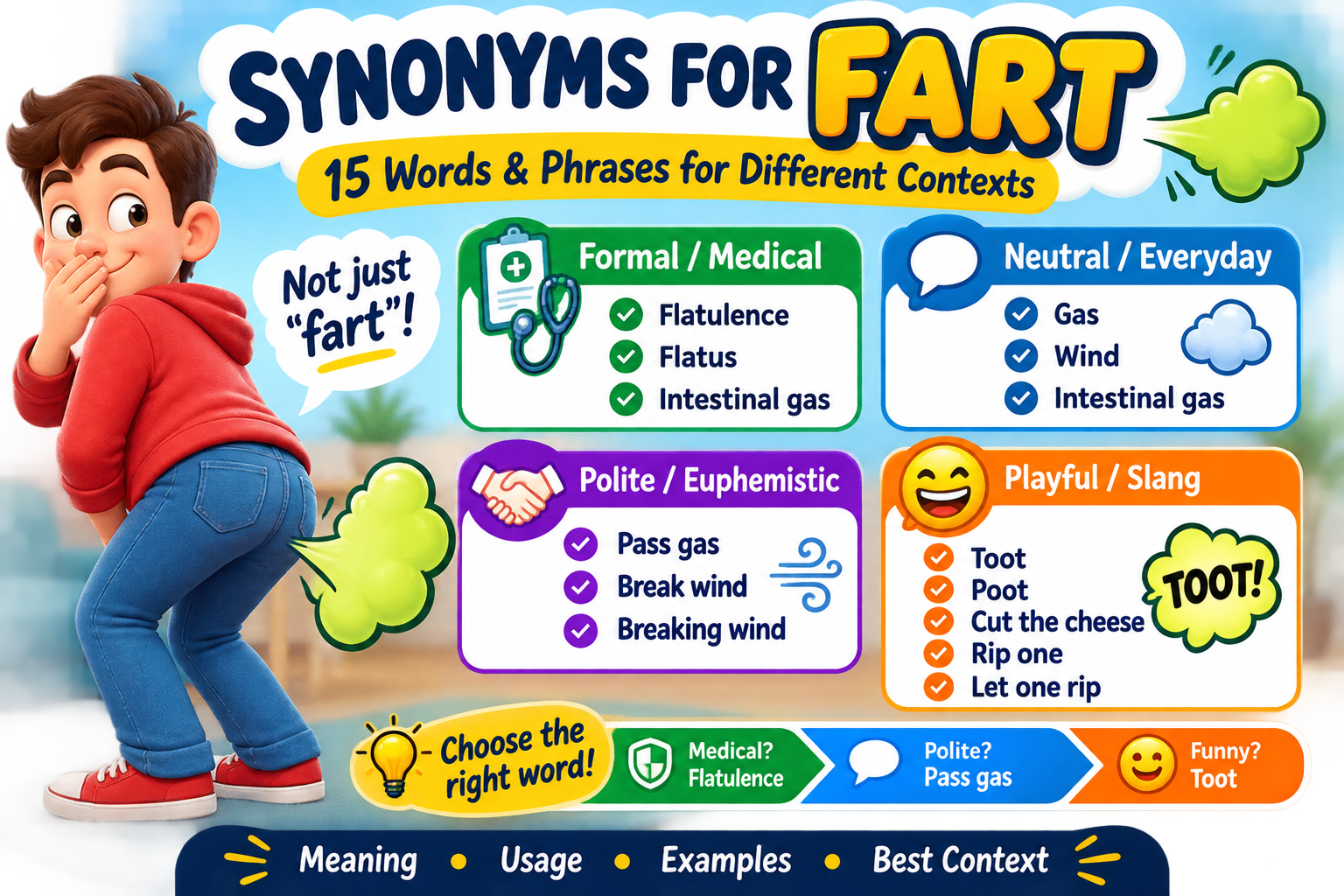
Looking for synonyms for fart? The best alternative depends on what you mean and how formal you want to sound. Flatulence and flatus are more clinical, while gas, wind, and intestinal gas are neutral alternatives for the noun. For the verb, pass gas and break wind are polite expressions, while toot, cut the cheese, and rip one are informal or humorous.
Not every expression works in every situation. Some are genuine synonyms, some are near-synonyms, and others are slang phrases used mainly for humor.
Quick Answer
The closest useful synonyms and alternatives for fart include flatulence, flatus, gas, wind, intestinal gas, pass gas, break wind, flatulate, toot, breaking wind, cut the cheese, rip one, and blow off. For formal or medical writing, choose flatulence or flatus. In polite everyday conversation, pass gas or break wind works better. Informal expressions such as toot and cut the cheese are more playful.
Core Synonyms for Fart
| Word or phrase | Relationship | Meaning | Register | Best context |
|---|---|---|---|---|
| Flatulence | Direct/technical noun | Gas released from the digestive tract | Formal/medical | Health and clinical writing |
| Flatus | Direct/technical noun | Intestinal gas | Medical/technical | Medical or scientific contexts |
| Gas | Near synonym | Intestinal gas or an episode of passing gas | Neutral | Everyday conversation |
| Wind | Near synonym | Intestinal gas, especially in British English | Neutral | Everyday British English |
| Intestinal gas | Contextual alternative | Gas in the digestive tract | Neutral/formal | Health explanations |
| Pass gas | Direct verbal alternative | Release intestinal gas | Polite/neutral | Everyday conversation |
| Break wind | Direct verbal alternative | Release intestinal gas | Polite/euphemistic | Conversation and writing |
| Flatulate | Direct verbal alternative | Release intestinal gas | Technical/uncommon | Formal or humorous technical usage |
| Toot | Contextual alternative | Make a small fart-like sound or pass gas | Informal/playful | Family-friendly or humorous contexts |
| Breaking wind | Verbal/noun phrase | The act of passing gas | Polite/euphemistic | Conversation |
| Cut the cheese | Slang/idiom | Fart | Informal/humorous | Casual speech |
| Rip one | Slang | Fart | Informal/vulgar | Casual speech |
| Blow off | Slang/contextual | Pass gas | Informal | Casual speech |
| Let one rip | Slang/idiom | Release a fart, often loudly | Informal | Humorous conversation |
| Poot | Playful alternative | A small or childish-sounding fart | Informal/playful | Humor and children’s language |
The core dictionary-style sources support a much smaller set than broad online thesauruses sometimes suggest. Cambridge lists flatulence, gas, and wind for the noun, while Thesaurus.com lists flatulence, gas, wind and separates verbal alternatives such as expel gas, toot, break wind, cut one, cut the cheese, pass gas, and rip one.
1. Flatulence
Flatulence is the best choice when you need a formal, medical, or clinical term.
It refers to the presence or release of intestinal gas and is much more appropriate than fart in health-related writing.
Example:
Certain foods can contribute to excessive flatulence.
Best for: medical information, health articles, professional writing.
Do not use it when: you want casual or humorous conversation.
2. Flatus
Flatus is a technical or medical term for intestinal gas.
It is less common in ordinary conversation than flatulence, but it can be useful in medical, scientific, or anatomical contexts.
Example:
The examination focused on abdominal discomfort and intestinal flatus.
Best for: medical and scientific contexts.
Flatus vs. flatulence
The two words overlap, but they are not always interchangeable in ordinary usage. Flatus is the technical term for intestinal gas, while flatulence commonly refers to the condition or process involving excessive intestinal gas.
3. Gas
Gas is one of the most natural neutral alternatives to fart when talking about digestive gas.
For example:
I think the beans gave me gas.
However, gas does not always mean an actual fart. It can refer more broadly to gas in the digestive system.
Best for: everyday conversation and health discussions.
4. Wind
Wind can refer to intestinal gas, particularly in British English.
Example:
The medication can sometimes cause wind.
It is a useful alternative when discussing digestive discomfort without using the more direct word fart.
Best for: everyday British English and health contexts.
Cambridge specifically lists wind among the principal noun synonyms for fart.
5. Intestinal Gas
Intestinal gas is a clear, neutral phrase rather than a slang synonym.
It is particularly useful when explaining the subject to readers who may find fart too informal.
Example:
Some foods can increase intestinal gas.
Best for: health articles, educational content, and neutral explanations.
6. Pass Gas
Pass gas is one of the best polite alternatives to the verb fart.
Example:
It’s normal to pass gas several times a day.
It sounds considerably more polite and neutral than fart and is appropriate in many everyday and health-related contexts.
Best for: polite conversation, health writing, and general explanations.
7. Break Wind
Break wind is a traditional euphemistic expression meaning to fart.
Example:
He quietly broke wind and tried not to draw attention to himself.
It is understandable and established, although it can sound somewhat old-fashioned or deliberately euphemistic depending on the context.
Best for: polite or humorous writing.
Both Cambridge-derived results and major thesaurus sources identify break wind as an alternative to fart.
8. Flatulate
Flatulate is a verb meaning to release intestinal gas.
It is much less common in everyday American English than fart or pass gas, so it should not automatically be treated as the most natural replacement.
Example:
The animal began to flatulate after eating the new food.
Best for: technical, medical, or deliberately formal wording.
Naturalness: Correct, but uncommon.
9. Toot
Toot is a playful, mild alternative to fart.
It can make the subject sound less crude or more humorous.
Example:
The little boy laughed after the dog tooted.
Because toot is playful, it is especially useful in family-friendly writing and humorous conversation.
Best for: children, humor, casual speech.
Thesaurus.com includes toot among the stronger verbal alternatives for fart.
10. Breaking Wind
Breaking wind is the noun phrase corresponding to break wind.
Example:
Breaking wind is a normal bodily function.
It is more euphemistic than farting and can be useful when you want to avoid crude wording.
11. Cut the Cheese
Cut the cheese is a humorous slang expression meaning to fart.
Example:
Someone cut the cheese during dinner, and everyone started laughing.
It is not appropriate for formal or professional writing.
Best for: jokes, casual conversation, humorous content.
Online thesaurus sources list cut the cheese as an informal alternative, but it should be clearly classified as an idiomatic expression rather than a formal synonym.
12. Rip One
Rip one is informal slang for farting, often suggesting a noticeable or forceful fart.
Example:
He joked that he had to step outside before he ripped one.
It is casual and can sound vulgar, so it should be avoided in professional communication.
Best for: informal speech and humor.
13. Blow Off
Blow off can be used informally to mean pass gas, but it is potentially ambiguous because blow off has many unrelated meanings in English.
For that reason, it is usually not the best replacement if clarity matters.
Example:
The dog blew off after eating too quickly.
Best for: informal contexts where the meaning is obvious.
14. Let One Rip
Let one rip is a humorous idiom for releasing a fart, usually implying that it is loud or forceful.
Example:
He let one rip and immediately opened a window.
This expression is strongly informal.
Best for: jokes, stories, and casual conversation.
15. Poot
Poot is a playful, childish-sounding word for a fart.
It is not suitable for formal writing, but it can work in humorous or family-friendly contexts.
Example:
The cartoon character made a tiny poot and looked embarrassed.
Best for: children’s language, comedy, and playful writing.
Which Word Should I Use?
The best alternative depends on the situation.
For medical or health writing
Choose flatulence, flatus, or intestinal gas.
Excessive flatulence can sometimes be associated with dietary changes.
For polite everyday conversation
Choose pass gas or break wind.
It’s normal to pass gas.
For neutral everyday language
Choose gas or wind.
Certain foods can cause gas.
For humorous writing
Choose toot, cut the cheese, or let one rip.
The dog tooted during the meeting.
For slang
Choose rip one, cut the cheese, or let one rip, depending on the tone.
These expressions should not be presented as interchangeable in every situation. Register and context matter.
Fart vs. Flatulence
| Feature | Fart | Flatulence |
|---|---|---|
| Part of speech | Noun and verb | Mainly noun |
| Register | Informal | Formal/medical |
| Tone | Direct, sometimes crude | Clinical/neutral |
| Everyday use | Very common | Less common |
| Health writing | Usually too informal | Preferred |
| Humor | Common | Usually less humorous |
Fart is a direct everyday word. Flatulence is the more formal and clinical alternative.
For example:
Informal: The dog farted.
Clinical: The dog experienced flatulence.
The second sentence sounds more appropriate in a veterinary or medical context.
Fart vs. Flatus
Fart is the ordinary informal word. Flatus is a technical term associated with intestinal gas.
Informal: He passed gas.
Technical: Intestinal flatus was observed.
Use flatus when the surrounding vocabulary is technical or medical. In ordinary conversation, it will usually sound unnecessarily clinical.
Fart vs. Pass Gas
These expressions have essentially the same basic meaning when fart is used as a verb, but their register differs.
Fart: direct and informal
Pass gas: polite and neutral
If you are speaking to a doctor, writing educational material, or trying to sound polite, pass gas is usually the safer choice.
Fart vs. Toot
Toot is not always an exact substitute because it adds a playful or humorous tone.
Compare:
The baby farted.
with:
The baby tooted.
The second sentence sounds softer, more playful, and less crude.
Common Mistakes
Mistake 1: Treating every related word as a synonym
Words such as odor, stink, smell, and stench describe smells, not the act of releasing intestinal gas. Broad thesaurus results can mix these concepts together.
Mistake 2: Using slang in formal writing
Expressions such as cut the cheese, rip one, and let one rip are unsuitable for medical, academic, or professional writing.
Use flatulence, flatus, or intestinal gas instead.
Mistake 3: Assuming “gas” always means a fart
Gas can refer to intestinal gas generally. It does not necessarily describe a specific act of passing gas.
Mistake 4: Using “toot” when precision matters
Toot is playful rather than clinical. If you are writing about digestive health, flatulence or intestinal gas is more precise.
Mistake 5: Using “break wind” in every situation
Although understandable, break wind can sound euphemistic or old-fashioned. Pass gas is often more natural when a neutral expression is needed.
Frequently Asked Questions
What is the most polite word for fart?
Pass gas is one of the most natural polite alternatives to fart. Break wind is another euphemistic option. In medical or health writing, flatulence or intestinal gas is generally more appropriate.
What is the medical term for fart?
Flatulence is the common medical or clinical term associated with passing intestinal gas. Flatus is a more technical term referring to intestinal gas itself.
What is another word for fart in formal writing?
Use flatulence, flatus, or intestinal gas, depending on the sentence. Flatulence is generally the most accessible formal alternative.
Is “gas” a synonym for fart?
Gas is a near-synonym in some contexts, but it is broader. It can refer to intestinal gas generally rather than one specific release of gas.
Is “toot” another word for fart?
Yes, toot can be used as a playful or mild alternative to fart. It is informal and humorous rather than formal or medical.
Is “cut the cheese” a synonym for fart?
Cut the cheese is an informal idiom meaning to fart. It is best treated as a slang or humorous alternative rather than a neutral synonym.
What is the difference between fart and flatulence?
Fart is the ordinary informal word used as both a noun and a verb. Flatulence is a more formal term used primarily as a noun, especially in medical and health-related contexts.
What is a professional way to say fart?
In professional or health-related writing, use pass gas, flatulence, or intestinal gas, depending on the sentence. The most appropriate choice depends on whether you are describing the action, the condition, or the gas itself.
Conclusion
There is no need to use a large thesaurus list when looking for alternatives to fart. The most useful choices are determined by context. Use flatulence or flatus for technical and medical language, pass gas or break wind when you want a polite expression, gas or wind for neutral everyday usage, and toot or expressions such as cut the cheese when humor is appropriate.
The key is not simply finding another word for fart; it is choosing an alternative that matches the meaning, register, tone, and situation.

Emily Johnson is a linguistics graduate and vocabulary specialist. She writes detailed synonym explanations and helps readers understand subtle differences between words, improving both writing and speaking skills. Synonyms help express ideas more clearly and precisely in English.