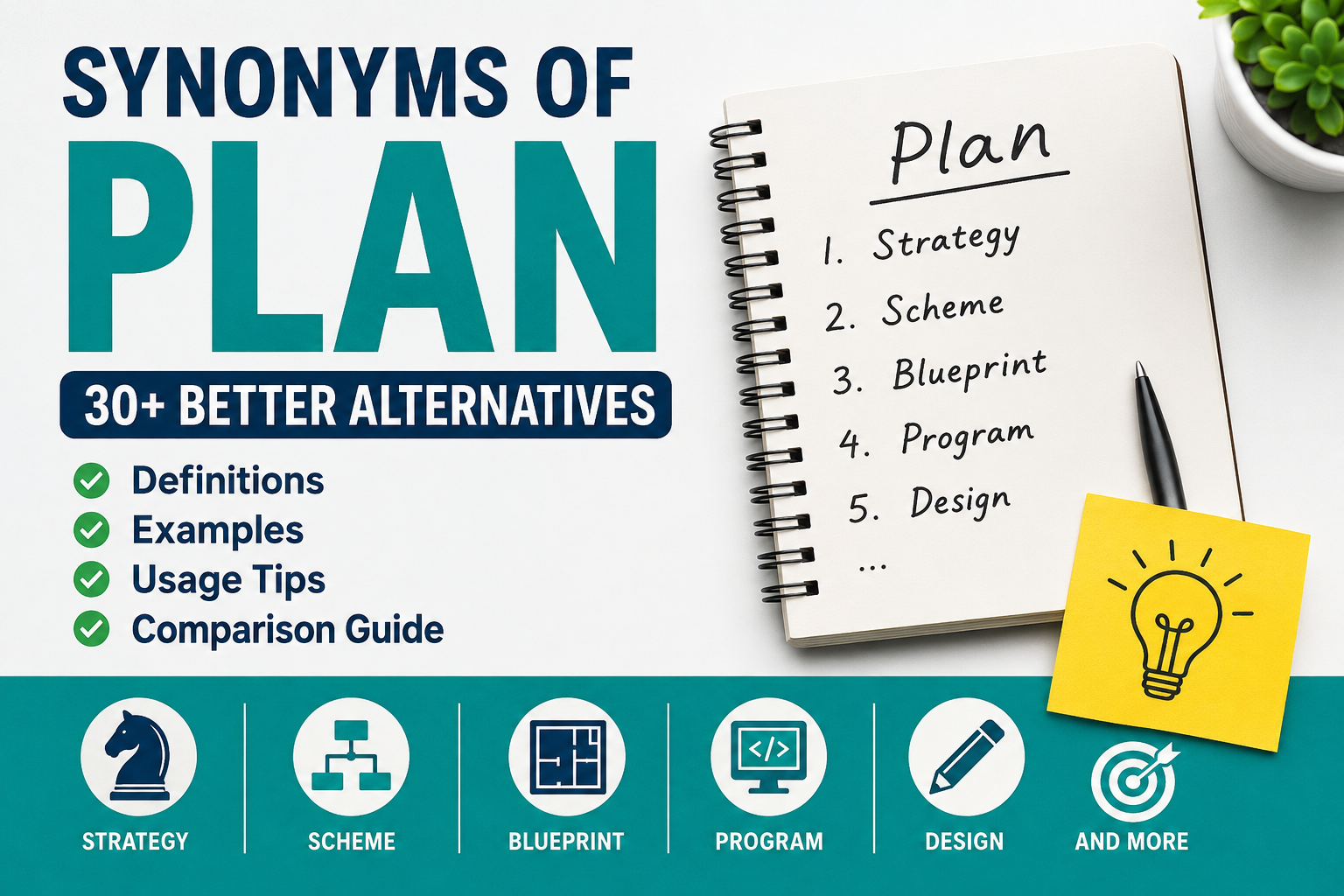
Looking for the best synonyms of plan? The right alternative depends on what you mean by plan. You might mean a strategy for reaching a goal, an intention to do something, a proposal, a detailed design, or a series of steps. Words such as strategy, blueprint, design, scheme, project, proposal, intention, aim, outline, and roadmap can work in the right contexts, but they are not interchangeable in every sentence.
This guide separates genuine synonyms from near-synonyms and contextual alternatives, so you can choose a word that fits your meaning, tone, and situation.
Quick Answer: What Are the Best Synonyms of Plan?
The closest common synonyms of plan include strategy, design, scheme, blueprint, project, program, proposal, outline, roadmap, and arrangement. However, each has a different emphasis. Strategy suggests an approach for achieving a goal, blueprint suggests a detailed model, proposal suggests an idea presented for consideration, and intention focuses on what someone means or expects to do.
30 Synonyms and Alternatives for Plan
The best synonym for plan depends on what you mean. Some words describe a strategy, while others refer to an intention, a proposal, a design, or a specific type of plan.
Core Synonyms for Plan
| Word | Relationship | Best meaning/context | Formality |
|---|---|---|---|
| Strategy | Near synonym | A deliberate approach for achieving a goal | Neutral/Formal |
| Design | Near synonym | The way something is planned or arranged | Neutral/Formal |
| Scheme | Near synonym | A carefully arranged plan; sometimes suggests questionable motives | Neutral |
| Project | Near synonym | A planned undertaking with a defined objective | Neutral |
| Approach | Near synonym | A particular way of dealing with a goal or problem | Neutral |
| Method | Near synonym | A way of doing something | Neutral |
| Arrangement | Near synonym | An organized set of plans or preparations | Neutral |
| Idea | Near synonym | A general conception of what could be done | Neutral |
| Intention | Near synonym | What someone intends to do | Neutral/Formal |
| Aim | Near synonym | The result someone wants to achieve | Neutral/Formal |
Contextual Alternatives for Plan
| Word | Relationship | Best meaning/context | Formality |
|---|---|---|---|
| Blueprint | Contextual alternative | A detailed model or framework | Neutral |
| Program | Contextual alternative | An organized set of actions or activities | Neutral/Formal |
| Proposal | Contextual alternative | A plan presented for consideration | Formal |
| Outline | Contextual alternative | A brief structure or summary of a plan | Neutral |
| Roadmap | Contextual alternative | A staged path toward a goal | Neutral/Professional |
| Procedure | Contextual alternative | An established sequence or method | Formal |
| Program of action | Contextual alternative | An organized set of intended actions | Formal |
| Purpose | Near synonym | The reason or intended objective | Neutral/Formal |
| Objective | Contextual alternative | A specific result to be achieved | Formal/Professional |
| Target | Contextual alternative | A measurable result or desired level | Professional |
Words Related to Plans and Intentions
| Word | Relationship | Best meaning/context | Formality |
|---|---|---|---|
| Goal | Near synonym | The desired result rather than the method | Neutral |
| Agenda | Contextual alternative | A list or program of matters to address | Neutral/Formal |
| Draft | Contextual alternative | An initial version of a proposed plan or document | Neutral |
| Preparation | Contextual alternative | The process of getting ready | Neutral/Formal |
| Course of action | Contextual alternative | A particular set of actions to take | Formal |
| Game plan | Contextual alternative | A practical strategy, especially in informal contexts | Informal/Neutral |
| Master plan | Contextual alternative | A comprehensive long-term plan | Neutral |
| Arrangement | Contextual alternative | Preparations made for an event or activity | Neutral |
| Proposal | Contextual alternative | A suggested course of action | Formal |
| Blueprint | Contextual alternative | A detailed framework for achieving something | Neutral |
Specific Types of Plans
| Word | Relationship | Best meaning/context | Formality |
|---|---|---|---|
| Contingency plan | Specific type | A plan for dealing with a possible future problem | Formal/Professional |
| Roadmap | Contextual alternative | A staged plan for reaching a future objective | Professional |
| Action plan | Specific type | A plan that identifies actions needed to achieve a goal | Neutral/Professional |
| Strategic plan | Specific type | A long-term plan for achieving major objectives | Formal/Professional |
| Implementation plan | Specific type | A plan explaining how a project or decision will be put into practice | Formal/Professional |
| Project plan | Specific type | A structured plan for completing a project | Neutral/Professional |
| Backup plan | Specific type | An alternative plan used if the original fails | Neutral |
| Development plan | Specific type | A plan for improving or developing something | Neutral/Professional |
| Operational plan | Specific type | A plan for managing ongoing activities | Formal/Professional |
| Master plan | Specific type | A comprehensive plan covering a large or long-term objective | Neutral/Formal |
Not every word above can replace plan in every sentence. Some are direct or near synonyms, while others work only in particular contexts. The safest approach is to choose the alternative according to the exact meaning you want to express.
What Does “Plan” Mean?
As a noun, plan can refer to a set of decisions about what to do and how to do it, a method for achieving something, an intention, or a technical drawing showing an arrangement. As a verb, plan can mean to decide in advance what to do, intend to do something, or design something.
For example:
- We need a plan to increase sales. — a method or strategy
- My plan is to study abroad. — an intention
- The architect drew up the plan. — a technical drawing
- We plan to move next year. — intend
- They planned the campaign carefully. — organized in advance
Because these meanings differ, the best synonym changes with the sentence.
The Closest Synonyms of Plan
1. Strategy
Strategy is one of the strongest alternatives when plan means a deliberate approach for achieving an important goal.
Example:
The company developed a new strategy to increase customer retention.
Use strategy especially for business, competition, politics, marketing, and other situations involving long-term decisions.
Plan: We need a plan to grow the business.
Strategy: We need a strategy to grow the business.
The second version emphasizes the overall approach rather than simply the existence of a plan.
2. Blueprint
A blueprint suggests a detailed model or framework for how something will be developed or achieved.
Example:
The five-year proposal provides a blueprint for economic development.
It is often metaphorical in modern writing, although its literal meaning relates to technical plans and designs.
3. Design
Design overlaps with plan when the emphasis is on how something will be structured or arranged.
Example:
The architect created a detailed design for the new building.
It is especially natural for buildings, products, systems, websites, and other things that require deliberate structure.
4. Scheme
Scheme can mean a carefully organized plan, but it carries an important connotation in some contexts. It can suggest cleverness, secrecy, or dishonest intent.
Neutral:
The government introduced a scheme to improve public transportation.
Negative:
They devised a scheme to deceive investors.
So while scheme and plan can overlap, replacing plan with scheme may change the tone. Merriam-Webster specifically notes that scheme can emphasize calculation and, in some cases, craftiness or self-interest.
5. Project
A project is a planned undertaking, usually involving a defined goal, scope, or period of work.
Example:
The renovation project will take six months.
Project is not a universal synonym for plan. A project is generally the undertaking itself, whereas a plan describes how something will be accomplished.
6. Proposal
A proposal is an idea or plan put forward for consideration or approval.
Example:
The committee rejected the proposal for a new parking system.
A proposal is therefore especially useful in professional, academic, government, and business contexts.
7. Outline
An outline gives the main structure or stages without necessarily providing every detail.
Example:
She prepared an outline for the marketing campaign.
An outline is usually less detailed than a complete plan.
8. Roadmap
Roadmap is a common professional term for a staged path toward a future objective.
Example:
The product roadmap outlines the company’s priorities for the next two years.
It works especially well in business, technology, product development, and organizational strategy.
9. Approach
Approach means a particular way of dealing with a problem or pursuing an objective.
Example:
We need a different approach to customer support.
Unlike plan, approach does not necessarily imply a detailed sequence of actions.
10. Method
A method is a particular way of doing something.
Example:
The team developed a more efficient method for processing applications.
Use method when the emphasis is on how something is done rather than what will happen in the future.
Synonyms for Different Meanings of “Plan”
When “plan” means strategy
Use:
- strategy
- approach
- roadmap
- blueprint
- course of action
- game plan
Example:
Our marketing strategy focuses on organic search traffic.
When “plan” means intention
Use:
- intention
- aim
- purpose
- objective
- goal
- ambition
Example:
Her intention is to start her own business.
Be careful here: goal and aim usually identify what someone wants to achieve, whereas plan can include the actions intended to achieve it.
When “plan” means a proposal
Use:
- proposal
- suggestion
- recommendation
- project
- scheme
- initiative
Example:
The board approved the proposal after several revisions.
When “plan” means a structure or design
Use:
- design
- blueprint
- outline
- layout
- diagram
- drawing
Example:
The architect revised the building design.
This sense is especially important because plan can refer literally to a drawing or diagram showing the arrangement of a building or other structure.
Which Word Should I Use Instead of “Plan”?
Choose “strategy” when:
You mean a deliberate approach for achieving a significant goal.
The company needs a new strategy for entering international markets.
Choose “blueprint” when:
You want to emphasize a detailed framework or model.
The report provides a blueprint for reform.
Choose “proposal” when:
The plan is being presented for approval or consideration.
She submitted a proposal for improving the website.
Choose “roadmap” when:
You are describing stages or priorities leading toward a future objective.
The product roadmap covers the next three releases.
Choose “outline” when:
You are describing the basic structure without all the details.
I created an outline for my presentation.
Choose “intention” when:
You mean what someone intends to do.
His intention is to retire next year.
Choose “goal” when:
You mean the desired result rather than the steps used to reach it.
Our goal is to increase sales by 20%.
Choose “method” when:
You mean the way something is done.
We need a better method for analyzing the data.
Choose “scheme” when:
You mean a carefully organized plan, particularly when calculation or a special motive is relevant.
They developed a scheme to reduce operating costs.
Be cautious when the context could make scheme sound deceptive.
Plan vs. Strategy
These words overlap, but strategy usually emphasizes the overall approach used to achieve an important objective.
| Plan | Strategy |
|---|---|
| Can be simple or detailed | Usually emphasizes an overall approach |
| Can concern everyday activities | Often used for significant or competitive goals |
| May describe specific steps | Often describes principles and direction |
| Very broad everyday use | Common in business, politics, sports, and management |
Example:
We made a plan for the weekend.
Natural.
We made a strategy for the weekend.
Grammatically possible, but unnecessarily grand in most contexts.
On the other hand:
The company needs a long-term strategy for entering the Asian market.
Here, strategy is much more natural.
Plan vs. Scheme
Both can refer to an organized method for achieving something, but scheme can carry a negative implication.
They developed a plan to reduce costs.
Neutral.
They developed a scheme to manipulate the market.
The second sentence suggests deliberate calculation and potentially questionable behavior.
This is one reason a thesaurus replacement is not always a good writing replacement. Merriam-Webster explicitly distinguishes scheme from plan through this connotation.
Plan vs. Proposal
A plan is something intended to be carried out. A proposal is something put forward for consideration.
We finalized the plan for the new office.
We submitted a proposal for the new office.
The proposal may eventually become the plan, but they are not identical concepts.
Plan vs. Goal
A goal is the result you want. A plan describes what you intend to do to reach it.
Goal: Increase website traffic by 30%.
Plan: Publish three search-optimized articles each week and improve internal linking.
Think of it this way:
Goal = where you want to go
Plan = how you intend to get there
Plan vs. Intention
Intention focuses on what someone means or intends to do.
My intention is to apply for the position.
A plan usually suggests more organization or preparation:
My plan is to update my résumé, contact the recruiter, and submit my application this week.
Oxford similarly distinguishes plan, purpose, aim, intention, and related words according to what someone intends to achieve or do.
Useful Collocations With “Plan”
Some combinations are especially common and can help you choose a more precise alternative.
Plan + business/work
- business plan
- strategic plan
- action plan
- marketing plan
- project plan
- development plan
- contingency plan
- implementation plan
Example:
The team presented its strategic plan for the next three years.
Plan + personal life
- travel plans
- wedding plans
- retirement plans
- future plans
- holiday plans
- weekend plans
Example:
Do you have any plans for the weekend?
Plan + verbs
Common patterns include:
- make a plan
- create a plan
- develop a plan
- formulate a plan
- follow a plan
- change a plan
- revise a plan
- implement a plan
- abandon a plan
- stick to a plan
Oxford’s dictionary entries also identify common patterns such as plan for, plan to, have a plan, come up with a plan, and plan of action.
Synonyms for “Plan” as a Verb
When plan is a verb, the alternatives depend strongly on the intended meaning.
For “decide in advance”
- arrange
- prepare
- organize
- devise
- formulate
- work out
- map out
We planned the event carefully.
We organized the event carefully.
For “intend”
- intend
- aim
- mean
- propose
- contemplate
- envisage
I plan to study abroad.
I intend to study abroad.
These can be close, but intend focuses more directly on the intention itself.
For “design”
- design
- outline
- draft
- map out
- formulate
They planned the new office layout.
They designed the new office layout.
Oxford identifies these major verb senses as making arrangements, intending or expecting to do something, and making a design or outline.
Common Mistakes When Choosing a Synonym for Plan
Mistake 1: Treating “goal” as an exact replacement
A goal is what you want to achieve. A plan is how you intend to achieve it.
Better:
Our goal is to increase sales.
Our plan is to launch three new campaigns.
Mistake 2: Using “strategy” for every ordinary plan
“Strategy” can sound too formal or grand for simple situations.
Natural:
What’s your plan for Saturday?
Less natural:
What’s your strategy for Saturday?
Mistake 3: Assuming “scheme” is always neutral
In American English especially, scheme can suggest something suspicious or dishonest depending on context.
Mistake 4: Confusing “proposal” with “final plan”
A proposal is generally something submitted or suggested for consideration. It may be accepted, rejected, or revised.
Mistake 5: Using “intention” when you mean detailed preparation
My intention is to move next year.
This tells us what you want to do, but not necessarily how you will do it.
Antonyms of Plan
There is no single perfect antonym for every sense of plan. Depending on the context, useful opposites or contrasting concepts include:
- improvisation — acting without advance planning
- spontaneity — acting naturally without prior arrangement
- disorganization — lack of orderly preparation
- uncertainty — absence of a settled course
- randomness — lack of deliberate structure
For example:
We had no plan and simply improvised.
Here, improvised provides a clearer contrast than trying to find one universal antonym for plan.
Pronunciation of “Plan”
US IPA: /plæn/
UK IPA: /plæn/
The noun and verb use the same pronunciation. Cambridge and Oxford both give /plæn/.
Frequently Asked Questions
What is the best synonym for plan?
The best synonym depends on the meaning. Strategy is often best for an overall approach, blueprint for a detailed framework, proposal for something submitted for consideration, intention for what someone means to do, and design for a structured arrangement.
What is another word for plan?
Common alternatives include strategy, design, scheme, blueprint, project, proposal, outline, roadmap, approach, method, intention, aim, and goal. Not all are interchangeable, so the context determines the best choice.
What is a formal synonym for plan?
Depending on context, formal alternatives include strategy, proposal, course of action, program of action, objective, intention, formulation, and framework. For professional writing, choose the word that preserves the precise meaning rather than simply choosing the most formal-sounding word.
Is “strategy” the same as “plan”?
Not exactly. A strategy is usually the broader approach used to achieve an important objective, while a plan can refer to anything from a simple arrangement to a detailed sequence of actions.
Is “scheme” a synonym for plan?
Yes, in some contexts. However, scheme can suggest calculation, secrecy, or questionable motives. It should therefore be used carefully when the original word plan is completely neutral.
What is the difference between a plan and a goal?
A goal is the result you want to achieve; a plan describes what you intend to do to achieve it. For example, “increase sales” is a goal, while “launch a new advertising campaign and contact 50 prospects” could be part of the plan.
What is the difference between a plan and an intention?
An intention is what someone means or expects to do. A plan usually suggests a more developed idea about what will happen or how something will be accomplished.
What is the verb form of plan?
Plan is already a verb. Its common forms are plan, plans, planned, and planning. As a verb, it can mean to make arrangements, intend to do something, or design something.
Final Takeaway
There is no single synonym for plan that works perfectly everywhere. The best word depends on what you want to emphasize.
- Choose strategy for an overall approach.
- Choose blueprint for a detailed framework.
- Choose proposal for a suggested plan awaiting consideration.
- Choose outline for a basic structure.
- Choose roadmap for stages leading toward a future objective.
- Choose intention for what someone means to do.
- Choose goal for the result you want.
- Choose design for structure or arrangement.
- Choose scheme when the context supports its particular tone.
- Keep plan when it is already the clearest and most natural choice.
The best vocabulary is not necessarily the most sophisticated vocabulary. It is the word that communicates the intended meaning most precisely.

Michael Thompson is an English language specialist and experienced editor who focuses on vocabulary development and clear communication. He creates high-quality synonym guides, word comparisons, and writing tips to help students and professionals express their ideas more effectively. His work combines linguistic knowledge with practical SEO strategies to make learning both useful and engaging.