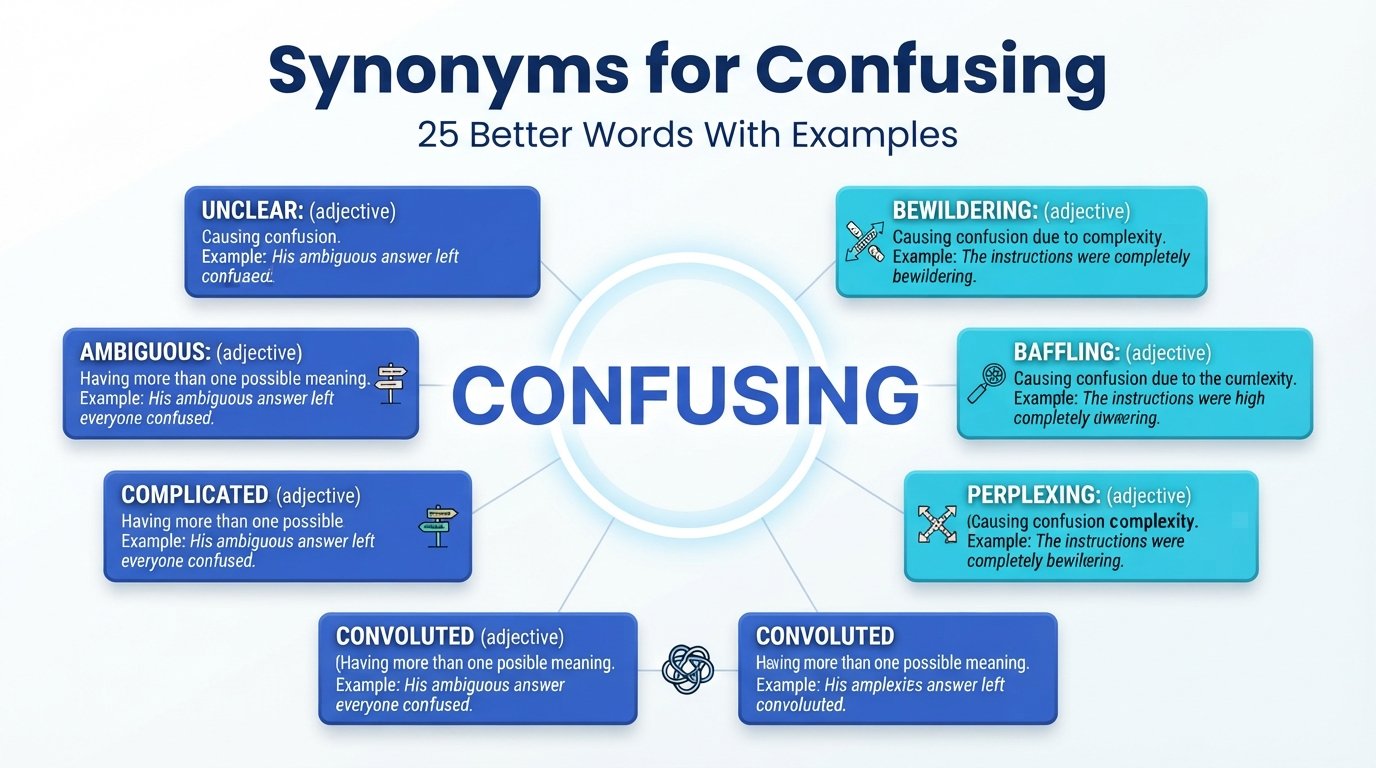
Finding the right synonym for confusing depends on what makes something difficult to understand. A complicated process may be confusing because it has too many parts, while an ambiguous statement may be confusing because it has more than one possible meaning. Other alternatives, such as baffling, perplexing, or misleading, add different shades of meaning.
This guide explains 25 useful synonyms and related alternatives for confusing, with examples and context notes so you can choose a word that fits naturally.
Quick Answer: What Are the Best Synonyms for Confusing?
Some of the closest synonyms for confusing are bewildering, baffling, puzzling, perplexing, mystifying, and confounding. Depending on context, unclear, ambiguous, complicated, convoluted, obscure, and misleading can also work. However, these words are not exact substitutes in every sentence.
For example, baffling suggests that something is difficult to explain, while ambiguous means it can have more than one interpretation. Misleading goes further by suggesting that something creates a wrong or inaccurate impression.
What Does “Confusing” Mean?
Confusing is an adjective describing something that makes it difficult to understand what is happening, what something means, or what someone should do. Cambridge defines it as something that makes you feel confused because it is difficult to understand.
Examples:
- The instructions were confusing.
- The explanation was confusing.
- The map was confusing.
- The new system is confusing for first-time users.
The word can describe information, instructions, situations, explanations, systems, messages, or other things that create uncertainty or difficulty in understanding.
25 Synonyms and Related Alternatives for Confusing
Close Synonyms for Confusing
| Word | Relationship | Meaning | Best Context |
|---|---|---|---|
| Bewildering | Close synonym | Extremely difficult to understand or make sense of | Situations, explanations, events |
| Baffling | Close synonym | Very difficult to understand or explain | Problems, behavior, results |
| Puzzling | Close synonym | Difficult to understand because something seems unusual | Events, behavior, questions |
| Perplexing | Close synonym | Causing uncertainty or difficulty in understanding | Problems, decisions, explanations |
| Mystifying | Close synonym | Difficult to understand or explain | Strange events, behavior, results |
| Confounding | Close synonym | Causing confusion or making something difficult to explain | Problems, evidence, results |
Words for Unclear or Complicated Information
| Word | Relationship | Meaning | Best Context |
|---|---|---|---|
| Unclear | Contextual synonym | Not expressed or presented clearly | Instructions, writing, messages |
| Ambiguous | Contextual synonym | Open to more than one interpretation | Statements, wording, rules |
| Complicated | Contextual synonym | Containing many interconnected or difficult parts | Processes, systems, procedures |
| Complex | Contextual alternative | Having many related parts or factors | Subjects, systems, problems |
| Convoluted | Contextual alternative | Excessively complicated and difficult to follow | Explanations, arguments, processes |
| Obscure | Contextual alternative | Difficult to understand because it is not clear or well known | References, writing, meanings |
| Misleading | Contextual alternative | Giving a wrong or inaccurate impression | Information, headlines, statements |
Stronger Alternatives for Confusion
| Word | Relationship | Meaning | Best Context |
|---|---|---|---|
| Disorienting | Contextual alternative | Making someone lose a clear sense of direction or understanding | Places, experiences, situations |
| Unintelligible | Strong contextual alternative | Impossible or extremely difficult to understand | Speech, writing, audio |
| Incomprehensible | Strong contextual alternative | Impossible or extremely difficult to understand | Ideas, explanations, behavior |
| Opaque | Contextual alternative | Difficult to understand or interpret | Policies, systems, reasoning |
| Vague | Contextual alternative | Lacking precise information or detail | Instructions, descriptions, answers |
| Murky | Contextual alternative | Unclear, uncertain, or difficult to understand | Issues, motives, explanations |
| Non-intuitive | Contextual alternative | Not working in an expected or obvious way | Software, systems, instructions |
Related and Contextual Alternatives
| Word | Relationship | Meaning | Best Context |
|---|---|---|---|
| Labyrinthine | Strong contextual alternative | Extremely complicated, like a maze | Bureaucracy, systems, procedures |
| Intricate | Related/contextual | Having many connected details or parts | Designs, systems, arguments |
| Jumbled | Related/contextual | Mixed together in a disorganized way | Notes, information, ideas |
| Chaotic | Related/contextual | Characterized by extreme disorder or lack of organization | Situations, environments, systems |
| Difficult to follow | Phrase-level alternative | Hard to understand or track from beginning to end | Writing, speech, explanations |
The distinction matters. Collins, for example, lists bewildering, complicated, puzzling, and misleading as synonyms of confusing, while Cambridge groups related alternatives such as baffling, bewildering, puzzling, perplexing, and complicated under the broader idea of difficulty in understanding.
The Closest Synonyms for Confusing
1. Bewildering
Bewildering describes something that leaves people very uncertain about what to think, understand, or do.
Example:
The number of conflicting instructions was bewildering.
Use bewildering when confusion is especially strong or difficult to resolve.
2. Baffling
Baffling means extremely difficult to understand or explain.
Example:
The sudden change in the results was baffling to the researchers.
It works particularly well for unexplained problems, behavior, events, or results.
3. Puzzling
Puzzling describes something that is difficult to understand because it seems strange, unexpected, or contradictory.
Example:
Her sudden decision was puzzling.
Compared with baffling, puzzling can sound somewhat less intense.
4. Perplexing
Perplexing means causing uncertainty because something is difficult to understand or resolve.
Example:
The report presented several perplexing questions.
It is useful in formal, academic, and professional writing.
5. Mystifying
Mystifying emphasizes that something is difficult to explain or understand.
Example:
The software’s sudden error remained mystifying.
It often suggests that the reason behind something is unknown.
6. Confounding
Confounding describes something that creates confusion or makes a situation difficult to explain.
Example:
The conflicting evidence was confounding the investigation.
It is particularly useful for complex problems, evidence, or results.
Contextual Alternatives for Confusing
Not every useful alternative means exactly the same thing. These words become better choices when the source of confusion is specific.
Unclear
Use unclear when information is not expressed or presented clearly.
Example:
The instructions are unclear about where applicants should submit the form.
This is often a more neutral alternative to confusing.
Ambiguous
Use ambiguous when wording or information allows more than one reasonable interpretation.
Example:
The contract contains an ambiguous clause.
An ambiguous statement is not simply difficult; its meaning may genuinely be open to different interpretations.
Complicated
Use complicated when something contains many parts, steps, or relationships that make it difficult to understand or manage.
Example:
The application process is unnecessarily complicated.
Importantly, something can be complicated without being confusing.
Complex
Complex means consisting of many interconnected parts or factors.
Example:
Climate systems are complex.
Unlike confusing, complex does not necessarily have a negative meaning. A complex subject may be difficult but still well explained.
Convoluted
Use convoluted when something is unnecessarily complicated and difficult to follow.
Example:
The lawyer’s explanation was so convoluted that the main point was easy to miss.
This word often carries a critical tone.
Obscure
Obscure can describe information that is difficult to understand because it is unclear, hidden, specialized, or not widely known.
Example:
The article contains several obscure references.
It is especially useful when the problem involves unfamiliar information.
Misleading
Use misleading when something creates an inaccurate or false impression.
Example:
The headline was misleading because it omitted important information.
A misleading statement is different from an ordinary confusing statement because it can lead someone toward an incorrect conclusion.
Stronger Alternatives for Extremely Confusing
Sometimes confusing does not fully express the degree of difficulty.
Unintelligible
Use unintelligible when speech, writing, or sound is impossible or extremely difficult to understand.
Example:
The recording was almost unintelligible because of the background noise.
Incomprehensible
Use incomprehensible when something is extremely difficult or impossible to understand.
Example:
The technical explanation was incomprehensible to most readers.
Labyrinthine
Use labyrinthine for something extremely complicated, especially a system, procedure, or bureaucracy.
Example:
The company’s approval process was labyrinthine.
Opaque
Use opaque figuratively when a system, process, explanation, or decision is difficult to understand.
Example:
The organization’s decision-making process remains opaque.
Confusing vs. Complicated
These words are related, but they are not identical.
Complicated describes something with many difficult or interconnected parts. Confusing focuses on the difficulty of understanding it.
Compare:
- The tax system is complicated.
- The tax instructions are confusing.
The system may have many rules, while the instructions may fail to explain those rules clearly.
Confusing vs. Unclear
Unclear is often the closest neutral alternative when the problem is a lack of clarity.
- The email was unclear about the deadline.
- The email was confusing because it gave two different deadlines.
The first sentence focuses on insufficient clarity. The second emphasizes the confusion created by the conflicting information.
Confusing vs. Ambiguous
Ambiguous has a more specific meaning.
Something is ambiguous when it can reasonably be understood in two or more ways.
Example:
“The manager saw the employee with the glasses” is potentially ambiguous because the wording can support more than one interpretation.
By contrast, something can be confusing without being ambiguous.
Confusing vs. Misleading
These words should not be treated as interchangeable.
Confusing means something makes understanding difficult.
Misleading means something creates an inaccurate or false impression.
Example:
The chart was confusing because it contained too much information.
The chart was misleading because it left out an important category.
The second sentence makes a stronger claim about the information’s effect.
Confusing vs. Complex
A complex idea has many connected parts or factors. A confusing explanation makes the idea difficult to understand.
For example:
Quantum physics is complex.
That does not necessarily mean a particular explanation of quantum physics is confusing.
This distinction is useful in professional and academic writing because calling a subject confusing may criticize its presentation, while complex can simply describe its inherent difficulty.
Best Synonym for Different Contexts
For confusing instructions
Use:
- unclear
- confusing
- complicated
- difficult to follow
Example:
The installation instructions were unclear.
For a confusing explanation
Use:
- unclear
- convoluted
- perplexing
- difficult to follow
Example:
His explanation was convoluted and difficult to follow.
For a confusing situation
Use:
- bewildering
- perplexing
- chaotic
- disorienting
Example:
The sudden change in plans created a bewildering situation.
For confusing information
Use:
- unclear
- ambiguous
- misleading
- contradictory
Example:
The website contains conflicting information about the application deadline.
For a confusing problem
Use:
- baffling
- puzzling
- perplexing
- mystifying
Example:
The unexpected result was baffling.
For confusing writing
Use:
- unclear
- convoluted
- obscure
- difficult to follow
Example:
The report was technically accurate but unnecessarily convoluted.
Common Mistakes When Choosing a Synonym for Confusing
Mistake 1: Treating “complex” as an exact synonym
Complexity does not automatically create confusion.
Better: Use complex when emphasizing many interconnected parts.
Mistake 2: Using “ambiguous” for every unclear statement
Ambiguity specifically involves more than one possible interpretation.
Better: Use unclear when the meaning simply has not been communicated clearly.
Mistake 3: Using “misleading” when something is merely difficult
Misleading suggests that the information gives a wrong impression.
Better: Use confusing or unclear when there is no evidence of misleading information.
Mistake 4: Using “chaotic” for ordinary confusion
Chaotic emphasizes disorder or lack of organization.
Better: Use baffling or perplexing when the main problem is understanding.
Mistake 5: Confusing “confusing” with “confused”
Confusing describes something that causes confusion:
The instructions were confusing.
Confused describes a person or thing experiencing or characterized by confusion:
I was confused by the instructions.
This grammatical distinction is important when replacing the word.
Which Word Should You Use?
Bewildering fits situations where the confusion is strong.
Choose baffling when something is difficult to explain or solve.
Puzzling works when something seems strange or unexpected.
For formal writing, perplexing describes a situation involving difficult uncertainty.
When information lacks clarity, unclear is usually the better choice.
Ambiguous applies when something has multiple possible interpretations.
For situations involving many difficult parts or steps, complicated is appropriate.
Convoluted describes something excessively complicated and difficult to follow.
When information creates a wrong impression, misleading is the more precise term.
Finally, unintelligible describes something that cannot be understood clearly.
FAQ About Synonyms for Confusing
What is the best synonym for confusing?
There is no single best synonym for every context. Bewildering, baffling, puzzling, and perplexing are strong general alternatives. For unclear communication, unclear may be more precise; for multiple interpretations, ambiguous is usually better.
What is a professional word for confusing?
Perplexing, unclear, ambiguous, complicated, and convoluted can work in professional writing, depending on the context. Unclear is often the most neutral choice when describing poorly communicated information.
What is a formal synonym for confusing?
Perplexing, perplexing, ambiguous, convoluted, obscure, and incomprehensible can serve formal purposes in appropriate contexts. The best choice depends on what causes the difficulty.
Is “complicated” the same as “confusing”?
No. Complicated means something has many difficult or interconnected parts, while confusing focuses on the difficulty of understanding it. A complicated subject can be explained clearly.
Is “unclear” a synonym for confusing?
Often, yes, in contexts involving communication or information. However, unclear emphasizes a lack of clarity, while confusing emphasizes the difficulty or uncertainty experienced by the reader or listener.
What is a stronger word than confusing?
Depending on the context, baffling, bewildering, perplexing, incomprehensible, or unintelligible can express a stronger degree of difficulty. They are not interchangeable in every situation.
What is the difference between confusing and ambiguous?
Confusing means difficult to understand. Ambiguous means capable of being understood in more than one way. Something may be confusing without being ambiguous.
What is the difference between confusing and misleading?
Something confusing makes understanding difficult. Something misleading creates an inaccurate impression or can lead someone toward a wrong conclusion.
Conclusion
The best synonym for confusing depends on the exact type of difficulty you want to describe. Bewildering, baffling, puzzling, perplexing, and mystifying are strong choices when something is difficult to understand. For communication problems, unclear may be more precise, while ambiguous fits statements with multiple interpretations and misleading fits information that creates a wrong impression.
Instead of choosing the most complicated-sounding word, choose the alternative that identifies why something is confusing. That small distinction makes your writing clearer, more precise, and more natural.

Sarah Williams is an ESL teacher and content writer with a passion for simplifying English vocabulary. She creates easy-to-understand synonym guides and learning resources that help beginners and intermediate learners build strong language skills.