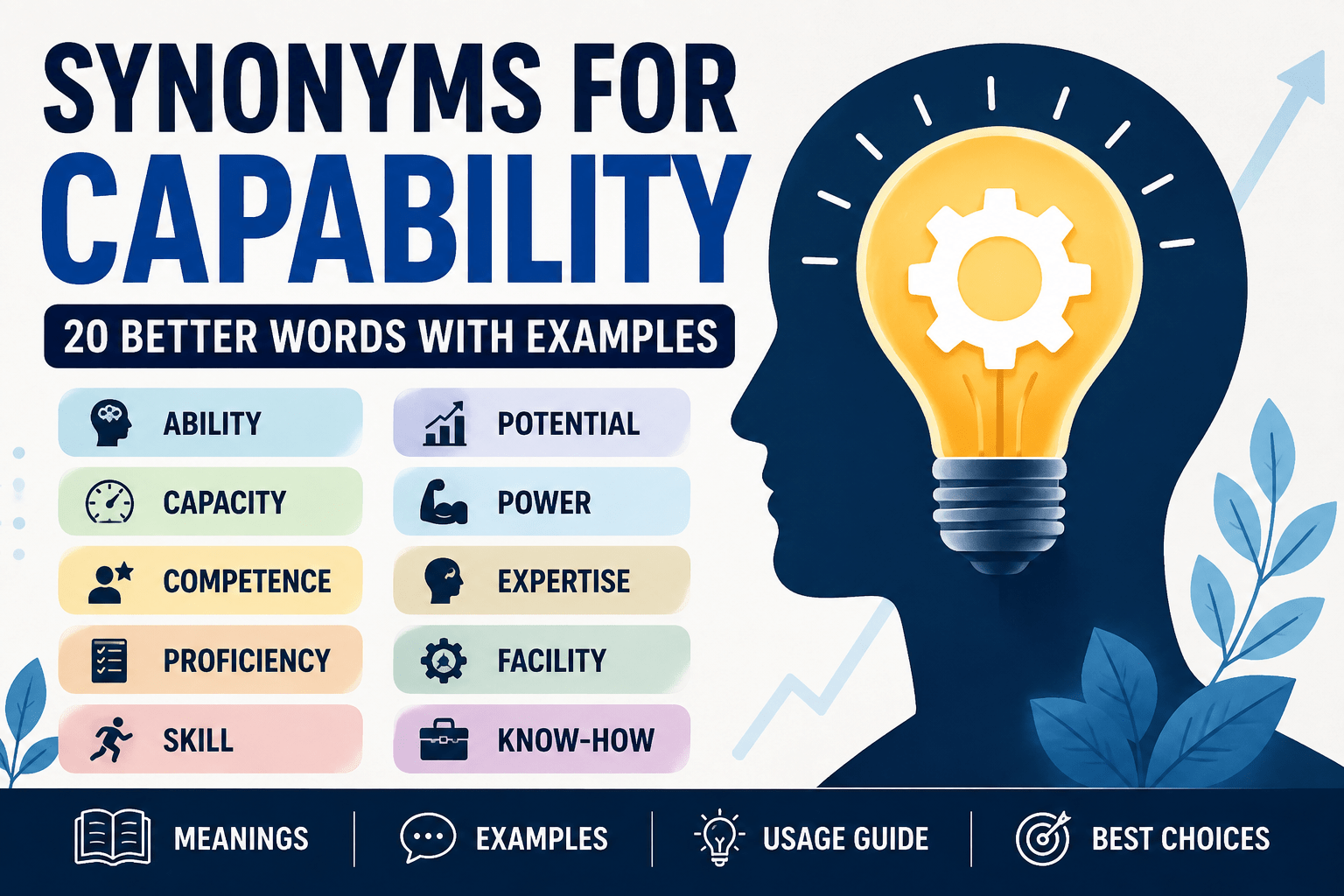
Finding the right synonym for capability is not simply a matter of replacing one word with another. Depending on the sentence, capability can refer to someone’s ability, a team’s competence, a machine’s technical function, an organization’s resources, or unrealized potential. The best alternative therefore depends on what you mean.
The closest general synonyms include ability, capacity, competence, proficiency, power, and potential. Other words such as skill, expertise, talent, aptitude, know-how, and facility work well in particular contexts but introduce slightly different meanings.
Quick Answer: What Are the Best Synonyms for Capability?
The closest synonyms for capability are ability, capacity, competence, and power. Use ability for general power to do something, capacity when emphasizing the amount or extent someone or something can handle, competence for adequate professional ability, and potential when the ability has not yet been fully developed. For technical systems, functionality or feature may sometimes be more precise.
Core Synonyms for Capability
| Word | Relationship | Meaning | Best Context | Formality |
| Ability | Direct synonym | Power or skill to do something | General use | Neutral |
| Capacity | Near synonym | Ability or amount that can be handled | People, systems, organizations | Neutral/Formal |
| Competence | Near synonym | Ability to perform adequately and effectively | Work and professional settings | Formal |
| Power | Near synonym | Ability or force to accomplish something | Physical, political, technical | Neutral |
| Potential | Contextual alternative | Ability that may be developed or realized | People, projects, technology | Neutral |
| Proficiency | Contextual alternative | High level of skill | Languages and specialized skills | Formal |
| Skill | Contextual alternative | Learned ability to perform a task | Work and practical activities | Neutral |
| Facility | Contextual alternative | Ability to do something easily and well | Languages, intellectual tasks | Formal |
| Faculty | Contextual alternative | Natural or developed mental ability | Intellectual or specialized contexts | Formal |
| Means | Contextual alternative | Resources or methods available to accomplish something | Practical/business contexts | Neutral/Formal |
| Know-how | Contextual alternative | Practical knowledge of how to do something | Work and technical contexts | Informal/Neutral |
| Expertise | Related/stronger | Specialized knowledge or skill | Professional fields | Formal |
| Talent | Related/stronger | Natural aptitude or exceptional ability | Creative and personal skills | Neutral |
| Aptitude | Related | Natural ability to learn or perform something | Education and careers | Formal |
| Qualification | Contextual alternative | Credential or condition showing suitability | Employment/professional contexts | Formal |
| Wherewithal | Contextual alternative | Resources or means needed to do something | Financial/practical contexts | Formal |
| Efficacy | Related, not exact | Ability of something to produce a desired result | Medicine, systems, methods | Formal |
| Prowess | Related, stronger | Exceptional skill or ability | Sports, military, specialized performance | Literary/Formal |
| Readiness | Related, context-specific | State of being prepared to act | Organizations and operations | Neutral/Formal |
| Functionality | Contextual alternative | Features or functions a system provides | Software and technology | Technical |
Not every word in this table can replace capability in every sentence. The distinctions are what make these alternatives useful.
What Does “Capability” Mean?
Capability is a noun referring to the ability or qualities necessary to do something. It can describe a person, group, organization, machine, technology, or system. Oxford also recognizes a second important sense involving a country’s military or weapons power.
Merriam-Webster similarly defines capability as the quality or state of being capable and also recognizes senses involving a feature capable of development and the potential or facility for a particular use.
Examples
- She has the capability to lead the team.
- The software has advanced analytical capabilities.
- The company is developing its production capabilities.
- The country has significant military capabilities.
The word is especially common when discussing organizations, technology, systems, professional skills, and potential performance.
1. Ability
Ability is usually the closest and safest synonym for capability.
It means the power, skill, or capacity to do something.
Example
She has the ability to solve complex problems quickly.
Choose “ability” when:
- You want a natural everyday word.
- You are talking about a person’s power to do something.
- You want a simple alternative to capability.
Capability can sound slightly more formal or technical, especially when describing organizations, machines, or systems.
2. Capacity
Capacity overlaps strongly with capability, but it often emphasizes the extent, limit, or amount that someone or something can handle.
Example
The factory has the capacity to produce 10,000 units per month.
Capability vs. capacity
- Capability = what something is able to do.
- Capacity = how much it can handle or how far its ability extends.
For example:
The computer has the capability to process large datasets.
The server has the capacity to store 20 terabytes of data.
Both are correct, but the emphasis changes.
3. Competence
Competence refers to the ability to perform a task effectively and to an acceptable or required standard.
Example
Her technical competence made her an excellent project manager.
This is particularly useful in:
- workplaces
- education
- professional assessments
- management
- qualifications
Choose “competence” when:
The focus is on being capable enough to perform a role successfully.
It is more specific than capability because it often implies demonstrated or adequate performance.
4. Power
Power can mean the ability or force to accomplish something.
Example
The machine has enough power to operate continuously.
The organization has the power to influence policy.
Use power when the emphasis is on force, control, authority, physical strength, or ability to produce an effect.
It is not always interchangeable with capability.
5. Potential
Potential refers to ability or possibility that may be developed or realized.
Example
The young engineer has enormous potential.
Capability vs. potential
This is an important distinction:
- Capability = an ability that exists or is available.
- Potential = an ability that may be developed or realized.
Compare:
The system has the capability to analyze the data.
The system has the potential to become much more efficient.
The first describes an existing capability; the second emphasizes future possibility.
6. Proficiency
Proficiency means a high level of skill or competence in a particular activity.
Example
The position requires proficiency in English.
It works especially well with:
- languages
- software
- technical skills
- professional abilities
- specialized tasks
Proficiency is usually stronger and narrower than capability because it suggests a developed level of skill.
7. Skill
Skill refers to an ability developed through learning, training, or practice.
Example
Her communication skills are among her greatest strengths.
Use skill when talking about a specific learned ability.
For example:
- writing skills
- coding skills
- leadership skills
- communication skills
- technical skills
Capability can include skills, but it is broader.
8. Facility
Facility can mean a natural or developed ability to do something easily and well.
Example
He has a remarkable facility for languages.
This word is more formal and is particularly natural with intellectual, linguistic, artistic, or technical abilities.
Common pattern
a facility for something
For example:
She has a facility for learning new languages.
9. Faculty
Faculty can refer to a natural or developed mental ability or power.
Example
Age can affect a person’s mental faculties.
It can also mean the academic staff of a university, so context matters.
In the sense of ability, it is relatively formal and less common than ability or capacity.
10. Means
Means refers to the resources, methods, or financial ability available for accomplishing something.
Example
The company has the means to expand internationally.
This is not a perfect synonym for capability, but it can work when capability depends on available resources.
Difference
Capability = ability to do something.
Means = resources available to make it possible.
11. Know-how
Know-how means practical knowledge of how to perform a task.
Example
The team has the technical know-how to maintain the system.
It is particularly useful in:
- business
- technology
- manufacturing
- practical work
It is less formal than expertise or proficiency.
12. Expertise
Expertise means specialized knowledge or skill.
Example
Her cybersecurity expertise is highly valued by the company.
Do not treat expertise as an exact synonym for capability. Someone can have the capability to perform a task without being an expert.
Expertise usually implies a high level of specialized knowledge.
13. Talent
Talent refers to a natural aptitude or exceptional ability, particularly in a creative or specialized area.
Example
She has a natural talent for music.
Use talent when emphasizing natural ability rather than general capacity.
14. Aptitude
Aptitude means a natural ability or tendency to learn or perform something.
Example
He showed a strong aptitude for mathematics.
It is particularly common in:
- education
- career testing
- recruitment
- training
Capability vs. aptitude
Capability concerns what someone can do; aptitude often concerns how naturally suited they are to learning or doing something.
15. Qualification
Qualification can sometimes work as a contextual alternative when capability is demonstrated through training, credentials, or professional requirements.
Example
Her qualifications make her suitable for the position.
However, qualification is not a general synonym for capability.
A qualification may demonstrate that someone is capable, but the words have different meanings.
16. Wherewithal
Wherewithal means the money, resources, or means necessary to do something.
Example
The company has the wherewithal to compete with larger firms.
It is more formal and often appears in phrases such as:
the wherewithal to succeed
Use it when capability means having the necessary resources, rather than possessing a skill.
17. Efficacy
Efficacy refers to the ability of something to produce a desired result.
Example
Researchers studied the efficacy of the new treatment.
It is common in:
- medicine
- science
- public policy
- technical writing
It is not a direct synonym for human capability.
18. Prowess
Prowess means exceptional skill or ability.
Example
The athlete is known for his technical prowess.
It is stronger and more expressive than capability.
Use it when you want to emphasize impressive performance.
19. Readiness
Readiness refers to being prepared or equipped to act.
Example
The organization improved its emergency response readiness.
It overlaps with capability when preparation determines whether something can be done, but the words are not interchangeable in every context.
20. Functionality
Functionality refers to the functions or features that a system, device, or piece of software provides.
Example
The latest version adds new functionality.
In technology writing, functionality can sometimes be more precise than capability.
For example:
The software has advanced image-editing capabilities.
The software offers new image-editing functionality.
The first emphasizes what the software can do; the second emphasizes the available functions or features.
Which Word Should You Use Instead of “Capability”?
Use “ability” when:
You mean general power or skill to do something.
She has the ability to manage difficult projects.
Use “capacity” when:
You mean the amount or extent someone or something can handle.
The factory has the capacity to produce 5,000 units.
Use “competence” when:
You mean effective professional performance.
His professional competence is unquestionable.
Use “skill” when:
You mean a learned ability.
Her communication skills are excellent.
Use “proficiency” when:
You mean a high level of developed skill.
He demonstrated proficiency in Python.
Use “potential” when:
You mean an ability that could be developed.
The technology has enormous potential.
Use “expertise” when:
You mean advanced specialized knowledge or skill.
She has expertise in cybersecurity.
Use “know-how” when:
You mean practical knowledge.
The team has the know-how to solve the problem.
Use “means” or “wherewithal” when:
You mean resources available to accomplish something.
They have the means to expand.
Capability vs. Ability
These are the closest general alternatives.
| Feature | Capability | Ability |
| Core meaning | Power or qualities needed to do something | Power or skill to do something |
| People | Yes | Yes |
| Technology | Very common | Possible |
| Organizations | Very common | Common |
| Tone | Neutral/formal | Neutral |
| Future potential | Often possible | Possible |
| Best general replacement | — | Ability |
Cambridge explicitly gives ability as a synonym of capability, while Oxford defines capability as the ability or qualities necessary to do something.
Capability vs. Capacity
These words overlap, but capacity often highlights limits or the amount that can be handled.
The system has the capability to process complex calculations.
The system has the capacity to process one million requests per hour.
In the second sentence, the numerical limit is important.
Capability vs. Competence
Capability is broader.
Competence usually suggests adequate ability to perform a particular task or role effectively.
The company has the capability to enter new markets.
The manager demonstrated strong competence in financial planning.
For professional evaluations, competence can be more precise.
Capability vs. Potential
These words are often confused.
Capability generally points to an ability that is available or possessed.
Potential points toward what may be possible in the future.
The team has the capability to complete the project.
The team has the potential to become a market leader.
Capability vs. Expertise
Expertise implies specialized knowledge and usually a high degree of skill.
The engineer has the capability to repair the system.
The engineer has extensive expertise in robotics.
A person can have the capability without having expert-level knowledge.
Common Capability Collocations
Natural collocations are especially useful when choosing alternatives.
Common expressions include:
- technical capability
- technological capability
- analytical capability
- administrative capability
- production capability
- operational capability
- military capability
- advanced capabilities
- enhanced capabilities
- limited capability
- demonstrate capability
- develop capabilities
- improve capabilities
- build capability
- have the capability to
- capability of doing something
- within someone’s capabilities
- beyond someone’s capabilities
Cambridge’s collocation resources include combinations such as administrative capability, analytical capabilities, system capability, technical capability, and technological capability.
Oxford also records patterns such as capability to do something, capability of doing something, capability for doing something, and within/beyond someone’s capabilities.
Common Mistakes With Capability Synonyms
1. Treating “potential” as an exact synonym
Potential usually concerns an ability that has not been fully realized.
2. Treating “expertise” as identical to capability
Expertise implies specialized knowledge or skill, often at a high level.
3. Using “qualification” to mean ability
A qualification can demonstrate suitability or competence, but it is not itself the same thing as capability.
4. Using “efficacy” for people
Efficacy normally concerns how effectively a method, treatment, system, or intervention produces a desired result.
5. Using “talent” for machines
Talent normally describes a natural ability, especially in people. Capability is much more natural for machines and systems.
6. Assuming “capacity” always means ability
Capacity also commonly means the amount that something can contain, accommodate, or handle.
Antonyms of Capability
The main opposite of capability is inability.
Other contextual opposites include:
- incapability
- incompetence
- inadequacy
- inefficiency
- powerlessness
- ineptitude
The correct antonym depends on the intended meaning.
For example:
His inability to complete the task caused a delay.
But:
The employee’s incompetence became a serious problem.
Inability is neutral; incompetence is more judgmental and specifically suggests insufficient skill or competence.
Cambridge lists inability as the antonym in its core thesaurus treatment, while its broader thesaurus includes incompetence, ineptitude, inadequacy, and related terms.
Pronunciation of Capability
US IPA: /ˌkeɪ.pəˈbɪl.ə.t̬i/
UK IPA: /ˌkeɪ.pəˈbɪl.ə.ti/
The main stress falls on bil:
cap-a-BIL-i-ty
Cambridge and Merriam-Webster provide corresponding pronunciation information for the word.
Word Origin of Capability
Capability comes from the same word family as capable. Merriam-Webster dates the first known use of capability to 1587 and traces the word family through capable to Middle French and Late Latin.
The historical development is consistent with the modern idea of having the qualities or power needed to accomplish something.
Frequently Asked Questions
What is the closest synonym for capability?
Ability is usually the closest general synonym for capability. Capacity, competence, and power can also work depending on the sentence. The best choice depends on whether you are emphasizing general ability, limits, professional performance, or power.
What is a professional synonym for capability?
Competence, proficiency, expertise, or capacity can be appropriate professional alternatives. Choose competence for effective job performance, proficiency for developed skill, and expertise when specialized knowledge is important.
Is ability the same as capability?
They are very close and can often be used interchangeably. However, capability is particularly common when discussing systems, organizations, technical functions, and potential, while ability is a very natural general-purpose word for people and actions.
What is a synonym for technical capability?
Depending on the context, useful alternatives include technical ability, technical capacity, technical competence, technical proficiency, expertise, and technical functionality. The correct choice depends on whether you mean skill, system capacity, expertise, or available features.
What is a synonym for capability at work?
Common professional alternatives include ability, competence, skill, proficiency, expertise, and capacity. For a person’s job performance, competence or skill may be more natural. For an organization’s overall strengths, capability or capacity may be better.
Is potential a synonym for capability?
Potential is a contextual synonym rather than a perfect replacement. Capability generally describes an existing ability or set of qualities, while potential emphasizes an ability that may be developed or realized in the future.
What is the difference between capability and capacity?
Both can mean ability, but capacity often emphasizes the amount, extent, or limit that someone or something can handle. Capability focuses more broadly on what a person, system, or organization is able to do.
Conclusion
The best synonym for capability depends on the exact meaning you want to express. Ability is the safest general replacement, while capacity emphasizes limits or extent and competence focuses on effective performance. Proficiency and expertise are better when developed or advanced skill matters, while potential is appropriate for unrealized future ability.
For professional and technical writing, choosing the right alternative can make a sentence considerably more precise. Instead of simply replacing capability, identify whether you mean ability, skill, capacity, competence, potential, expertise, or available resources—then choose the word that communicates that specific idea.

Sarah Williams is an ESL teacher and content writer with a passion for simplifying English vocabulary. She creates easy-to-understand synonym guides and learning resources that help beginners and intermediate learners build strong language skills.