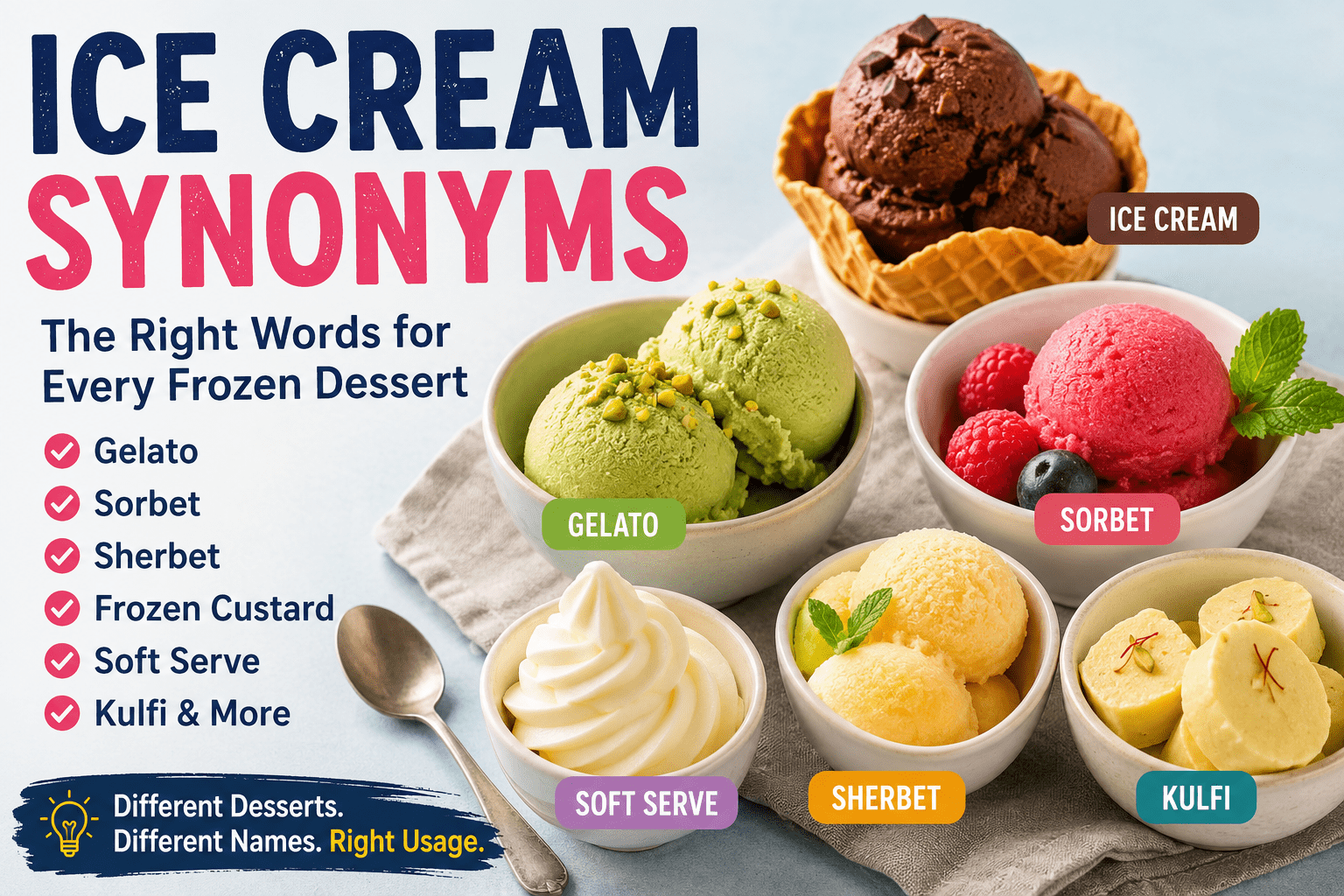
Finding a synonym for ice cream is surprisingly difficult because English does not have many true one-word replacements for this familiar dessert. Words such as gelato, sorbet, sherbet, frozen custard, soft serve, and kulfi are often suggested as alternatives, but they usually describe specific types of frozen desserts rather than meaning exactly the same thing as ice cream.
That distinction matters if you are writing an article, choosing vocabulary, learning English, or trying to avoid repetitive wording. In this guide, we separate genuine alternatives from related terms and explain exactly when each word works. The goal is not to give you a giant thesaurus list—it is to help you choose the most accurate word for your context.
Quick Answer: What Are the Synonyms for Ice Cream?
There are very few exact synonyms for ice cream. Iced cream can function as a rare or alternative form, but in modern everyday American English, ice cream is by far the standard term. Words such as gelato, frozen dessert, sorbet, sherbet, frozen custard, soft serve, and kulfi are better treated as related terms or specific varieties, not exact synonyms.
Ice Cream Synonyms and Related Terms at a Glance
| Word or phrase | Relationship | What it means | Best context |
| Iced cream | Rare alternative | An alternative form of the phrase ice cream | Uncommon or historical usage |
| Frozen dessert | Broad related term | A general category covering many frozen sweet foods | Formal or general descriptions |
| Gelato | Specific type | An Italian-style frozen dessert, usually denser and served slightly warmer | Italian-style desserts |
| Sorbet | Specific type | A frozen dessert generally made from fruit juice or purée rather than dairy | Dairy-free fruit desserts |
| Sherbet | Specific type | A frozen dessert containing fruit and a small amount of dairy | Fruit-based frozen desserts |
| Frozen custard | Specific type | A rich frozen dessert made with dairy and egg yolks | Custard-based desserts |
| Soft serve | Specific type/style | Soft, airy frozen dessert dispensed from a machine | Cones and fast-food settings |
| Kulfi | Specific type | A dense South Asian frozen dairy dessert | South Asian cuisine |
| Semifreddo | Related dessert | A semi-frozen Italian dessert with a softer, mousse-like texture | Italian desserts |
| Dairy dessert | Broad related term | A general category of desserts made with dairy ingredients | Product descriptions |
The key point is simple: most of these are not interchangeable with “ice cream.” They identify particular frozen desserts with different ingredients, textures, preparation methods, or culinary traditions.
What Does “Ice Cream” Mean?
Ice cream is a sweet frozen food typically made from milk or cream, sugar, and flavorings. Cambridge defines it as a very cold, sweet food made from frozen milk, cream, or fruit, with sugar and often a flavor such as vanilla or chocolate.
The term functions primarily as a noun.
Examples:
- We bought chocolate ice cream for dessert.
- She ordered a scoop of vanilla ice cream.
- The children wanted ice cream after dinner.
The standard American pronunciation is approximately /ˈaɪs ˌkriːm/. Cambridge gives the same basic pronunciation for American English and a slightly different stress pattern for British English.
Is “Iced Cream” a Synonym for Ice Cream?
Iced cream is the closest candidate if you specifically need an alternative form of the phrase, but it is not a normal modern replacement in everyday American English.
For most readers, writers, and speakers, ice cream is the natural choice.
For example:
We stopped for ice cream after lunch.
Replacing ice cream with iced cream would sound unusual to most modern American English speakers.
So, if your goal is natural contemporary English, stick with “ice cream.”
The Best Related Words for Ice Cream
Because exact synonyms are limited, the most useful vocabulary comes from words describing different kinds of frozen desserts.
1. Gelato
It is an Italian frozen dessert that resembles ice cream but is not simply another word for it. Unlike traditional ice cream, it generally uses more milk and less cream, creating a denser texture. The dessert is also churned more slowly and is commonly served at a slightly warmer temperature.
Use “gelato” when:
- referring specifically to an Italian-style frozen dessert
- discussing its dense texture
- talking about an Italian gelateria
Example:
We stopped at an Italian café for pistachio gelato.
Ice cream vs. gelato:
Both are frozen desserts, but gelato identifies a particular style rather than serving as a general synonym for ice cream.
2. Frozen Dessert
Frozen dessert is a broader category rather than an exact synonym.
It can refer to different frozen sweet products, including products that resemble ice cream but do not meet a particular legal or compositional definition of ice cream. Recent food coverage also distinguishes frozen dairy desserts from traditional ice cream based on ingredients and formulation.
Use “frozen dessert” when:
- you need a broad category
- discussing several kinds of frozen treats
- writing a product or food-industry description
Example:
The menu offers several frozen desserts, including ice cream and sorbet.
This sentence demonstrates why frozen dessert is broader than ice cream.
3. Sorbet
Sorbet is a fruit-based frozen dessert that generally does not contain dairy.
Example:
She chose raspberry sorbet instead of chocolate ice cream.
Calling sorbet ice cream would be inaccurate because the two desserts differ in composition and culinary identity.
Best choice: Use sorbet when the dessert is specifically a fruit-based frozen treat.
4. Sherbet
Sherbet is another frozen dessert that can resemble sorbet or ice cream, but it has its own identity and typically contains some dairy.
Example:
The restaurant served orange sherbet as a light dessert.
Do not automatically replace ice cream with sherbet. The words refer to different products.
5. Frozen Custard
Frozen custard is a rich frozen dessert made with dairy ingredients and egg yolks. Its egg content gives it a particularly rich and dense character.
Example:
We ordered vanilla frozen custard after dinner.
It is closely related to ice cream but is more specific.
6. Soft Serve
Soft serve describes a soft, machine-dispensed frozen dessert.
It is often associated with cones, fast-food restaurants, and self-serve machines.
Example:
The kids wanted chocolate soft serve.
Because soft serve describes a particular style and texture, it is not a complete synonym for ice cream.
7. Kulfi
Kulfi is a traditional South Asian frozen dairy dessert. It is generally denser than conventional churned ice cream and is commonly flavored with ingredients such as cardamom, pistachio, saffron, or rose.
Example:
We finished the meal with pistachio kulfi.
Use kulfi when referring specifically to this South Asian dessert. Calling it simply ice cream can remove an important cultural and culinary distinction.
8. Semifreddo
Semifreddo is an Italian semi-frozen dessert with a softer, mousse-like texture.
Example:
The restaurant served chocolate semifreddo with berries.
It belongs in the broader family of frozen desserts but is not an exact synonym for ice cream.
9. Dairy Dessert
Dairy dessert is a broad descriptive phrase for a dessert containing dairy ingredients.
It is more general than ice cream and may include several products.
Example:
The manufacturer introduced a new frozen dairy dessert.
This term is particularly useful in technical, commercial, or product-labeling contexts, but it would sound unnatural as a casual substitute for ice cream.
10. Frozen Treat
Frozen treat is an informal descriptive phrase rather than a dictionary-level synonym.
It can refer to ice cream, popsicles, frozen yogurt, sorbet, or other cold desserts.
Example:
We grabbed a frozen treat on the way home.
This works when you want variety or a casual tone, but it does not identify ice cream specifically.
Which Word Should I Use?
The best word depends on what you actually mean.
Choose “ice cream” when:
You mean the familiar frozen dessert made with dairy ingredients, sugar, and flavorings.
I bought chocolate ice cream.
Choose “gelato” when:
You specifically mean the Italian-style frozen dessert.
The gelato was dense and intensely flavored.
Choose “sorbet” when:
You mean a fruit-based frozen dessert without the dairy character of ice cream.
Lemon sorbet is refreshing on a hot day.
Choose “frozen custard” when:
The dessert is specifically custard-based and contains egg yolks.
The shop is famous for its frozen custard.
Choose “soft serve” when:
You mean the soft, machine-dispensed style.
We stopped for soft serve after the game.
Choose “kulfi” when:
You are referring to the traditional South Asian dessert.
The cardamom kulfi was rich and aromatic.
Choose “frozen dessert” when:
You need a broad category that can include several types of frozen sweets.
The restaurant has a large selection of frozen desserts.
Ice Cream vs. Gelato vs. Sorbet
These three terms are often confused because they all describe cold, sweet frozen foods.
| Term | Main distinction | Dairy? | Typical use |
| Ice cream | General frozen dairy dessert | Usually yes | Everyday frozen dessert |
| Gelato | Italian-style, denser frozen dessert | Usually yes | Italian cuisine |
| Sorbet | Fruit-based frozen dessert | Generally no | Fruit flavors and dairy-free options |
The important lesson is that similar does not mean synonymous.
If a sentence specifically refers to an Italian gelato, replacing gelato with ice cream removes useful information. Likewise, calling sorbet ice cream can be factually misleading.
Ice Cream vs. Frozen Dessert
These terms have a broader-versus-narrower relationship.
Ice cream identifies a particular kind of frozen dessert.
Frozen dessert is a broader expression that can include ice cream along with other frozen sweet products.
For example:
The shop sells several frozen desserts, including ice cream, sorbet, and gelato.
Here, frozen desserts works as the category, while ice cream, sorbet, and gelato identify individual types.
This distinction is especially useful in formal food writing and product descriptions. Some products may be labeled frozen dairy dessert rather than ice cream because their formulation differs from the standards associated with the term ice cream.
Common Mistakes With Ice Cream Synonyms
Mistake 1: Treating every frozen dessert as ice cream
Gelato, sorbet, sherbet, kulfi, and semifreddo are related to ice cream, but they are not interchangeable terms.
Mistake 2: Using “cream” as a synonym
Cream is an ingredient and also has several unrelated meanings. It is not a synonym for ice cream.
Incorrect:
I ordered a bowl of cream.
Better:
I ordered a bowl of ice cream.
Mistake 3: Assuming “frozen dessert” means exactly “ice cream”
Frozen dessert is broader. It can include multiple types of frozen sweets.
Mistake 4: Calling sorbet ice cream
Sorbet has a different composition and culinary identity. If the product is sorbet, call it sorbet.
Mistake 5: Using “gelato” simply to sound sophisticated
Gelato is not merely a fancy word for ice cream. It identifies a particular Italian-style dessert with characteristic preparation and texture.
Are There Any True Synonyms for Ice Cream?
Very few.
Iced cream is the closest lexical alternative, but it is uncommon in modern everyday American English. For natural contemporary writing, ice cream remains the preferred expression.
Most words appearing in synonym lists are better classified as related terms, specific varieties, or broader categories.
That distinction is important because a good synonym resource should help readers make accurate vocabulary choices rather than simply produce a long list of vaguely related words.
Frequently Asked Questions
What is another word for ice cream?
There is no widely used perfect one-word synonym for ice cream in modern American English. Iced cream is an uncommon alternative form. In most contexts, words such as gelato, sorbet, and frozen custard describe specific types of frozen desserts rather than true synonyms.
Is gelato a synonym for ice cream?
No. Gelato and ice cream are closely related frozen desserts, but gelato specifically refers to an Italian-style frozen dessert. It generally has a denser texture and is made and served differently from conventional ice cream.
Is frozen dessert another word for ice cream?
Not exactly. Frozen dessert is a broader category that can include ice cream and other frozen sweets. Therefore, it can sometimes describe ice cream, but it is not an exact synonym.
What is a formal word for ice cream?
There is no particularly formal replacement that naturally means exactly ice cream. Frozen dessert is more technical or general, especially in product and food-industry contexts, but it has a broader meaning.
Is sorbet the same as ice cream?
No. Sorbet is a distinct frozen dessert, generally fruit-based and without the dairy character of traditional ice cream. It should not normally be used as a synonym for ice cream.
What is the difference between ice cream and frozen custard?
Frozen custard is a specific type of frozen dessert that includes egg yolks, giving it a rich and dense character. Ice cream does not necessarily contain egg yolks in the same way.
What are some words related to ice cream?
Useful related vocabulary includes gelato, sorbet, sherbet, frozen custard, soft serve, kulfi, semifreddo, frozen dessert, dairy dessert, cone, scoop, sundae, and topping. These words are related to ice cream but should not all be treated as synonyms.
Conclusion
The best answer to “What are the synonyms for ice cream?” is actually more nuanced than a typical thesaurus list suggests. Modern English has very few genuine alternatives to ice cream. Iced cream is possible but uncommon, while gelato, sorbet, sherbet, frozen custard, soft serve, kulfi, semifreddo, and frozen dessert are better understood as specific varieties or related terms.
For everyday American English, the safest and most natural choice is simply ice cream. When precision matters, choose the specific term that describes the dessert you actually mean. That approach produces better writing than replacing a familiar word with a technically related—but inaccurate—alternative.

Sarah Williams is an ESL teacher and content writer with a passion for simplifying English vocabulary. She creates easy-to-understand synonym guides and learning resources that help beginners and intermediate learners build strong language skills.