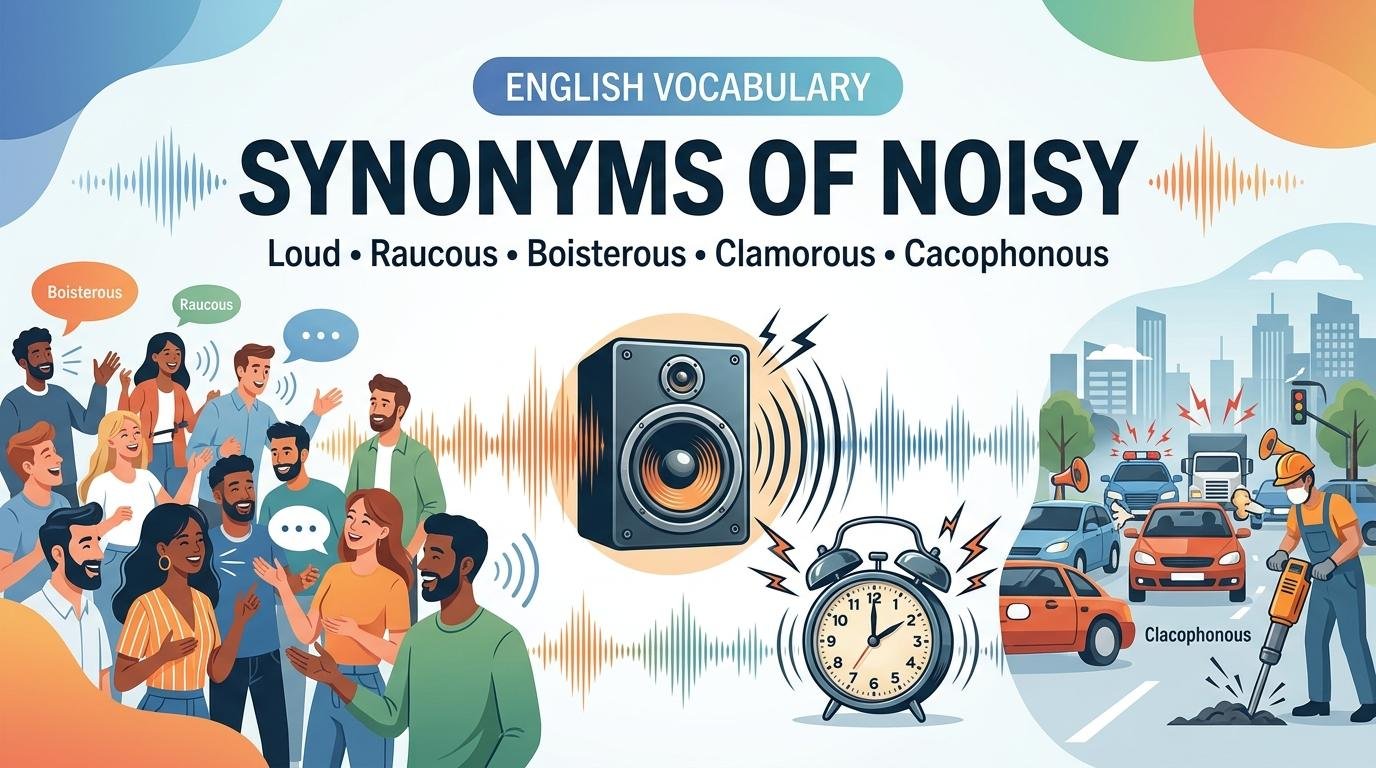
If you need a better word than noisy, the right choice depends on what kind of noise you mean. Loud is the simplest everyday alternative, while boisterous suggests energetic or rowdy activity, raucous emphasizes a harsh sound, clamorous suggests sustained or insistent noise, and deafening emphasizes extreme volume. Words such as strident, cacophonous, and vociferous add still more specific nuances.
The key is not to replace noisy with the most impressive-looking thesaurus word. Choose the word that describes the type, intensity, source, or character of the noise most accurately.
Quick Answer
The closest and most useful synonyms of noisy include loud, boisterous, clamorous, raucous, vociferous, strident, cacophonous, deafening, uproarious, and rowdy. Loud is the safest general replacement. Use boisterous for energetic people or crowds, raucous for harsh sounds, clamorous for loud and insistent noise, and deafening for extremely loud sounds.
What Does “Noisy” Mean?
Noisy is an adjective meaning making a lot of noise or being full of noise. It commonly describes people, crowds, places, machines, vehicles, music, protests, and environments.
For example:
- a noisy classroom
- a noisy crowd
- a noisy engine
- noisy neighbors
- a noisy street
Oxford gives examples involving children, traffic, crowds, protests, classrooms, offices, and streets, reflecting how broadly noisy is used in everyday English.
The word can also have specialized meanings. In electronics, a noisy signal contains unwanted variation, while in data-related contexts, noisy data contains information or variation that may be irrelevant or difficult to interpret.
There is also a less common figurative sense in which noisy means conspicuously showy or attention-grabbing, as in a noisy pattern.
Pronunciation
- US: /ˈnɔɪ.zi/
- UK: /ˈnɔɪ.zi/
The pronunciation is the same in the Cambridge entries for British and American English.
The Best Synonyms of Noisy at a Glance
Not every word in a thesaurus is a true substitute for noisy. The table below separates close alternatives from words that add a particular nuance.
| Word | Relationship | Strength | Formality | Best Context |
|---|---|---|---|---|
| Loud | Direct / very close | Moderate | Neutral | Everyday sound |
| Boisterous | Near synonym | Strong | Neutral | Lively people or crowds |
| Clamorous | Near synonym | Strong | Formal | Insistent, sustained noise |
| Raucous | Near synonym | Strong | Neutral | Harsh, rough sounds |
| Vociferous | Contextual alternative | Strong | Formal | Loud speech, protest, opinions |
| Strident | Contextual alternative | Strong | Formal | Harsh, piercing voices or sounds |
| Cacophonous | Contextual alternative | Very strong | Formal | Discordant mixture of sounds |
| Deafening | Contextual alternative | Very strong | Neutral | Extremely loud sound |
| Uproarious | Near synonym | Strong | Neutral | Very lively, noisy activity |
| Rowdy | Contextual alternative | Strong | Neutral | Disorderly, noisy people |
| Obstreperous | Contextual alternative | Strong | Formal | Noisy, unruly resistance |
| Tumultuous | Contextual alternative | Strong | Formal | Confused, turbulent noise or activity |
| Piercing | Contextual alternative | Strong | Neutral | Sharp, penetrating sounds |
| Ear-splitting | Contextual alternative | Very strong | Informal | Extremely loud sounds |
| Blaring | Contextual alternative | Strong | Neutral | Radios, horns, speakers, alarms |
Collins and Merriam-Webster both group many of these words with noisy, but their definitions show important differences in meaning and usage.
Closest Synonyms of Noisy
1. Loud
Meaning: Producing a sound at a high volume.
How it differs: Loud is the closest everyday alternative to noisy, but the two are not identical. Something can be loud without creating the broader sense of a noisy environment.
Best used for: Sounds, music, voices, machines, alarms, vehicles, and individual noises.
Example:
The music was too loud for such a small room.
Best choice when: You simply mean high volume.
2. Boisterous
Meaning: Noisy, energetic, and often lively or rowdy.
How it differs: Boisterous usually describes people, groups, behavior, laughter, or activity, rather than a machine making an unwanted sound.
Example:
A boisterous crowd gathered outside the stadium.
The word can suggest high spirits rather than purely unpleasant noise. Merriam-Webster notes that boisterous particularly suggests noisiness and turbulence caused by high spirits.
3. Clamorous
Meaning: Very noisy, often with an element of insistence or demand.
How it differs: Clamorous is especially useful when people are loudly calling for something, protesting, demanding, or competing to be heard.
Example:
The protesters made clamorous demands for reform.
Merriam-Webster distinguishes clamorous from boisterous by emphasizing insistency as well as loudness.
4. Raucous
Meaning: Loud, harsh, and often rough or unpleasant to hear.
How it differs: Raucous focuses more on the quality of the sound than merely its volume.
Example:
The bar erupted in raucous laughter.
Use raucous for shouting, laughter, voices, celebrations, crowds, or music when the sound is rough and uncontrolled.
5. Vociferous
Meaning: Loud and forceful, especially in expressing an opinion or protest.
How it differs: Vociferous is strongly associated with people speaking, arguing, complaining, demanding, or protesting loudly.
Example:
Several residents were vociferous in their opposition to the proposal.
Cambridge specifically lists vociferous in contexts involving loud voices and people demanding to be heard.
6. Strident
Meaning: Loud, harsh, and piercing or unpleasant.
How it differs: Strident emphasizes a sound’s harsh, grating, or discordant quality, especially a voice.
Example:
Her strident voice carried across the meeting room.
It is more precise than noisy when you want to describe a sound that is difficult or unpleasant to listen to.
7. Cacophonous
Meaning: Characterized by a confusing mixture of loud, discordant sounds.
How it differs: This is not simply “very noisy.” It suggests that multiple sounds clash together without harmony.
Example:
The station was filled with a cacophonous mixture of announcements, horns, and shouting.
Use it in formal, descriptive, literary, or analytical writing.
8. Deafening
Meaning: So loud that it is overwhelming or potentially painful to the ears.
How it differs: Deafening is about extreme intensity, not just the presence of noise.
Example:
The deafening roar of the engines shook the building.
9. Uproarious
Meaning: Extremely lively, noisy, or full of laughter and excitement.
How it differs: It often carries a positive or entertaining tone.
Example:
The audience gave an uproarious response to the comedian.
It is therefore not always a good substitute for noisy. A room can be noisy without being uproarious.
10. Rowdy
Meaning: Noisy, disorderly, and difficult to control.
How it differs: Rowdy describes behavior, particularly that of people or groups. It adds a sense of unruliness.
Example:
The hotel received complaints about a rowdy group of guests.
More Context-Specific Alternatives
Some words overlap with noisy but should not be treated as universal synonyms.
Obstreperous
Use obstreperous when someone is not merely noisy but also unruly, resistant, or difficult to control.
The obstreperous customer refused to leave the store.
Tumultuous
Use tumultuous when noise is part of a confused, turbulent, or highly agitated situation.
The announcement was followed by tumultuous applause.
Piercing
Use piercing for a sound that is sharp and penetrating.
A piercing whistle broke the silence.
Ear-splitting
Use ear-splitting when emphasizing extreme volume, especially in informal writing.
The concert ended with an ear-splitting blast of music.
Blaring
Use blaring for something producing a loud, forceful sound, particularly horns, alarms, televisions, radios, or speakers.
A blaring car horn woke the entire street.
Noisy vs. Loud: What Is the Difference?
Noisy and loud overlap, but they focus on slightly different ideas.
| Word | Main emphasis | Example |
|---|---|---|
| Noisy | A lot of unwanted or noticeable noise | The office is noisy. |
| Loud | High volume | The music is loud. |
| Deafening | Extremely high volume | The explosion was deafening. |
| Raucous | Harsh, rough sound | They gave a raucous cheer. |
| Cacophonous | Clashing mixture of sounds | The street was cacophonous. |
A useful rule is:
Loud = volume; noisy = an environment or situation characterized by noise.
That distinction is not absolute, but it is a useful guide for natural word choice.
Noisy vs. Boisterous vs. Raucous
These three are easily confused.
Use noisy
When you simply want to say that there is a lot of noise.
The children were noisy.
Use boisterous
When the people are noisy and energetic or high-spirited.
The children were boisterous after the game.
Use raucous
When the noise is loud, rough, harsh, or uncontrolled.
The fans became raucous after the final goal.
The choice therefore changes the picture the reader gets: noisy is neutral, boisterous emphasizes lively behavior, and raucous emphasizes rough sound.
Noisy vs. Vociferous
Vociferous is narrower than noisy.
You can describe:
- a noisy classroom
- a noisy engine
- a noisy street
But vociferous is most natural for people expressing themselves loudly:
vociferous critics
vociferous protesters
vociferous opposition
vociferous complaints
So:
❌ a vociferous washing machine
would normally sound unnatural.
✓ a vociferous protest
is natural.
Cambridge lists vociferous in both loud-voice contexts and contexts involving forceful demands or opinions.
Which Word Should I Use?
Choose according to the meaning you want:
- General noise: noisy
- High volume: loud
- Extremely loud: deafening
- Loud and energetic people: boisterous
- Loud and rough sound: raucous
- Loud and insistent demands: clamorous
- Loudly expressing opinions: vociferous
- Harsh or piercing voice/sound: strident
- Many discordant sounds together: cacophonous
- Lively and noisy celebration: uproarious
- Disorderly noisy people: rowdy
- Very loud informal expression: ear-splitting
- Loud horns, alarms, or speakers: blaring
Common Collocations with “Noisy”
Some combinations are particularly natural:
- noisy neighbors
- noisy children
- noisy crowd
- noisy classroom
- noisy office
- noisy environment
- noisy street
- noisy traffic
- noisy engine
- noisy machine
- noisy party
- noisy protest
Oxford specifically illustrates noisy with children, traffic, crowds, protests, classrooms, offices, streets, and engines.
Different synonyms fit different collocations:
| Original phrase | Better alternative when appropriate |
|---|---|
| noisy crowd | boisterous / raucous crowd |
| noisy protest | clamorous / vociferous protest |
| noisy voice | strident / raucous voice |
| noisy engine | loud / deafening engine |
| noisy music | loud / blaring music |
| noisy environment | loud / cacophonous environment |
| noisy children | boisterous children |
| noisy party | uproarious / rowdy party |
Common Mistakes When Choosing a Synonym
1. Treating every synonym as interchangeable
A thesaurus relationship does not mean two words work in every sentence.
Noisy can describe an engine, but vociferous normally cannot.
2. Using “deafening” simply to mean “noisy”
Deafening is much stronger. It suggests an overwhelming level of sound.
The classroom was noisy. ✓
The classroom was deafening. — possible, but much more dramatic
3. Using “boisterous” for machines
Boisterous usually describes people, groups, behavior, laughter, or activity.
a boisterous crowd ✓
a boisterous engine ✗
4. Using “cacophonous” for any loud sound
Cacophonous implies discordant or clashing sounds, not simply high volume.
5. Confusing “noisy” with “noisome”
These words look related but have different meanings. Noisy concerns sound; noisome usually means harmful, offensive, or unpleasant, especially in relation to smell.
Antonyms of Noisy
Depending on the context, useful opposites include:
- quiet
- silent
- hushed
- peaceful
- calm
- still
- tranquil
- soundless
- noiseless
- subdued
The best antonym depends on what noisy describes. For an environment, quiet or peaceful is often most natural; for the absence of sound itself, silent or soundless may be better.
FAQ
What is the closest synonym for noisy?
Loud is generally the closest everyday synonym. However, loud emphasizes volume, while noisy can describe an environment or situation containing a lot of noise.
What is another word for a very noisy place?
Depending on the type of noise, use cacophonous, deafening, clamorous, or simply loud. Cacophonous is especially appropriate when many discordant sounds overlap.
What is a strong synonym for noisy?
Deafening is strong when you mean extremely loud. Raucous, clamorous, and cacophonous are strong choices when you want to emphasize the character of the noise rather than volume alone.
What is a formal synonym for noisy?
Clamorous, vociferous, strident, cacophonous, and obstreperous can work in formal writing, depending on context. They are not interchangeable.
What is a synonym for noisy people?
For people, boisterous, rowdy, uproarious, or obstreperous may be appropriate, depending on whether you mean lively, disorderly, cheerful, or difficult behavior.
What is the difference between noisy and loud?
Loud primarily describes high volume, while noisy describes something characterized by a lot of noise. They overlap substantially, but noisy is often more natural for environments such as a noisy office.
What is the difference between noisy and raucous?
Noisy is general. Raucous adds the idea of a loud, harsh, rough, or rowdy sound. A crowd can be noisy without necessarily being raucous.
Can “noisy” describe data or signals?
Yes. In technical contexts, noisy signal can refer to an unwanted change or interference in an electronic signal, while noisy data can contain unexplained, unexpected, or irrelevant information.
Conclusion
The best synonym for noisy depends on what you want to emphasize. Loud is the safest general alternative; boisterous suits lively people or crowds; raucous describes harsh or rough sound; clamorous suggests loud, insistent noise; vociferous works especially well for forceful speech or protest; and deafening emphasizes extreme volume.
For precise writing, don’t simply replace noisy with a more complicated word. Identify the kind of noise first, then choose the synonym that expresses that specific idea.

Michael Thompson is an English language specialist and experienced editor who focuses on vocabulary development and clear communication. He creates high-quality synonym guides, word comparisons, and writing tips to help students and professionals express their ideas more effectively. His work combines linguistic knowledge with practical SEO strategies to make learning both useful and engaging.