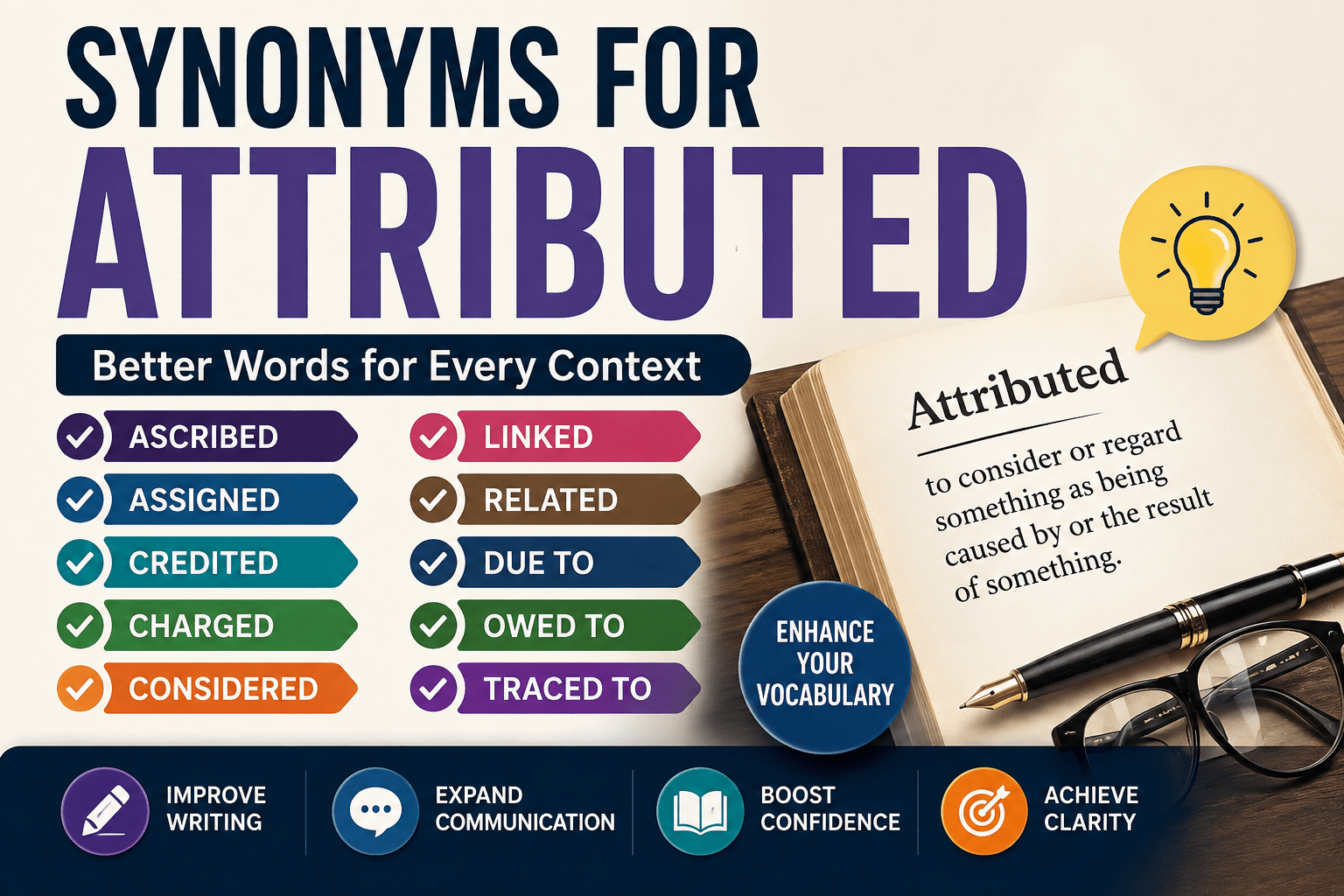
When you need a synonym for attributed, the best replacement depends on what you mean. In phrases such as “attributed to hard work,” “attributed to the author,” or “attributed to climate change,” strong alternatives include ascribed, credited, assigned, imputed, linked to, traced to, and ascribed to. However, these words are not completely interchangeable: some emphasize cause, some authorship, and others responsibility or blame.
Quick Answer
The closest synonyms for attributed are ascribed, credited, assigned, imputed, linked to, traced to, and connected with. Ascribed is often the closest general substitute, while credited works especially well when recognizing a person as the source of an achievement or work. Imputed usually suggests blame or responsibility, and traced to emphasizes identifying an origin or cause.
What Does “Attributed” Mean?
Attributed is the past participle of the verb attribute. In the common construction “attribute something to someone or something,” it means to regard something as being caused by, produced by, originating from, or belonging to a particular source. Cambridge defines attribute as saying or thinking that something results from a particular thing, or saying that a particular person was the first to say, do, or invent something.
For example:
The company’s rapid growth was attributed to strong customer demand.
Here, attributed to means that strong customer demand was regarded as the reason for the growth.
The word can also concern authorship:
The painting was attributed to a 17th-century Dutch artist.
In this use, the phrase indicates that the artist was regarded as the creator or source, sometimes without absolute certainty.
Merriam-Webster similarly distinguishes between attributing something to a cause and regarding something as made or originated by a particular person or source.
The Best Synonyms for “Attributed”
| Word or phrase | Relationship | Strength | Formality | Best context |
|---|---|---|---|---|
| Ascribed | Direct / near synonym | Similar | Formal | Causes, qualities, authorship |
| Credited | Near synonym | Similar | Neutral–formal | Achievements, sources, people |
| Assigned | Near synonym | Similar | Formal | Causes, responsibility, classifications |
| Imputed | Near synonym | Strong nuance | Formal | Blame, motives, responsibility |
| Traced to | Contextual alternative | Similar | Neutral–formal | Origins and causes |
| Linked to | Contextual alternative | Weaker | Neutral | Associations and possible causes |
| Connected to | Contextual alternative | Weaker | Neutral | General relationships |
| Related to | Contextual alternative | Weaker | Neutral | Broad associations |
| Laid to | Contextual alternative | Similar | Neutral | Causes, especially problems |
| Put down to | Contextual alternative | Similar | Informal | Everyday explanations |
| Blamed on | Contextual alternative | Stronger | Neutral | Negative causes or responsibility |
| Accounted for by | Contextual alternative | Similar | Formal | Explanations and causes |
| Originated from | Contextual alternative | More specific | Neutral | Sources and origins |
| Derived from | Contextual alternative | More specific | Formal | Origins, sources, concepts |
| Credited to | Contextual alternative | Similar | Neutral–formal | Authorship and achievements |
The most important distinction is that these are not all interchangeable in every sentence. Attributed is broad, whereas words such as credited and imputed carry more specific implications.
1. Ascribed
Ascribed is usually the closest formal synonym for attributed.
Meaning: To regard something as being caused by, belonging to, or originating from a particular person or thing.
Best used for: Causes, characteristics, qualities, authorship, and explanations.
Example:
The decline in sales was ascribed to changing consumer preferences.
Attributed and ascribed are often interchangeable, but ascribe can sound slightly more formal or analytical.
Merriam-Webster notes that ascribe can suggest inferring or conjecturing a cause, quality, or authorship, while attribute generally suggests somewhat less tentativeness.
2. Credited
Credited is an excellent alternative when attributed concerns recognition of a person as the source of an achievement, idea, discovery, or work.
The breakthrough was credited to the research team.
The novel is credited to an unknown author.
However, credited is not always a perfect substitute.
Compare:
Her success was attributed to years of preparation.
Her success was credited to years of preparation.
The first simply identifies the perceived cause. The second can sound more like recognition or acknowledgment.
Merriam-Webster specifically distinguishes credit as assigning something, particularly an action, to a person or other source as its agent, source, or explanation.
3. Assigned
Assigned can replace attributed when something is deliberately allocated to a person, category, cause, period, or source.
The artifact was assigned to the Roman period.
The responsibility was assigned to the project manager.
It is usually more definite than attributed. Attributed can indicate an interpretation or judgment, whereas assigned often suggests a deliberate classification or decision.
Merriam-Webster describes assign as implying attribution with certainty or after deliberation.
4. Imputed
Imputed is a formal alternative that often carries a negative implication.
The report imputed the company’s losses to poor management.
The critic imputed selfish motives to the politician.
It is especially useful when something such as blame, responsibility, motive, or fault is assigned to someone.
Because of this negative or accusatory nuance, imputed should not automatically replace attributed.
Attributed: neutral
Imputed: often suggests blame, fault, or an inferred negative quality
5. Traced To
Traced to is particularly natural when discussing an origin, source, cause, or historical development.
The tradition can be traced to ancient Greece.
The contamination was traced to a faulty valve.
This phrase often implies investigation or evidence used to identify where something originated.
It is therefore especially useful in:
- research
- history
- science
- journalism
- technical writing
6. Linked To
Linked to is a useful alternative when the relationship is an association rather than a firmly established cause.
The condition has been linked to environmental factors.
The decline was linked to rising costs.
This distinction matters. Attributed to can present something as the explanation for an outcome, whereas linked to can be more cautious.
For academic and scientific writing, linked to may therefore be preferable when the evidence demonstrates an association but does not establish direct causation.
7. Connected To
Connected to is broader and more neutral than attributed to.
The incident was connected to a series of earlier events.
It describes a relationship but does not necessarily identify one thing as the cause of another.
Use it when you want to emphasize relationship or association, rather than direct causation.
8. Related To
Related to is another broad alternative.
The symptoms were related to changes in diet.
It is useful when the exact causal relationship is uncertain or when the relationship itself matters more than identifying a specific cause.
Because it is broader, it is usually not a precise replacement for attributed to.
9. Laid To
Laid to is a natural phrase for assigning a cause, especially when discussing an undesirable result.
The delay was laid to heavy traffic.
The failure was laid to poor planning.
It is less common and less versatile than attributed to, particularly in formal academic prose.
10. Put Down To
Put down to is an informal alternative, especially common in British English.
She put the mistake down to exhaustion.
He put the delay down to bad weather.
It works naturally in conversation but is generally less suitable than attributed to in formal academic or professional writing.
11. Blamed On
Blamed on is stronger and more negative than attributed to.
The accident was blamed on poor maintenance.
Unlike attributed, blamed explicitly suggests fault or responsibility.
Therefore:
- Use attributed to for neutral explanation.
- Use blamed on when fault is being assigned.
12. Accounted for By
Accounted for by is a formal alternative when explaining why something happened.
The increase in demand was accounted for by population growth.
It is particularly useful in analytical and academic writing, although it can sound more technical than attributed to.
13. Originated From
Originated from focuses specifically on the source or beginning of something.
The concept originated from an earlier philosophical tradition.
It is not a universal synonym for attributed, because attribution can concern causes, authorship, qualities, or responsibility rather than literal origin.
14. Derived From
Derived from means that something developed or was obtained from a particular source.
The term is derived from an ancient Greek word.
This is useful for:
- words
- concepts
- materials
- theories
- products
- ideas
It should not replace attributed to when the intended meaning is simply “regarded as being caused by.”
15. Credited To
Credited to deserves separate attention because it is especially common when identifying the person responsible for an achievement, idea, or creation.
The discovery is credited to the research team.
The quote is credited to Mark Twain.
The phrase emphasizes recognition of a source or creator rather than merely identifying a cause.
Closest Synonyms for “Attributed To”
If you need a quick replacement for attributed to, use this guide:
| If you mean… | Best alternative |
|---|---|
| A cause is regarded as responsible | ascribed to |
| A person receives recognition | credited to |
| Something is deliberately classified | assigned to |
| Blame or motive is assigned | imputed to |
| An origin has been discovered | traced to |
| A possible association is identified | linked to |
| A general relationship exists | connected to / related to |
| A negative cause is assigned | blamed on |
| An explanation is being given | accounted for by |
| An origin or source is emphasized | derived from / originated from |
Attributed vs. Ascribed vs. Credited
These three words are particularly easy to confuse.
Attributed
Use attributed as the broad, neutral choice for assigning a cause, source, or authorship.
The improvement was attributed to better training.
Ascribed
Use ascribed when you want a formal alternative, especially when discussing a perceived cause, quality, or authorship.
The improvement was ascribed to better training.
Credited
Use credited when emphasizing recognition of a person or source.
The improvement was credited to the new training program.
Simple rule:
Attributed is the broadest choice; ascribed is a close formal alternative; credited emphasizes recognition.
Attributed vs. Assigned
These words overlap, but they are not identical.
Attributed often describes a conclusion about a cause or source:
The decline was attributed to inflation.
Assigned more strongly suggests a deliberate classification or allocation:
The artifact was assigned to the fourth century.
In other words, attribute can describe an interpretation, while assign often suggests a decision or classification.
Attributed vs. Imputed
The difference is mainly one of connotation.
The behavior was attributed to stress.
This is relatively neutral.
The behavior was imputed to malicious intent.
This sounds more accusatory and suggests that a motive or responsibility has been assigned.
Use imputed carefully because it can imply blame or an unfavorable judgment.
Attributed vs. Linked
These terms can differ in how strongly they express causation.
The increase was attributed to higher demand.
This presents higher demand as the explanation.
The increase was linked to higher demand.
This emphasizes an association and may sound more cautious.
For evidence-based writing, choose the wording that accurately reflects the strength of the evidence.
Which Word Should I Use?
Use ascribed when:
You want the closest formal alternative to attributed.
Use credited when:
You are recognizing a person, group, author, or source.
Use assigned when:
Something has been deliberately classified or allocated.
Use imputed when:
You are assigning blame, responsibility, or motive.
Use traced to when:
You are identifying an origin or source through investigation.
Use linked to when:
You want to express an association without necessarily asserting direct causation.
Use blamed on when:
You explicitly mean that someone or something is considered responsible for a negative result.
Use put down to when:
You are writing informally or conversationally.
Common Collocations With “Attributed”
Some of the most natural constructions include:
- attributed to hard work
- attributed to poor management
- attributed to climate change
- attributed to several factors
- attributed to human error
- attributed to the author
- attributed to the artist
- attributed to a particular cause
- attributed to increased demand
- attributed to changes in behavior
Examples:
The company’s success was attributed to strong leadership.
The painting was attributed to a Dutch master.
The decline was attributed to several economic factors.
The error was attributed to human oversight.
Notice that the most natural replacement changes according to context. Credited to works especially well for achievements or authorship, while traced to is stronger when identifying an origin.
Common Mistakes With “Attributed”
1. Treating Every Related Word as an Exact Synonym
Words such as related, connected, and linked describe relationships but do not always express the same degree of causation as attributed.
Choose the word according to the evidence and intended meaning.
2. Using “Credited” for Every Cause
Credited often carries a positive or recognition-oriented sense.
The award was credited to the designer.
This sounds natural.
But when discussing an undesirable event:
The accident was attributed to mechanical failure.
Here, attributed is generally more neutral.
3. Using “Blamed” When You Mean “Attributed”
These words differ in tone.
The success was attributed to careful planning.
The success was blamed on careful planning.
The second sentence is inappropriate because blamed normally introduces something considered responsible for a negative outcome.
4. Confusing “Attributed” With “Attributable”
Attributed means that something has been assigned to a cause or source:
The result was attributed to better preparation.
Attributable means capable of being regarded as caused by something:
The improvement was attributable to better preparation.
The grammatical structures are different, so they should not be substituted mechanically.
Examples in Different Contexts
Academic Writing
The change in test performance was attributed to improved study methods.
Possible alternative:
The change in test performance was ascribed to improved study methods.
Business Writing
The increase in revenue was attributed to stronger customer demand.
Possible alternative:
The increase in revenue was linked to stronger customer demand.
Historical Writing
The manuscript was attributed to an unknown Renaissance writer.
Possible alternative:
The manuscript was ascribed to an unknown Renaissance writer.
Journalism
The disruption was attributed to a technical failure.
Possible alternative:
The disruption was traced to a technical failure.
Everyday Conversation
She put the delay down to bad weather.
This is much more conversational than:
The delay was attributed to bad weather.
Antonyms of “Attributed”
The opposite depends on the intended meaning.
Possible contrasting expressions include:
- unattributed
- unassigned
- uncredited
- disassociated
- disconnected
- denied
- disavowed
However, there is no single universal antonym for attributed. The appropriate opposite depends on whether you mean not assigned to a cause, not credited to a person, or not connected with a source.
FAQ
What is the closest synonym for “attributed”?
Ascribed is usually the closest formal synonym, particularly in the construction “attributed to.” However, credited, assigned, imputed, and traced to may be better depending on the context.
What is another word for “attributed to”?
Common alternatives include ascribed to, credited to, assigned to, imputed to, traced to, linked to, and connected to. They differ in nuance and are not interchangeable in every sentence.
What is a formal synonym for “attributed”?
Ascribed is a strong formal alternative. Assigned, imputed, and accounted for by can also work in particular contexts.
What is the difference between “attributed” and “credited”?
Attributed is broader and can identify a cause, source, or authorship. Credited more strongly emphasizes recognition of a person or source as responsible for an achievement, work, or idea.
Is “ascribed” the same as “attributed”?
They are often close synonyms, especially when discussing causes, qualities, or authorship. However, ascribed can suggest an inference or interpretation, while attributed is generally more neutral.
What is the strongest synonym for “attributed”?
There is no universally “strongest” synonym. Imputed can sound stronger when assigning blame or motive, while traced to can sound more definite when an origin has been established.
What is a professional alternative to “attributed to”?
For professional writing, ascribed to, linked to, traced to, credited to, and accounted for by can all work, depending on the intended meaning.
Can “attributed to” mean “caused by”?
Yes. In contexts such as “the decline was attributed to inflation,” it means that inflation was regarded as the cause or explanation for the decline.
Conclusion
The best synonym for attributed depends on exactly what you want to express. Ascribed is generally the closest formal alternative, credited emphasizes recognition, assigned emphasizes classification or allocation, imputed often introduces blame or motive, and traced to emphasizes discovering an origin. Linked to and connected to are broader and can be more cautious.
For most neutral writing, attributed to remains an excellent choice because it can describe causes, sources, and authorship without automatically adding the stronger connotations carried by some alternatives.

Sarah Williams is an ESL teacher and content writer with a passion for simplifying English vocabulary. She creates easy-to-understand synonym guides and learning resources that help beginners and intermediate learners build strong language skills.