The word “where” is one of the most common English words for asking about or referring to a place, position, or situation. However, there is no single replacement that works naturally in every sentence.
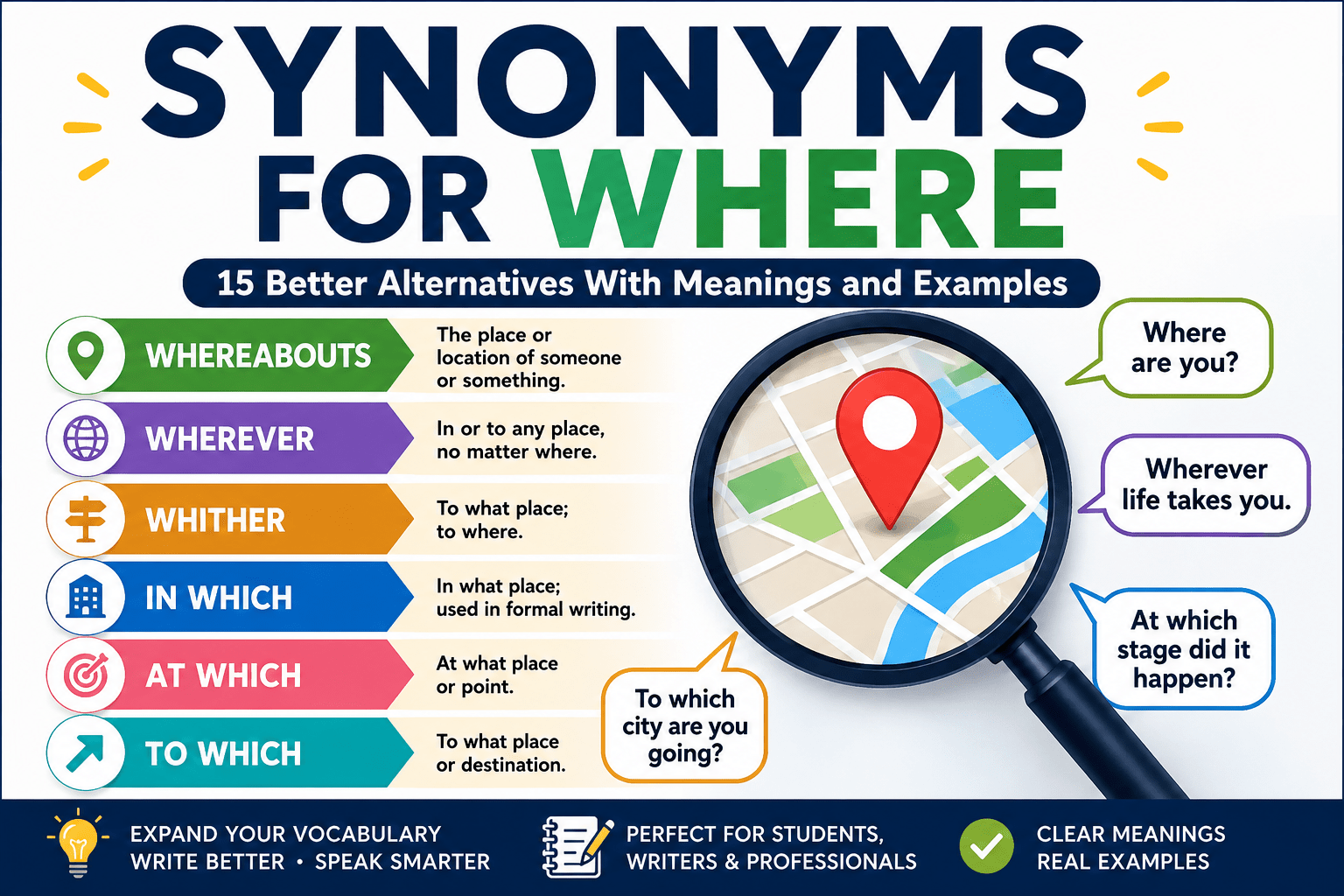
Depending on the context, useful alternatives include whereabouts, wherever, whither, in which, at which, to which, and the place in which. Some are direct substitutes, while others are grammatical alternatives used mainly in formal writing. Cambridge identifies where as both an adverb and conjunction used for places, situations, and stages in a process.
Quick Answer: What Are the Synonyms for “Where”?
The closest alternatives to where depend on its grammatical use. Whereabouts can ask about someone’s location, wherever means “in any place,” and whither means “to what place” and is now uncommon or literary. In formal relative clauses, phrases such as in which, at which, and to which can sometimes replace where.
Core Synonyms and Alternatives for Where
| Word or phrase | Relationship | Meaning | Formality | Best context |
|---|---|---|---|---|
| Whereabouts | Near synonym | What or approximately what place | Neutral | Asking about location |
| Wherever | Related alternative | In or to any place | Neutral | Unlimited or unspecified places |
| Whither | Contextual alternative | To what place | Formal/literary | Formal or old-fashioned writing |
| In which | Grammatical alternative | In what/which place | Formal | Relative clauses |
| At which | Grammatical alternative | At what place/point | Formal | Locations or points |
| To which | Grammatical alternative | To what place | Formal | Direction or destination |
| The place in which | Phrase alternative | The specific place where | Formal | Precise writing |
| The location at which | Phrase alternative | A particular location | Formal | Technical/professional writing |
| The point at which | Contextual alternative | A particular stage or point | Neutral–formal | Processes and events |
| The situation in which | Contextual alternative | A particular situation | Formal | Abstract contexts |
| At what place | Expanded alternative | At what location | Formal/awkward | Very explicit questions |
| In what location | Expanded alternative | In what location | Formal | Technical contexts |
| What place | Phrase alternative | Which place | Neutral | Specific constructions |
| At what point | Contextual alternative | At what stage or point | Neutral | Time/process |
| Location | Noun-related alternative | A place or position | Neutral | “The where” as a noun |
Important: These are not all strict synonyms. Whereabouts is a close lexical alternative in location questions, while in which and at which are grammatical substitutions that work only in certain sentence structures.
What Does “Where” Mean?
Where primarily asks about or refers to a place or position.
For example:
- “Where do you live?”
- “Where did you put my keys?”
- “Where are we going?”
- “I know where she works.”
Cambridge defines where as referring to “what place” and also notes that it can refer to a particular stage in a process or situation.
Oxford similarly describes where as referring to a place or situation and notes its use after words referring to a place or situation, with the sense “at, in, or to which.”
1. Whereabouts
Whereabouts is one of the closest alternatives when asking about someone’s or something’s location.
Meaning
The place where someone or something is, especially when the exact location is unknown.
Example
“Do you know her whereabouts?”
You can also say:
“Whereabouts in London do you live?”
Best use
Use whereabouts when the focus is specifically on location.
It cannot replace where in every sentence.
Natural:
“Do you know where he is?”
Also natural:
“Do you know his whereabouts?”
2. Wherever
Wherever means in any place, at any place, or to any place.
Example
“Sit wherever you like.”
It is not an exact synonym for where because it adds the meaning of any or every possible place.
Compare:
“Where should we meet?”
with:
“Wherever you want to meet is fine.”
Choose “wherever” when:
The exact location is unrestricted or does not matter.
3. Whither
Whither traditionally means “to what place” or “where to.”
Example
“Whither are you going?”
Today, this word sounds archaic, literary, or highly formal. Oxford and Merriam-Webster recognize whither as a related alternative to where in the sense of destination.
In normal modern conversation, say:
“Where are you going?”
rather than:
“Whither are you going?”
4. In Which
In which can replace where in certain relative clauses, particularly in formal writing.
Compare:
“This is the room where we met.”
with:
“This is the room in which we met.”
The second version is more formal.
Cambridge notes that where is commonly used in informal language instead of expressions such as at which, on which, or for which in appropriate relative clauses.
Best use
Use in which when the relationship specifically means “in that place/situation.”
5. At Which
At which is useful when where refers to a particular point, location, or stage.
Example
“This is the point at which the process begins.”
Compare:
“This is the point where the process begins.”
Both can be natural, but at which sounds more formal.
It is especially useful in academic, legal, and professional writing.
6. To Which
Use to which when the meaning involves movement or direction toward a place.
Example
“That is the destination to which the travelers were heading.”
In ordinary conversation, where is usually more natural:
“That is where the travelers were heading.”
Best use
Use to which when you need a formal relative-clause construction emphasizing direction.
7. The Place in Which
The place in which is an expanded, formal alternative to the place where.
Example
“This is the place in which the ceremony took place.”
More naturally in everyday English:
“This is the place where the ceremony took place.”
The longer version can be useful when writing formally, but it should not be used simply to make a sentence sound more sophisticated.
8. The Location at Which
The location at which is particularly useful in technical, scientific, legal, or professional writing.
Example
“The report identifies the location at which the equipment was installed.”
In everyday English, this is usually simpler:
“The report identifies where the equipment was installed.”
Best use
Use it when location itself is important and a formal noun phrase is appropriate.
9. The Point at Which
When where refers to a stage, point, or moment in a process, the point at which can be an excellent alternative.
Example
“We reached the point at which further discussion was unnecessary.”
Compare:
“We reached the point where further discussion was unnecessary.”
Both are grammatical. The longer version is more formal.
Cambridge specifically recognizes where for referring to a particular stage in a process or activity.
10. The Situation in Which
Sometimes where refers not to a physical location but to a situation.
Example
“This is a situation in which everyone must cooperate.”
A more conversational version is:
“This is a situation where everyone must cooperate.”
Oxford recognizes this broader use of where for a situation as well as a physical place.
11. At What Place
At what place is a literal expansion of where, but it is usually less natural in ordinary modern English.
Example
“At what place did the meeting occur?”
A native speaker would normally say:
“Where did the meeting occur?”
Best use
Use it only when a deliberately explicit or formal construction is appropriate.
12. In What Location
In what location is another explicit alternative.
Example
“In what location was the photograph taken?”
However, “Where was the photograph taken?” is shorter and more natural.
This phrase is most appropriate when discussing technical, administrative, or specialized information.
13. What Place
In certain constructions, what place can express a similar idea.
Example
“To what place are you referring?”
or more naturally:
“What place are you referring to?”
This is not a universal replacement for where, but it can be useful when the sentence needs a noun phrase.
14. At What Point
At what point is useful when where refers to a stage in an argument, process, calculation, or development, rather than a physical location.
Example
“At what point did the experiment go wrong?”
Compare:
“Where did the experiment go wrong?”
The second is more conversational; the first emphasizes the specific stage at which the problem occurred.
15. Location
When where is used as a noun, location or place can be a genuine semantic alternative.
For example:
“We know the when, but not the where.”
can be expressed as:
“We know the time, but not the location.”
Merriam-Webster recognizes a noun use of where meaning a location or place and lists location, place, venue, site, spot, locality, position, and related nouns.
Where vs. Whereabouts
These words are closely related but not identical.
| Word | Meaning | Example |
| Where | Asks for a place | “Where is Sarah?” |
| Whereabouts | Asks about someone’s location | “What are Sarah’s whereabouts?” |
Where is much more common and versatile.
Whereabouts focuses specifically on location.
Where vs. Wherever
The difference is important.
Where asks about or identifies a particular place:
“Where should we go?”
Wherever refers to any place:
“We can go wherever you want.”
So wherever is not simply a more formal synonym for where.
Where vs. Whither
Where can ask about location or destination:
“Where are you going?”
Whither specifically carries the older sense of “to what place.”
“Whither are you going?”
Because whither is uncommon in modern everyday English, where is almost always the better choice.
Where vs. In Which
These can sometimes express the same idea:
“This is the house where I grew up.”
“This is the house in which I grew up.”
The first is more natural in ordinary English. The second is more formal.
Choose “where” when:
You want natural, direct modern English.
Choose “in which” when:
The sentence calls for a formal relative-clause construction.
Where in Formal Writing
Writers sometimes try to replace every occurrence of where with a more complicated phrase. That can make writing less natural rather than more sophisticated.
For example:
Natural:
“The study examines where the problem occurs.”
Possible but heavier:
“The study examines the location at which the problem occurs.”
Use the longer alternative only when it adds precision or fits the style.
Cambridge specifically notes that where is used naturally to introduce relative clauses and can often replace more formal constructions.
Common Mistakes With Where Synonyms
Mistake 1: Calling every related word a synonym
Place, location, site, venue, and spot are nouns, while where is commonly an adverb or conjunction. They may express a related concept but cannot simply replace where in every sentence.
Mistake 2: Using “wherever” as a direct replacement
“Wherever” adds the meaning of any place.
“Where do you want to go?”
is not equivalent to:
“Wherever do you want to go?”
The second construction can add emphasis or surprise.
Mistake 3: Overusing “in which”
“In which” is grammatical in appropriate contexts, but replacing every where with it can make ordinary English unnecessarily formal.
Mistake 4: Using “whither” in casual conversation
“Whither” is recognized English, but it is old-fashioned or literary for most modern speakers.
Mistake 5: Confusing “where” with “were”
Where refers to place or situation.
Were is a past-tense form of be.
“Where were you yesterday?”
These words sound similar in many accents but have completely different meanings.
Pronunciation of Where
US: /wer/
UK: /weə(r)/
The word has one syllable.
Oxford and Cambridge both provide these pronunciation forms in their dictionary entries.
Etymology of Where
Where comes from Old English hwǣr, meaning roughly “in what place.” Oxford traces the word to Old English and notes its relationship with other Germanic forms.
FAQ About Synonyms for Where
What is the closest synonym for “where”?
Whereabouts is one of the closest alternatives when asking about someone’s location, but it does not replace where in every grammatical context. Whither is related when the meaning is “to what place,” while wherever changes the meaning to “any place.”
What is another word for “where” in formal writing?
Depending on the sentence, formal alternatives include in which, at which, to which, the location at which, and the point at which. These are contextual grammatical alternatives rather than universal synonyms.
What is a synonym for “where” in a location question?
Whereabouts can work when asking about someone’s location. For example, “Where are they?” can become “What are their whereabouts?” However, the second version is more formal and noun-based.
Is “wherever” a synonym for “where”?
Not exactly. Wherever means “in, at, or to any place,” so it introduces an idea of unlimited or unspecified location. Where normally asks about or identifies a particular place.
Is “in which” the same as “where”?
Sometimes. In relative clauses, where can often correspond to in which, especially when the meaning is “in that place.” For example, “the house where I live” can become “the house in which I live.” The latter is more formal.
What is the formal word for “where”?
There is no single formal replacement for where. Depending on context, in which, at which, to which, whereabouts, or whither may work. The correct choice depends on the grammatical structure and intended meaning.
What is another word for “where” in an essay?
For formal essays, you may sometimes use in which, at which, the point at which, or the situation in which. However, do not replace where simply to sound formal. Clear, natural English is usually better.
Can “place” replace “where”?
Not grammatically in every sentence. Place is a noun, while where commonly functions as an adverb or conjunction. For example, “Where do you live?” cannot simply become “Place do you live?” But “the place where I live” can refer to the same underlying location.
Conclusion
The best synonym for “where” depends on how the word is being used. Whereabouts is useful for asking about location, wherever means any place, and whither is an uncommon literary alternative meaning “to what place.” In formal relative clauses, in which, at which, and to which can sometimes replace where.
The most important lesson is that not every word associated with location is a true synonym for “where.” Choose the alternative according to grammar, meaning, register, and context rather than simply replacing the word with the longest or most formal option.

Michael Thompson is an English language specialist and experienced editor who focuses on vocabulary development and clear communication. He creates high-quality synonym guides, word comparisons, and writing tips to help students and professionals express their ideas more effectively. His work combines linguistic knowledge with practical SEO strategies to make learning both useful and engaging.