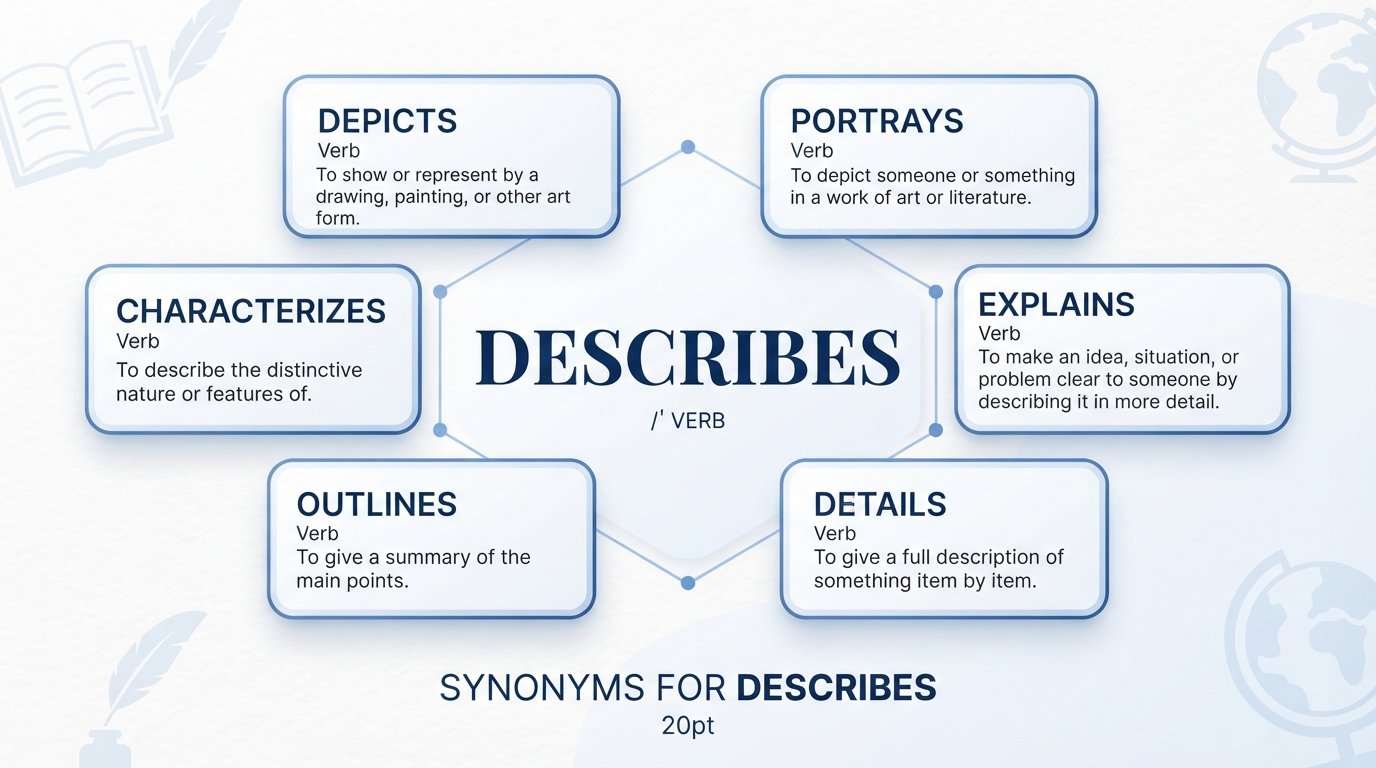
If you need a synonym for describes, the best choice depends on what kind of description you mean. Depicts and portrays work well for visual or creative representation, while explains emphasizes making an idea or process understandable. Details stresses specific information, outlines focuses on main points, characterizes highlights qualities, and recounts works well for events or experiences.
Quick Answer
The best synonyms for describes include depicts, portrays, explains, details, outlines, characterizes, defines, illustrates, represents, recounts, narrates, reports, and delineates. They are not interchangeable in every sentence. Choose the alternative according to whether you are describing appearance, qualities, meaning, information, a process, an event, or a visual representation.
What Does “Describes” Mean?
Describes is the third-person singular present form of the verb describe. It means to say or write what someone or something is like, or to give information about an event, process, object, person, or situation. Cambridge and Oxford both identify this core meaning and show that describe commonly occurs with people, things, processes, situations, and experiences.
For example:
The article describes how the system works.
The witness describes the suspect as tall and young.
The painting describes a peaceful rural scene.
Because describes has a broad meaning, a more specific verb can often make your writing clearer.
30 Synon30 Synonyms for Describes
Closest Synonyms for Describes
| Word | Relationship | Meaning | Best Context |
|---|---|---|---|
| Depicts | Close synonym | Represents something vividly | Images, scenes, writing |
| Portrays | Close synonym | Presents someone or something in a particular way | People, characters, stories |
| Details | Close synonym | Gives specific information | Reports, plans, procedures |
| Characterizes | Close synonym | Identifies distinctive qualities | People, groups, things |
| Delineates | Near synonym | Describes or marks something precisely | Formal or academic writing |
| Represents | Near synonym | Stands for or presents something | Symbols, art, ideas |
| Outlines | Near synonym | Gives the main points or structure | Essays, plans, reports |
| Defines | Near synonym | States the meaning or essential nature | Terms, concepts |
| Summarizes | Near synonym | Gives the main points briefly | Articles, reports |
| Presents | Near synonym | Shows or puts information before the reader | Academic and professional writing |
| Tells | Near synonym | Gives an account or information | General and narrative contexts |
Contextual Alternatives for Describes
| Word | Relationship | Meaning | Best Context |
|---|---|---|---|
| Explains | Contextual alternative | Makes something clear or understandable | Ideas, processes, causes |
| Illustrates | Contextual alternative | Makes an idea clear through an example or image | Teaching, writing, diagrams |
| Recounts | Contextual alternative | Tells what happened | Events, experiences |
| Narrates | Contextual alternative | Tells a story or sequence of events | Stories, accounts |
| Reports | Contextual alternative | Gives factual information | News, research, incidents |
| Relates | Contextual alternative | Tells or gives an account of something | Events, experiences |
| Specifies | Contextual alternative | States something precisely | Requirements, conditions |
| Reports on | Contextual alternative | Gives information about a subject | News, research |
| Sketches | Contextual alternative | Gives a brief or general description | Ideas, situations |
| Traces | Contextual alternative | Follows development or movement | History, processes |
| Chronicles | Contextual alternative | Records events in sequence | History, long-term events |
| Paints | Contextual/literary | Creates a vivid verbal picture | Creative writing |
| Renders | Contextual alternative | Represents or expresses something | Art, formal writing |
| Profiles | Contextual alternative | Gives a concise account of someone or something | People, organizations |
| Enumerates | Contextual alternative | Lists items one by one | Formal or technical writing |
| Expresses | Contextual alternative | Communicates an idea or quality | Feelings, ideas |
Related Alternatives for Describes
Some words are related to describes but do not always work as direct synonyms. Choose them according to whether you are identifying, presenting, explaining, or recording information.
| Word | Relationship | Meaning | Best Context |
|---|---|---|---|
| Identifies | Related/contextual | Points out or establishes what something is | People, objects, features |
| Labels | Related/contextual | Gives a name or classification | Categories, descriptions |
| Explains | Contextual alternative | Makes something clear or understandable | Ideas, processes, causes |
| Illustrates | Contextual alternative | Makes an idea clear through an example or image | Teaching, writing, diagrams |
| Recounts | Contextual alternative | Tells what happened | Events, experiences |
| Narrates | Contextual alternative | Tells a story or sequence of events | Stories, accounts |
| Reports | Contextual alternative | Gives factual information | News, research, incidents |
| Relates | Contextual alternative | Tells or gives an account of something | Events, experiences |
| Specifies | Contextual alternative | States something precisely | Requirements, conditions |
| Reports on | Contextual alternative | Gives information about a subject | News, research |
| Sketches | Contextual alternative | Gives a brief or general description | Ideas, situations |
| Traces | Contextual alternative | Follows development or movement | History, processes |
| Chronicles | Contextual alternative | Records events in sequence | History, long-term events |
| Paints | Contextual/literary | Creates a vivid verbal picture | Creative writing |
| Renders | Contextual alternative | Represents or expresses something | Art, formal writing |
Close Synonyms and Near Synonyms for Describes
These alternatives are closer in meaning to describes because they involve presenting, representing, outlining, or defining the qualities of something.
| Word | Relationship | Meaning | Best Context |
|---|---|---|---|
| Depicts | Close synonym | Represents something vividly | Images, scenes, writing |
| Portrays | Close synonym | Presents someone or something in a particular way | People, characters, stories |
| Details | Close synonym | Gives specific information | Reports, plans, procedures |
| Outlines | Near synonym | Gives the main points or structure | Essays, plans, reports |
| Characterizes | Close synonym | Identifies distinctive qualities | People, groups, things |
| Defines | Near synonym | States the meaning or essential nature | Terms, concepts |
| Represents | Near synonym | Stands for or presents something | Symbols, art, ideas |
| Delineates | Near synonym | Describes or marks something precisely | Formal or academic writing |
| Summarizes | Near synonym | Gives the main points briefly | Articles, reports |
| Presents | Near synonym | Shows or puts information before the reader | Academic and professional writing |
| Enumerates | Contextual alternative | Lists items one by one | Formal or technical writing |
| Expresses | Contextual alternative | Communicates an idea or quality | Feelings, ideas |
| Tells | Near synonym | Gives an account or information | General and narrative contexts |
| Profiles | Contextual alternative | Gives a concise account of someone or something | People, organizations |
Merriam-Webster’s thesaurus similarly groups depicts, portrays, characterizes, illustrates, recounts, defines, and outlines among alternatives to describes, while separating different senses of the verb.
Closest Synonyms for Describes
1. Depicts
Depicts is one of the closest alternatives when describes means representing a person, place, object, or scene.
The painting depicts a busy marketplace.
Use depicts especially for artwork, photographs, films, illustrations, and vivid written representation.
2. Portrays
Portrays emphasizes the way a person, character, situation, or subject is presented.
The novel portrays the main character as courageous but impulsive.
It is particularly natural when discussing literature, film, biographies, and public representations.
3. Characterizes
Characterizes focuses on the qualities or traits that define someone or something.
The report characterizes the region as economically diverse.
It is useful in academic, analytical, and professional writing.
4. Details
Details is stronger than describes when the writer gives specific or extensive information.
The manual details each step of the installation process.
Use it when precision and completeness matter.
5. Outlines
Outlines means giving the principal points without necessarily providing every detail.
The introduction outlines the main objectives of the study.
It is especially useful for essays, reports, plans, proposals, and presentations.
Contextual Synonyms for Describes
For Describing a Person
Use:
- characterizes
- portrays
- depicts
- presents
- profiles
Example:
The biography portrays the scientist as an innovative thinker.
Characterizes is particularly useful when focusing on personality or defining traits.
For Describing an Appearance
Use:
- depicts
- portrays
- pictures
- sketches
- renders
Example:
The author portrays the old house as dark and imposing.
For Describing a Process
Use:
- explains
- details
- outlines
- presents
- specifies
Example:
The guide explains how the application works.
Here, explains is usually more natural than depicts because the focus is understanding a process.
For Describing an Event
Use:
- recounts
- narrates
- reports
- relates
- chronicles
Example:
The memoir recounts her experiences during the journey.
For Academic Writing
Useful alternatives include:
- outlines
- details
- characterizes
- defines
- delineates
- illustrates
- presents
Example:
The first section outlines the methodology used in the study.
For academic writing, choose the verb according to the author’s actual function rather than replacing describes simply to avoid repetition.
Which Word Should I Use?
Choose depicts when:
You are presenting a visual or vivid representation.
The photograph depicts a crowded street.
Choose portrays when:
You are emphasizing how someone or something is presented.
The film portrays the leader as ambitious.
Choose explains when:
The goal is to make something understandable, especially a process, reason, or idea.
The teacher explains how the experiment works.
Choose details when:
You want to emphasize specific information.
The report details the company’s expenses.
Choose outlines when:
You are giving only the major points.
The proposal outlines three possible solutions.
Choose characterizes when:
You are identifying distinctive qualities.
The study characterizes the population as highly diverse.
Choose recounts when:
You are telling about past events or experiences.
The memoir recounts her childhood.
Choose defines when:
You are stating the meaning or essential nature of something.
The introduction defines the key terms.
Describes vs. Explains
These words overlap, but they are not identical.
Describes tells the reader what something is like or what happened.
Explains generally goes further by making something clear, particularly its operation, reason, or cause.
Compare:
The article describes the machine.
The article explains how the machine works.
The first sentence focuses on characteristics or information. The second focuses on understanding the process.
Describes vs. Depicts
Describes is broader. Depicts emphasizes representation.
The writer describes the village in detail.
The painting depicts the village at sunset.
Depicts is especially natural for visual art, images, scenes, and vivid literary representation. Merriam-Webster lists depicts and portrays among the principal synonyms associated with the representational sense of describes.
Describes vs. Portrays
Describes provides information about a subject, while portrays emphasizes how that subject is presented.
The biography describes his early career.
The biography portrays him as a determined young entrepreneur.
The second sentence carries more emphasis on presentation or characterization.
Describes vs. Details
Details suggests a greater focus on specific information.
The report describes the project.
The report details the project’s costs, deadlines, and procedures.
Use details when the sentence emphasizes precise information.
Describes vs. Outlines
Outlines is more limited than describes.
The report describes the entire project.
The report outlines the project’s main objectives.
An outline normally gives the major points rather than an exhaustive account.
Describes vs. Defines
These verbs should not normally be treated as interchangeable.
Defines establishes what a word, concept, or thing means.
Describes gives information about its qualities or characteristics.
The dictionary defines the term.
The article describes how the term is used in practice.
Common Mistakes With Describes Synonyms
1. Using “explains” for every type of description
Explains is not a universal replacement. It works best when the purpose is to make something understandable.
2. Using “depicts” for purely factual information
The report depicts the company’s financial results.
This can sound unnatural unless the report is presenting the results visually or representationally.
Better:
The report details the company’s financial results.
3. Using “defines” when you mean “describes”
A definition establishes meaning; a description provides characteristics or information.
4. Using “outlines” when extensive detail is intended
An outline normally focuses on major points. If the sentence emphasizes comprehensive information, details may be more accurate.
5. Changing the word only for variety
Do not replace describes simply because it appears twice. A synonym is useful only when it preserves the intended meaning.
Examples of Describes in Sentences
- The article describes the effects of climate change.
- The witness describes the suspect as tall and thin.
- The novel describes life in a remote village.
- The manual describes the installation process.
- The report describes the results of the experiment.
- The biography describes her early career.
- The photograph describes the scene? → Depicts is usually more natural here.
- The introduction describes the study’s objectives.
- The documentary describes the challenges faced by the community.
- The researcher describes the findings in detail.
Cambridge gives similar constructions, including describe something in detail and describe someone/something as something, showing how broadly the verb functions in natural English.
Formal Synonyms for Describes
For formal, academic, or professional writing, useful alternatives include:
- characterizes
- delineates
- details
- defines
- outlines
- specifies
- presents
- reports
- documents
- illustrates
However, formality does not automatically make a word a better synonym. Specifies, for example, implies precision, while reports emphasizes communicating information.
Antonyms of Describes
There is no single perfect antonym for every sense of describes. Depending on context, opposites may include:
- conceals
- hides
- obscures
- withholds
- omits
- misrepresents
For example:
The report describes the problem clearly.
Opposite idea:
The report obscures the problem.
FAQ
What is the best synonym for describes?
There is no single best synonym in every context. Depicts, portrays, explains, details, outlines, and characterizes are among the most useful alternatives. Choose based on whether you mean visual representation, explanation, detailed information, summary, or qualities.
What is another word for describes in an essay?
Good choices include explains, outlines, details, characterizes, illustrates, presents, and defines. The correct choice depends on what the sentence is doing. Use outlines for main points, details for specific information, and explains when making an idea understandable.
What is a synonym for describes a person?
Characterizes and portrays are particularly useful. Characterizes focuses on qualities or traits, while portrays emphasizes how the person is presented.
What is a synonym for describes an event?
Use recounts, narrates, reports, relates, or chronicles, depending on context. Recounts is natural for personal experiences, while reports works well for factual or journalistic accounts.
Is explains a synonym for describes?
Sometimes. Explains can replace describes when the sentence focuses on making an idea, process, or reason clear. It is not a universal replacement because describing something and explaining why or how it works are different functions.
Is depicts a synonym for describes?
Yes, in contexts involving representation, especially visual or vivid representation. Depicts is particularly natural for paintings, photographs, films, scenes, and literary imagery.
What is a formal synonym for describes?
Depending on context, characterizes, delineates, specifies, details, outlines, or presents can work in formal writing. The most accurate choice depends on the intended meaning.
What is the difference between describes and portrays?
Describes broadly means giving information about what someone or something is like. Portrays emphasizes the way that subject is represented or presented, especially in literature, art, media, and characterization.
Conclusion
The best synonym for describes depends on the exact meaning you want to communicate. Use depicts for representation, portrays for presentation or characterization, explains for ideas and processes, details for precise information, outlines for main points, characterizes for qualities, and recounts for events or experiences.
The key is not to replace describes automatically. Choose the word that tells the reader exactly what kind of description is being given. That approach produces clearer, more natural English than simply selecting the most sophisticated-looking synonym.

Daniel Carter is a professional content strategist and language enthusiast. He focuses on semantic SEO, keyword research, and creating structured vocabulary content that ranks well on search engines while remaining user-friendly.