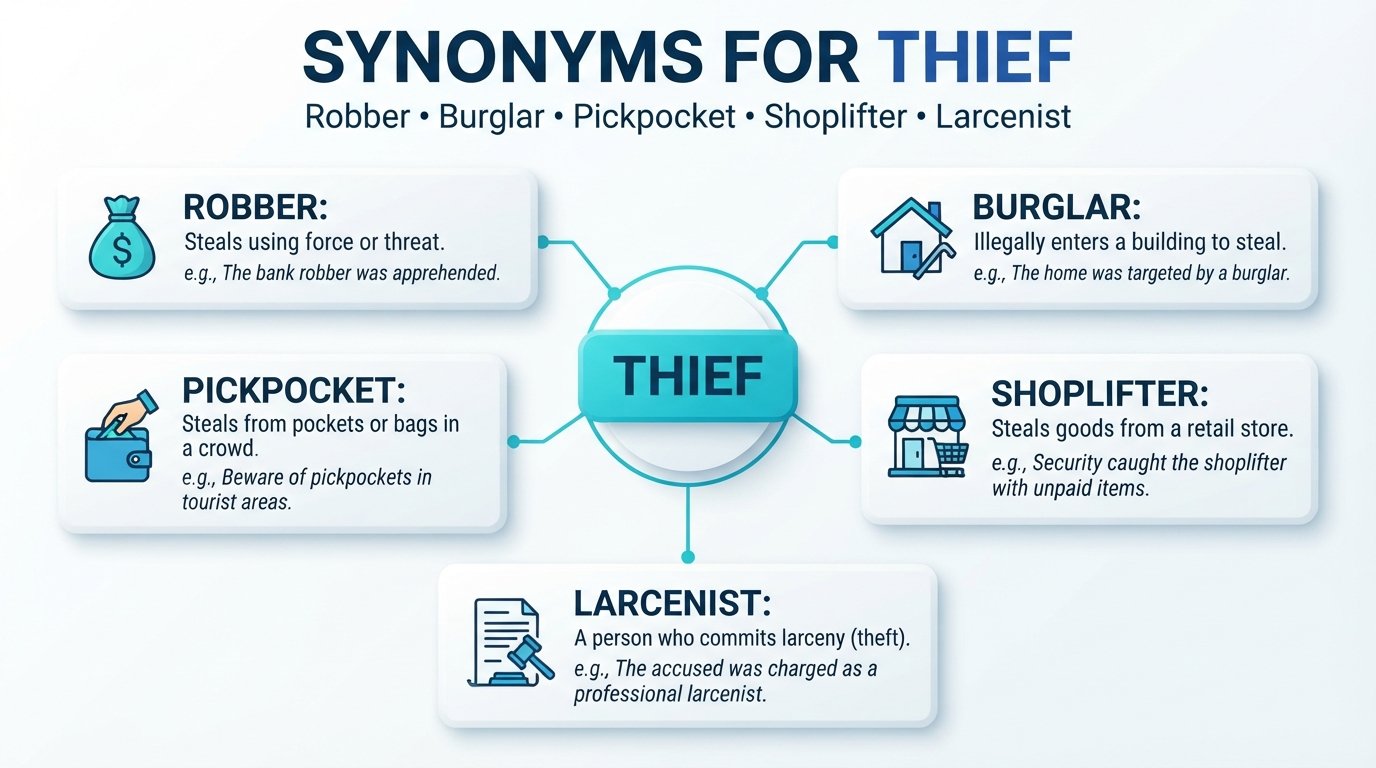
If you need synonyms for thief, the best choice depends on how the person steals. Robber, burglar, bandit, crook, and larcenist can describe people who steal, but words such as pickpocket, shoplifter, and embezzler refer to more specific forms of stealing. Choosing the right term makes your writing more precise and natural.
Quick Answer: Synonyms for Thief
Common synonyms and related alternatives for thief include robber, burglar, bandit, crook, larcenist, pilferer, purloiner, housebreaker, and stealer. However, several commonly listed alternatives are context-specific. A burglar enters a building to steal, a pickpocket steals from pockets or bags, and a shoplifter takes goods from a store without paying.
Common Thief Synonyms
| Word | Relationship | Meaning | Best Context |
|---|---|---|---|
| Robber | Near synonym | Someone who takes money or property illegally, often through robbery | General crime, robbery |
| Burglar | Specialized synonym | A person who illegally enters a building to steal | Homes and buildings |
| Bandit | Near synonym | A robber, traditionally one who operates as part of an armed group | Crime, historical or dramatic writing |
| Crook | Informal synonym | A dishonest or criminal person | Informal speech |
| Larcenist | Formal/legal-related | A person who commits larceny | Formal or legal writing |
| Stealer | Direct/rare alternative | Someone who steals | Literary or less common usage |
| Pilferer | Near synonym | Someone who steals small amounts or items, often repeatedly | Small-scale theft |
| Purloiner | Contextual alternative | Someone who takes something dishonestly or secretly | Formal/literary writing |
Specialized Types of Thieves
| Word | Relationship | Meaning | Best Context |
|---|---|---|---|
| Housebreaker | Specialized synonym | A person who breaks into houses to steal | Residential burglary |
| Cracksman | Historical/slang | A burglar, especially one skilled at breaking into safes | Historical or crime writing |
| Pickpocket | Specialized type | A thief who steals from pockets or bags, especially in crowds | Crowds, travel |
| Shoplifter | Specialized type | Someone who takes goods from a store without paying | Retail |
| Embezzler | Specialized type | Someone who illegally takes money or property entrusted to them | Workplace or financial crime |
| Mugger | Specialized type | A person who steals from someone through a threatening attack | Street crime |
| Looter | Specialized type | Someone who takes goods during disorder, war, or a disaster | Riots, war, disasters |
| Hijacker | Specialized criminal | Someone who takes control of a vehicle or similar target illegally | Aircraft, vehicles |
Formal, Contextual, and Related Alternatives
| Word | Relationship | Meaning | Best Context |
|---|---|---|---|
| Swindler | Related/near synonym | Someone who obtains money through deception or fraud | Fraud and scams |
| Defrauder | Specialized/related | Someone who obtains money or property through fraud | Formal or legal contexts |
| Plunderer | Contextual alternative | Someone who takes valuable things by force, especially during conflict or disorder | War, raids, historical contexts |
| Lifter | Informal/contextual | Someone who steals, especially in phrases such as “shoplifter” | Informal usage |
| Ransacker | Contextual alternative | Someone who searches a place aggressively while stealing or looking for valuables | Crime scenes, buildings |
Historical and Specialized Terms
| Word | Relationship | Meaning | Best Context |
|---|---|---|---|
| Footpad | Historical synonym | A robber who attacked travelers on foot | Historical writing |
| Highwayman | Historical synonym | A robber who historically attacked travelers on roads | Historical writing |
| Pirate | Contextual/historical | Someone who illegally attacks or robs ships, or commits certain forms of digital/media piracy | Maritime or digital contexts |
| Kleptomaniac | Related, not exact synonym | A person associated with kleptomania, a condition involving recurrent urges to steal | Psychological/medical context |
Which Words Are Closest to “Thief”?
If you need a replacement that remains broadly understandable, robber is one of the closest choices. Crook can also work informally, although it is broader because it can describe a dishonest or criminal person who is not necessarily a thief.
For formal writing, larcenist can be appropriate when the context specifically concerns larceny. Meanwhile, stealer exists but is considerably less natural in ordinary modern English than thief.
Cambridge’s thesaurus lists robber, burglar, bandit, crook, larcenist, and several specialized criminal terms among words related to thief. Collins similarly includes robber, crook, burglar, bandit, shoplifter, embezzler, pickpocket, and larcenist.
What Does “Thief” Mean?
A thief is a person who steals something from another person or place. The noun is countable, and its plural form is thieves. The pronunciation is /θiːf/ in both British and American English.
Examples:
- The police arrested the thief after reviewing the security footage.
- Someone stole my wallet, but I never saw the thief.
- The museum increased security to prevent thieves from entering.
The word is broad. It does not by itself tell the reader exactly how, where, or from whom the person stole.
1. Robber
Robber is one of the closest alternatives to thief, but it can suggest a more specific type of stealing.
A robber takes money or property illegally and may use force, threats, or intimidation. Cambridge defines a robber as someone who steals and gives examples involving violent criminal activity.
Example:
The robber demanded money from the cashier.
Thief vs. robber
A thief is the broader term. A robber is a type of thief associated with robbery.
- Thief: Someone secretly steals a laptop.
- Robber: Someone threatens a person and takes their wallet.
So, robber is useful when the manner of stealing matters.
2. Burglar
A burglar illegally enters a building to steal something. Cambridge specifically defines the word in relation to illegally entering buildings and stealing.
Example:
The burglar entered the house through a rear window.
Use burglar when the person breaks into a home, office, store, or another building.
Thief is broader:
The thief stole my bicycle.
Burglar is more specific:
The burglar broke into my house and stole my bicycle.
3. Bandit
Bandit is a word for a robber or outlaw, often associated with armed groups, attacks, or historical settings.
Example:
The travelers were attacked by a group of bandits.
It is especially common in historical, adventure, and dramatic writing. It is not normally the best everyday replacement for thief.
4. Crook
Crook is an informal word for a dishonest or criminal person.
Example:
The police finally caught the crook.
Unlike thief, crook does not necessarily specify stealing. A crook could be involved in fraud or other criminal activity.
Use it in informal writing or dialogue rather than formal legal or academic writing.
5. Larcenist
Larcenist is a formal term for someone who commits larceny.
Example:
The investigation focused on identifying the suspected larcenist.
This word is useful in legal, historical, or formal discussions of theft. It is less common in everyday conversation than thief.
6. Pilferer
A pilferer steals small amounts or small items, often repeatedly or casually.
Example:
The manager suspected a pilferer was taking office supplies.
The word is useful when the theft involves relatively small items rather than a major robbery.
7. Purloiner
Purloiner is a less common and somewhat formal or literary term for someone who takes something dishonestly or secretly.
Example:
The detective searched for the purloiner of the missing documents.
Because it is uncommon in everyday American English, thief or stealer will usually sound more natural.
8. Pickpocket
A pickpocket is a specific type of thief who steals from people’s pockets or bags, particularly in crowded places.
Example:
A pickpocket stole her wallet on the crowded train.
This is more precise than thief when the method involves secretly taking something from a person’s clothing or bag.
9. Shoplifter
A shoplifter takes goods from a store without paying for them.
Example:
The security guard stopped the shoplifter before he left the store.
A shoplifter is a type of thief, but thief is not specific to stores.
10. Embezzler
An embezzler is someone who illegally takes money or property that has been entrusted to them.
Example:
The company discovered that an employee had been an embezzler for several years.
This term is especially useful for workplace and financial contexts.
It would be inaccurate to replace every use of thief with embezzler, because embezzlement involves a particular relationship to the property being taken.
11. Swindler
A swindler obtains money or property through deception or fraud.
Example:
The swindler convinced several investors to give him money.
A swindler may steal, but deception is central to the meaning. Therefore, swindler is better classified as a near-synonym or related criminal term than as a perfect synonym for thief.
12. Defrauder
Defrauder refers to someone who commits fraud or deliberately deprives another person of money or property through deception.
Example:
The defrauder used false documents to obtain the money.
This word is most appropriate in formal, financial, or legal contexts.
13. Mugger
A mugger is someone who attacks or threatens a person in order to steal from them.
Example:
The mugger demanded his phone and wallet.
The important distinction is that mugger describes a thief who uses a threatening street attack. It should not be used as a general substitute for every kind of thief.
14. Plunderer
A plunderer takes valuable property, often by force, during conflict, raids, or disorder.
Example:
The invading army left the city vulnerable to plunderers.
The term has a stronger historical or dramatic flavor than ordinary thief.
15. Housebreaker
Housebreaker is an older or specialized term for someone who breaks into houses to steal.
Example:
The novel follows a notorious housebreaker in Victorian London.
For modern everyday English, burglar is usually more natural.
16. Footpad
Footpad is an archaic term for a robber who attacked travelers, particularly on roads.
Example:
The travelers feared an encounter with a footpad on the lonely road.
Use it mainly in historical writing or when deliberately creating an old-fashioned atmosphere.
17. Cracksman
Cracksman is an old or slang term for a burglar, particularly one skilled at breaking into safes or buildings.
Example:
The detective pursued a notorious cracksman who specialized in safes.
It is not a normal modern substitute for thief.
18. Looter
A looter takes goods during situations such as riots, war, disasters, or severe social disorder.
Example:
Police arrested several looters after the unrest.
The context is essential. A person who quietly steals a wallet is a thief, not normally a looter.
19. Lifter
Lifter can informally refer to someone who steals, particularly in compounds such as shoplifter.
Example:
Security officers were watching for shoplifters and other lifters.
On its own, however, lifter is ambiguous and is not normally the best replacement for thief.
20. Kleptomaniac
Kleptomaniac should not be treated as a simple synonym for thief.
It refers to a person associated with kleptomania, so it introduces a specific psychological context. Calling every person who steals a kleptomaniac is inaccurate.
Use thief when you simply mean someone who steals.
21. Ransacker
A ransacker is someone who searches a place thoroughly and roughly, often while looking for or taking valuables.
Example:
The ransacker emptied the drawers and cabinets.
The word emphasizes the disorderly searching of a place rather than theft alone.
22. Pirate
Pirate can refer to a person who historically attacks and robs ships. It also has other modern meanings, including unauthorized copying or distribution of protected material.
Example:
Pirates attacked merchant ships along the coast.
Because of these additional meanings, pirate should be treated as a contextual term rather than a general synonym for thief.
23. Highwayman
A highwayman is a historical term for a robber who attacked travelers on roads.
Example:
The novel’s hero is pursued by a notorious highwayman.
It is useful for historical fiction but sounds archaic in modern everyday English.
24. Stealer
Stealer literally refers to someone who steals, but it is much less common and natural in everyday English than thief.
Example:
The story describes him as a stealer of secrets.
In ordinary modern writing, thief will usually be the better choice.
25. Related Criminal Terms
Some words frequently appear in thesaurus results for thief, but they should not automatically replace it.
For example:
- Criminal — much broader than thief.
- Offender — broader and often legal in tone.
- Cheat — someone who behaves dishonestly, not necessarily someone who steals.
- Fraudster — someone who commits fraud.
- Scammer — someone who deceives people, usually to obtain money or information.
- Gangster — a member of a criminal organization or gang.
- Outlaw — a person outside or in defiance of the law, historically or figuratively.
These words may overlap with thief, but they describe broader or different concepts.
Thief Synonyms by Context
The easiest way to choose the right word is to identify how the person stole.
For General Theft
Use:
- thief
- robber
- crook
- larcenist
For Breaking Into Buildings
Use:
- burglar
- housebreaker
- cracksman
A burglar specifically enters a building to steal.
For Stealing From Pockets
Use:
- pickpocket
A pickpocket specifically targets pockets or bags, often in crowded places.
For Stealing From Stores
Use:
- shoplifter
A shoplifter takes goods from a store without paying.
For Workplace or Entrusted Money
Use:
- embezzler
For Fraud
Use:
- swindler
- defrauder
- fraudster
For Street Attacks
Use:
- mugger
- robber
For Historical Crime
Use:
- bandit
- highwayman
- footpad
- cracksman
- housebreaker
Thief vs. Robber vs. Burglar vs. Pickpocket vs. Shoplifter
These words overlap, but they are not interchangeable in every situation.
| Word | Key idea | Example |
|---|---|---|
| Thief | General stealing | The thief stole my phone. |
| Robber | Taking property through robbery | The robber threatened the cashier. |
| Burglar | Entering a building to steal | The burglar broke into the house. |
| Pickpocket | Stealing from pockets or bags | The pickpocket took her wallet. |
| Shoplifter | Stealing goods from a store | The shoplifter took a jacket. |
The important lesson is simple: thief is the broadest everyday word among these terms. The others add information about the method or setting of the theft. Cambridge and Oxford both distinguish the broad meaning of thief from more specific criminal terms.
Common Mistakes When Choosing a Synonym for Thief
Mistake 1: Calling every thief a burglar
A burglar specifically enters a building to steal. Someone who steals a bicycle left outside is still a thief, but burglar may not be appropriate.
Mistake 2: Using “robber” for every theft
Robber is associated with robbery, while thief is broader. A person who secretly takes someone’s wallet is not necessarily best described as a robber.
Mistake 3: Calling every thief a kleptomaniac
Kleptomaniac introduces a specific psychological meaning. It should not be used simply because someone stole something.
Mistake 4: Using “shoplifter” outside a retail context
A shoplifter steals goods from a store. Someone stealing a laptop from an office is not a shoplifter.
Mistake 5: Using “swindler” when there is no deception
A swindler obtains something through deception or fraud. If someone simply takes an unattended phone, thief is more accurate.
Mistake 6: Treating thesaurus lists as interchangeable words
Thesaurus results often contain broad synonyms, related criminals, and specialized terms together. Cambridge’s thesaurus, for example, lists robber, burglar, bandit, crook, larcenist, embezzler, and defrauder as words related to thief, while Collins includes additional specialized terms such as shoplifter and pickpocket.
Formal and Informal Synonyms for Thief
FFor formal writing, alternatives include larcenist, embezzler, defrauder, and purloiner.
In neutral everyday English, common choices are thief, robber, burglar, pickpocket, and shoplifter.
For informal English, crook is a common alternative.For historical or literary writing:
- footpad
- highwayman
- cracksman
- housebreaker
- bandit
The best word is not necessarily the most formal one. In many situations, simple thief is clearer and more natural.
What Is the Best Synonym for Thief?
There is no single replacement that works in every context.
Use robber when the person commits robbery, burglar when someone enters a building to steal, pickpocket when the theft involves pockets or bags, and shoplifter when someone steals from a store.
If you simply mean a person who steals, thief remains the clearest general term. Cambridge defines thief broadly as a person who steals, while Oxford similarly defines it as a person who steals something from another person or place.
Frequently Asked Questions
What is another word for thief?
Common alternatives include robber, burglar, bandit, crook, and larcenist. However, some alternatives are more specific: a pickpocket steals from pockets or bags, while a shoplifter steals goods from stores.
What is a formal word for thief?
Larcenist is a formal term associated with someone who commits larceny. Purloiner can also work in formal or literary contexts, although it is less common in everyday modern English.
Is robber another word for thief?
Yes, robber overlaps with thief, but it is more specific. A robber commits robbery, while thief is the broader everyday term for someone who steals.
What is a word for someone who steals from a store?
Shoplifter is the specific word for someone who takes goods from a store without paying.
What is a word for someone who steals from people’s pockets?
Pickpocket is the most precise term. It refers to a thief who steals from pockets or bags, especially in crowded places.
What is the difference between a thief and a burglar?
A thief is anyone who steals, while a burglar specifically enters a building illegally to steal. Therefore, every burglar can be described as a thief, but not every thief is a burglar.
What is the difference between a thief and a shoplifter?
A thief is a general term for someone who steals. A shoplifter is specifically someone who takes goods from a store without paying.
Conclusion
The best synonym for thief depends on the situation. Robber emphasizes robbery, burglar describes someone who enters a building to steal, pickpocket refers to theft from pockets or bags, and shoplifter identifies theft from a store. Other terms such as larcenist, pilferer, purloiner, embezzler, and swindler add different levels of formality or specificity.
For general writing, thief is usually the safest and clearest choice. When the method, setting, or type of theft matters, a more specific word can make your writing much more precise.

Daniel Carter is a professional content strategist and language enthusiast. He focuses on semantic SEO, keyword research, and creating structured vocabulary content that ranks well on search engines while remaining user-friendly.