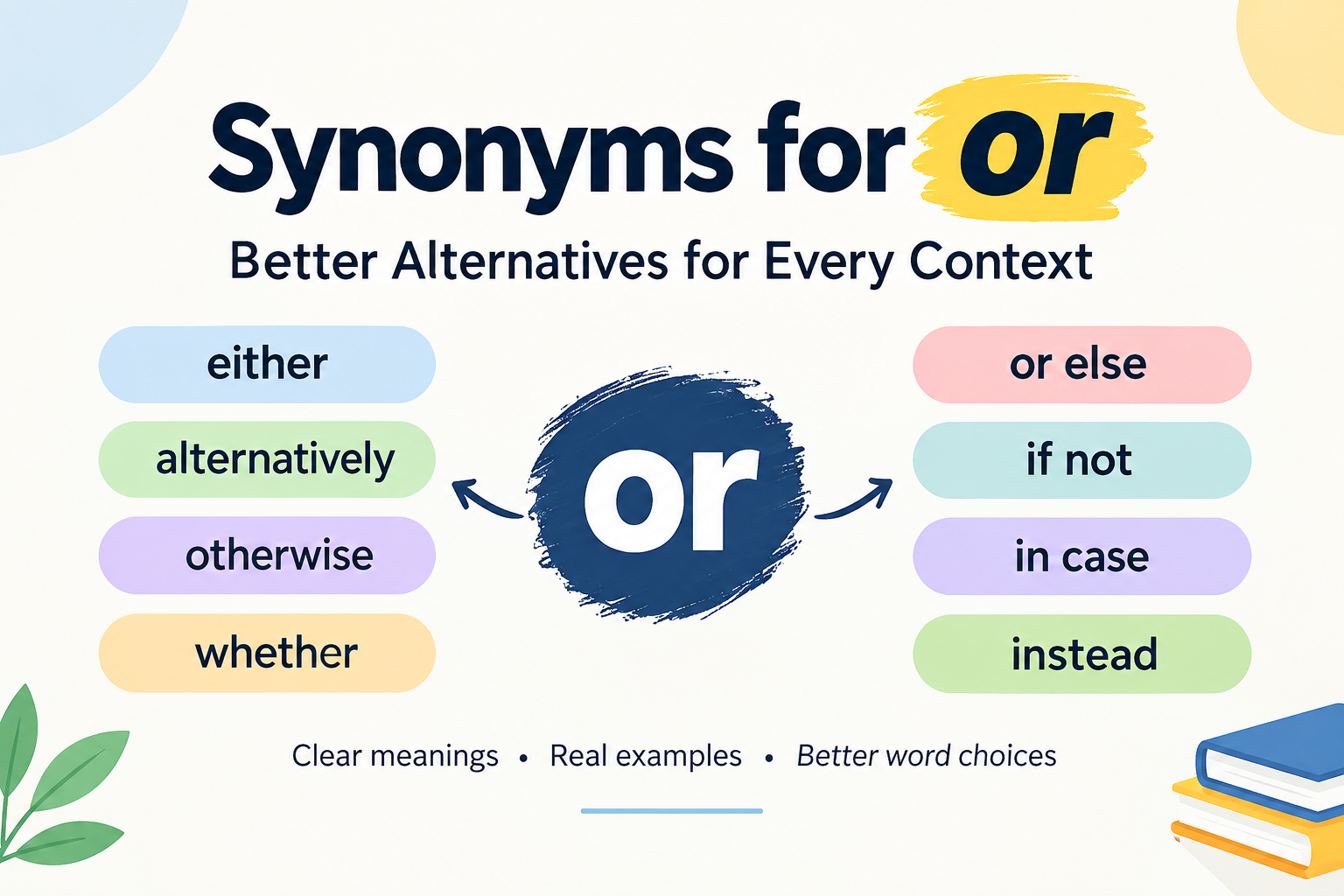
The word “or” is one of the most common ways to connect alternatives in English, but it does not have a single replacement that works in every sentence. Depending on the context, alternatives such as alternatively, otherwise, else, either, if not, instead, or else, and whether can express a similar idea. However, each has its own grammatical role and meaning.
This guide explains the most useful alternatives to “or”, shows where they work naturally, and highlights cases where replacing or would actually make the sentence less accurate.
Quick Answer
The closest alternatives to “or” include alternatively, otherwise, else, either, if not, or else, instead, and whether, but they are not interchangeable in every sentence. “Alternatively” introduces another option, “otherwise” often introduces a consequence, and “either” usually works with “or” rather than replacing it. Therefore, the best alternative depends on what or means in the sentence.
What Does “Or” Mean?
“Or” is primarily a coordinating conjunction used to connect two or more alternatives or possibilities.
For example:
Would you like tea or coffee?
You can walk or take the bus.
Cambridge explains that or connects words, phrases, and clauses representing alternatives or possibilities. It can also appear after a negative verb and can introduce an explanation or correction.
The word also has a conditional use:
Hurry, or you’ll miss the train.
Here, or has a meaning close to “otherwise” or “if not.”
Because or performs several grammatical functions, there is no universal one-word synonym.
Best Synonyms and Alternatives for “Or”
| Alternative | Relationship | Meaning / Use | Best Context |
|---|---|---|---|
| alternatively | Contextual alternative | Introduces another option | Formal and professional writing |
| otherwise | Contextual alternative | Indicates what happens if something else does not occur | Conditions and consequences |
| else | Near synonym | Introduces another possibility | Questions and informal/neutral writing |
| either | Related construction | Emphasizes one of two alternatives, normally with or | Choices and contrasts |
| or else | Near synonym | Presents another option or consequence | Warnings and consequences |
| if not | Contextual alternative | Means “if the first condition does not apply” | Conditional statements |
| whether | Related construction | Introduces alternatives or uncertainty | Indirect questions |
| instead | Contextual alternative | Indicates substitution rather than simple choice | Replacing one option with another |
| instead of | Contextual alternative | Identifies a replacement | Noun phrases and -ing forms |
| as an alternative | Phrase alternative | Explicitly introduces another choice | Formal writing |
| as another option | Phrase alternative | Presents an additional possibility | Explanatory writing |
| as an alternative to | Phrase alternative | Shows a substitute | Professional and academic writing |
| in lieu of | Contextual alternative | Means “instead of” | Formal contexts |
| alternately | Related word | Means one after another or in turns | Sequential situations |
| otherwise called | Contextual phrase | Introduces another name | Definitions and naming |
Important: These are not 15 interchangeable synonyms. Several are contextual alternatives or related constructions. That distinction matters if you want natural English.
The Closest Alternatives to “Or”
1. Alternatively
Alternatively is one of the most useful substitutes when you want to introduce another possible choice, especially in formal writing.
Example:
You can submit the form online. Alternatively, you can mail it.
Here, alternatively works because the writer has presented one option and then introduces another.
It does not normally replace or word-for-word:
You can submit the form online or mail it.
A natural revision would be:
You can submit the form online. Alternatively, you can mail it.
Best for: essays, reports, instructions, professional writing, and structured explanations.
2. Otherwise
Otherwise is useful when or introduces a consequence.
Compare:
Hurry, or you’ll miss the bus.
Hurry; otherwise, you’ll miss the bus.
The meaning is similar, but otherwise emphasizes the consequence of not doing the first action.
Cambridge specifically identifies a conditional meaning of or, such as “Do your coat up, Joe, or you’ll freeze.”
Best for: warnings, instructions, conditions, and formal writing.
3. Else
Else can express another possibility, especially in questions or expressions such as “what else,” “where else,” and “who else.”
For example:
Would you like tea, or something else?
What else would you recommend?
However, else cannot replace or mechanically in every sentence.
Best for: alternatives involving another person, thing, place, or possibility.
4. Either
Either is closely associated with or, but it usually does not replace or by itself.
Compare:
You can choose tea or coffee.
You can choose either tea or coffee.
The second sentence emphasizes the alternatives.
The common structure is:
either X or Y
Cambridge describes either … or as a construction used to emphasize alternatives.
Best for: emphasizing a choice between alternatives.
5. Or Else
Or else can introduce an alternative or, more commonly, a consequence or warning.
Leave now, or else you’ll miss the train.
It can sound stronger than simple or because it may imply an undesirable consequence.
Best for: warnings, threats, consequences, and emphatic speech.
6. If Not
If not can sometimes replace the conditional sense of or.
Finish the report today, or the client may cancel the order.
A possible revision is:
Finish the report today; if not, the client may cancel the order.
The two structures are similar, but the second explicitly expresses a condition.
Best for: conditional statements and formal explanations.
7. Whether
Whether is useful when discussing uncertainty between alternatives.
I don’t know whether she will come or stay home.
Notice that whether normally does not eliminate or when both alternatives are explicitly stated.
It is therefore better described as part of an alternative structure than as a direct synonym.
Best for: uncertainty, indirect questions, and formal writing.
8. Instead
Instead expresses an alternative by showing that one thing is chosen or done in place of another.
We could take the train, or we could drive.
Possible revision:
We could take the train. Instead, we could drive.
The second version changes the structure and emphasizes substitution.
Best for: presenting a replacement or contrasting choice.
9. Instead Of
Instead of is more specific than or because it explicitly identifies one option as a substitute for another.
We could take the train instead of driving.
It is especially useful before a noun phrase or gerund:
She walked instead of taking the bus.
Do not treat instead of as a universal replacement for or.
10. As an Alternative
As an alternative is a clear formal phrase for introducing another option.
As an alternative, applicants may submit the documents by mail.
It is particularly useful when you want to make the relationship between two options explicit.
Best for: professional, academic, and instructional writing.
Context-Specific Alternatives to “Or”
The following expressions can communicate a similar idea but should not be presented as exact synonyms.
For Formal Writing
Use:
- alternatively
- otherwise
- as an alternative
- as another option
- as an alternative to
For example:
Applicants may apply online. Alternatively, they may submit a paper form.
This sounds more formal than repeatedly joining every option with or.
For Conditions and Consequences
Use:
- otherwise
- or else
- if not
For example:
Submit the application by Friday; otherwise, it may not be considered.
Here, otherwise is more precise than simply trying to replace or with a random synonym.
For Substitution
Use:
- instead
- instead of
- in lieu of
- as an alternative to
For example:
The company offered a refund instead of store credit.
In lieu of is considerably more formal and is often associated with professional or legal language.
For Emphasizing Two Choices
Use:
- either … or
- whether … or
For example:
You can choose either the standard package or the premium package.
These constructions emphasize the relationship between alternatives rather than replacing or outright.
“Or” vs. “Alternatively”
These two expressions are related, but they have different grammatical roles.
| Or | Alternatively |
|---|---|
| Usually a conjunction | Usually an adverb |
| Joins alternatives directly | Introduces another option |
| Works inside a sentence | Often begins a new sentence or clause |
| Very common in everyday English | More common in formal or structured writing |
Compare:
You can call us or send an email.
You can call us. Alternatively, you can send an email.
Both communicate alternatives, but the sentence structures are different.
“Or” vs. “Otherwise”
The distinction becomes especially important with consequences.
Take an umbrella, or you’ll get wet.
Take an umbrella; otherwise, you’ll get wet.
In the second sentence, otherwise means approximately “if you do not do this.”
Therefore, otherwise is a strong alternative when or introduces a consequence, but it is not a general replacement.
“Or” vs. “Either”
These words are often confused because they frequently appear together.
You can choose tea or coffee.
You can choose either tea or coffee.
Here, either adds emphasis to the alternatives.
However, you normally would not write:
You can choose either tea coffee.
The standard structure is:
You can choose either tea or coffee.
Cambridge also notes that the negative counterpart is neither … nor, not neither … or.
“Or” vs. “Instead”
The difference is subtle but useful.
Or presents alternatives:
We can drive or take the train.
Instead emphasizes choosing one option in place of another:
We can drive. Instead, we could take the train.
Therefore, instead is better when substitution is the main idea.
Common Mistakes When Replacing “Or”
Mistake 1: Treating every related word as a synonym
Words such as instead, alternatively, otherwise, and either are related to or, but they perform different grammatical functions.
Do not create a thesaurus-style list and assume every word can replace or.
Mistake 2: Using “either” without “or”
Usually, when two alternatives are explicitly stated, use:
Either tea or coffee.
Not:
Either tea coffee.
Mistake 3: Confusing “otherwise” with a simple alternative
Otherwise often means that something will happen if the first condition is not fulfilled.
Study now; otherwise, you may fail.
That is different from:
You can study or relax.
Mistake 4: Using “alternately” when you mean “alternatively”
These words are not interchangeable.
Alternatively means as another option.
Alternatively, you can take the train.
Alternately generally means in turns or one after another.
The two teams played alternately throughout the afternoon.
Mistake 5: Replacing every “or” in an attempt to sound formal
There is usually no need to avoid or. It is concise, natural, and grammatically correct.
For example:
You can contact us by phone or email.
There is little benefit in forcing a longer expression into this sentence.
Is “Or” Formal or Informal?
“Or” is neutral and appropriate in virtually all varieties of standard English.
It works in:
- everyday conversation
- academic writing
- business communication
- technical writing
- instructions
- journalism
- formal documents
You should not replace or simply because you think it sounds too basic. Instead, choose an alternative only when it expresses the intended relationship more precisely.
Can “And” Replace “Or”?
No.
And normally combines things, while or presents alternatives.
Compare:
I bought apples and oranges.
This means both were bought.
I bought apples or oranges.
This presents alternatives and does not necessarily say that both were bought.
Cambridge likewise distinguishes or from and: or connects alternatives, while and expresses addition.
Can “Or” Mean “Otherwise”?
Yes, in certain contexts.
Hurry, or we’ll be late.
This can be understood as:
Hurry; otherwise, we’ll be late.
However, this is only one use of or. The word has other functions, including connecting alternatives and introducing clarification.
What Is the Best Synonym for “Or”?
There is no single best synonym for “or.”
Choose the alternative according to meaning:
- Alternatively — another option
- Otherwise — a consequence if something does not happen
- Either … or — emphasis on alternatives
- Else — another possibility
- Or else — alternative or consequence, often emphatic
- If not — conditional alternative
- Instead — replacement
- Whether … or — uncertainty between alternatives
- As an alternative — explicit and formal presentation of another choice
For ordinary sentences, however, “or” is often the most natural choice.
FAQ
What is another word for “or”?
Common alternatives include alternatively, otherwise, else, or else, and if not. However, these expressions do not have exactly the same grammatical function, so the correct choice depends on context.
What is a formal synonym for “or”?
Alternatively is often a useful formal alternative when introducing another option. Otherwise is also appropriate when or expresses a consequence or condition. In many formal sentences, however, the simple word or remains the clearest choice.
What can I use instead of “or” in an essay?
Depending on the meaning, you can use alternatively, otherwise, instead, as an alternative, or whether. Do not replace or simply to make the writing sound more sophisticated; use another expression only when it improves clarity.
Is “alternatively” the same as “or”?
Not exactly. Alternatively introduces another option, often after a complete sentence or clause. Or is a conjunction that directly connects alternatives within a sentence.
Is “otherwise” a synonym for “or”?
Otherwise can be equivalent to or when or expresses a consequence. For example, “Hurry, or you’ll be late” can become “Hurry; otherwise, you’ll be late.” It cannot replace or in every context.
Can “either” replace “or”?
Usually not by itself. Either commonly works with or in the construction either … or. For example, “You can choose either tea or coffee.”
What is the difference between “alternatively” and “alternately”?
Alternatively means as another option. Alternately generally means in turns or one after another. For example, “Alternatively, you can take the train” presents another choice, while “The speakers talked alternately” describes turns.
Should I avoid using “or” in formal writing?
No. Or is a standard, neutral conjunction and is completely appropriate in formal writing. Replace it only when another expression communicates a particular relationship—such as a consequence, substitution, or separately presented alternative—more clearly.
Conclusion
The best alternatives to “or” depend on what the word is doing in the sentence. Alternatively works well for another option, otherwise for a consequence, instead for substitution, and either … or for emphasizing a choice. Else, or else, if not, whether, and as an alternative can also be useful in specific contexts.
The most important point is that “or” itself is often the best choice. It is short, natural, neutral, and grammatically versatile. Rather than replacing it merely to avoid repetition, choose an alternative when it gives the reader a clearer or more precise meaning.

Sarah Williams is an ESL teacher and content writer with a passion for simplifying English vocabulary. She creates easy-to-understand synonym guides and learning resources that help beginners and intermediate learners build strong language skills.