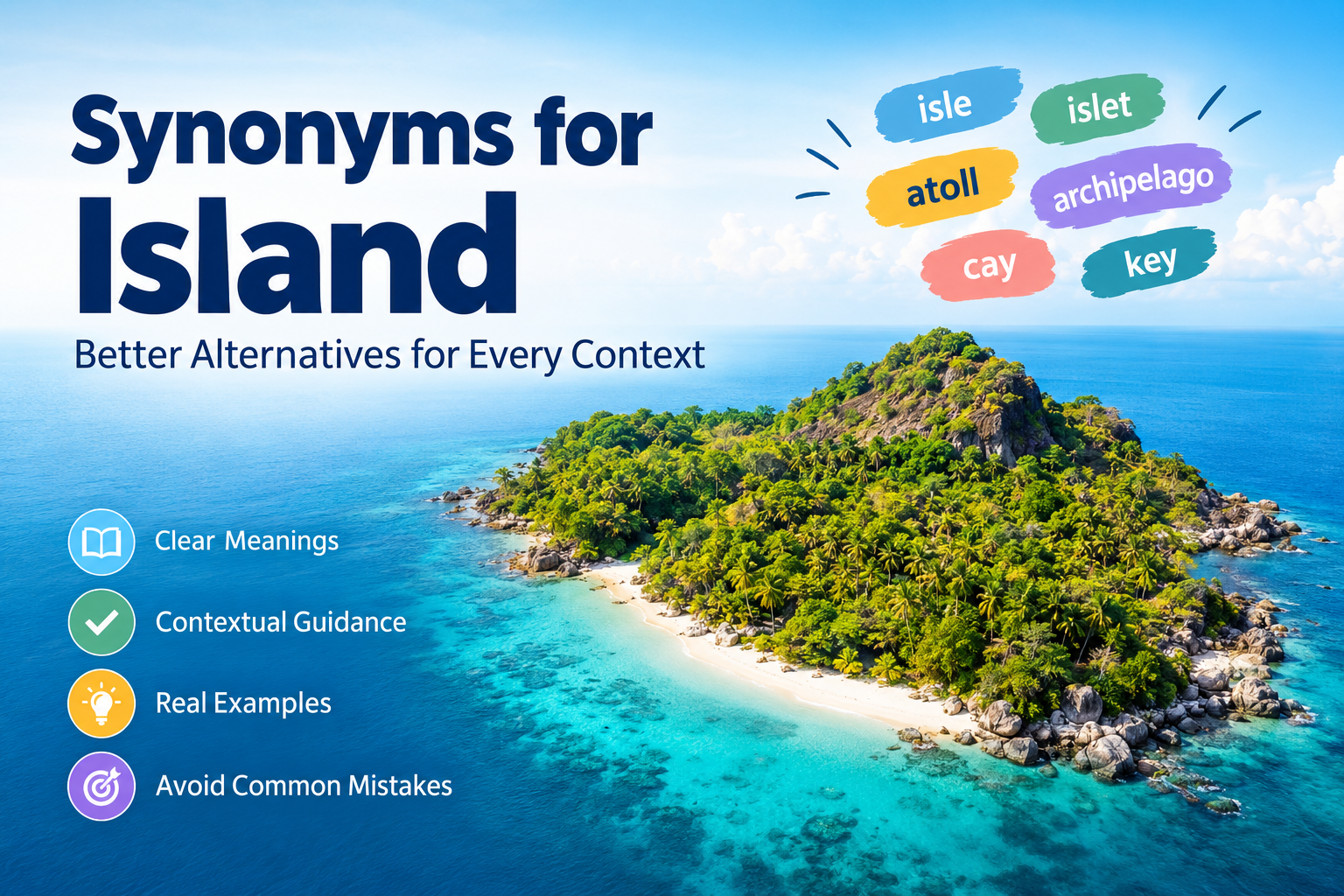
Finding a synonym for island is not always as simple as replacing it with another geographical word. Some alternatives, such as isle, can directly replace island in many contexts. Others, including islet, atoll, cay, and key, describe particular types or forms of islands and therefore cannot be used interchangeably in every sentence.
This guide separates genuine synonyms from related geographical terms so you can choose the most accurate word for your context.
Quick Answer: What Are the Synonyms for Island?
The closest synonym for island is isle. Other related terms include islet, atoll, cay, key, eyot, and holm, but these are more specific or regional terms rather than exact replacements. For figurative uses, words such as isolated spot, refuge, haven, and oasis can sometimes express the idea of something isolated or surrounded by contrasting conditions.
Core Synonyms and Alternatives for Island
| Word | Relationship | Meaning | Formality | Best Context |
|---|---|---|---|---|
| isle | Direct synonym | An island, especially in literary or geographical names | Neutral/Literary | General, literary, names |
| islet | Near synonym | A very small island | Neutral | Small islands |
| atoll | Specific type | A ring-shaped island or reef surrounding a lagoon | Technical/Neutral | Tropical geography |
| cay | Specific type | A small, low island, usually sandy | Neutral | Caribbean/tropical geography |
| key | Specific type | A small, low island, especially in the Caribbean or Florida | Regional/Neutral | Place names and geography |
| eyot | Specific/Regional | A small island in a river or stream | Literary/Regional | Rivers and literature |
| holm | Specific/Regional | A small island, especially in a river or coastal area | Literary/Regional | Place names and historical writing |
| island refuge | Contextual alternative | An isolated or protected place | Descriptive | Figurative writing |
| isolated spot | Contextual alternative | A place separated from its surroundings | Neutral | Figurative contexts |
| haven | Contextual alternative | A safe or peaceful place | Neutral/Literary | Figurative writing |
Important: Not all of these are exact synonyms. Isle is the strongest direct replacement. The others become appropriate only when their additional meaning fits the context.
What Does Island Mean?
An island is a piece of land completely surrounded by water. Oxford, Cambridge, and Merriam-Webster all give essentially this core geographical meaning. The word can also refer to things that resemble an island because they are isolated or surrounded, such as a kitchen island or an isolated area.
Example:
We spent a week on a remote island.
The noun island is pronounced /ˈaɪlənd/ in both major varieties of English.
1. Isle — The Closest True Synonym
Isle is the best direct synonym for island.
It means an island, but it is less common in ordinary modern conversation and is strongly associated with literary language, geographical names, and established expressions. Oxford specifically notes its use in poetry and names.
Example:
The small isle was surrounded by clear blue water.
Compare:
We bought a house on the island.
We bought a house on the isle.
Both are grammatically possible, but the second sounds more literary or evocative.
When should you use “isle”?
Choose isle when you want:
- a literary tone
- a poetic description
- a traditional geographical expression
- a word that avoids repeating island
Examples include the Isle of Skye and the British Isles.
2. Islet — A Very Small Island
Islet is related to island, but it adds an important meaning: small size.
The sailors spotted a tiny islet near the coast.
You should not normally replace every occurrence of island with islet. If the landmass is not particularly small, islet may be inaccurate.
Island vs. islet
| Island | Islet |
|---|---|
| General term | Smaller island |
| Works for islands of many sizes | Specifically suggests a small island |
| Common everyday word | More descriptive |
Best choice: Use islet when size matters.
3. Atoll — A Particular Kind of Island
An atoll is not a general synonym for every island. It refers to a specific geographical formation, typically associated with a ring-shaped coral reef or island structure enclosing a lagoon.
Example:
The researchers studied a remote Pacific atoll.
Therefore:
We visited an island.
does not automatically become:
We visited an atoll.
Use atoll only when the geographical formation fits.
Merriam-Webster includes atoll among words associated with island, but its own definition and usage demonstrate why it should be treated as a specific type rather than a universal replacement.
4. Cay — A Small, Low Island
A cay is a small, low island, commonly associated with tropical and Caribbean settings.
Example:
The boat stopped at a small cay for the afternoon.
The word is useful when the geographical context supports it.
Instead of:
They explored a tropical island.
you could write:
They explored a small tropical cay.
—but only if the place actually fits the geographical meaning of cay.
5. Key — A Regional Term for a Small Island
Key can refer to a small, low island, particularly in the Caribbean and around Florida.
For example:
The boat sailed between several Florida Keys.
This word is especially important in geographical names. It should not be treated as a universal synonym for island.
Island vs. key
Island is the broad category.
Key is a more specific geographical term.
That means every key may be described as an island in an appropriate context, but not every island is a key.
6. Eyot — A Small River Island
Eyot is a specialized word for a small island, particularly one in a river.
Example:
A wooded eyot divided the river into two channels.
This word is uncommon in everyday American English, but it can be useful in literary, historical, or geographical writing.
If your audience may not know the word, small river island is usually clearer.
7. Holm — A Small Island or Islet
Holm is another specialized term for a small island, particularly in British geographical names and older or regional usage.
Example:
The old map showed a tiny holm near the mouth of the river.
Because holm is relatively uncommon, it is usually better suited to literary, historical, or geographical contexts than everyday communication.
Contextual Alternatives for Island
Some thesaurus results use words such as refuge, haven, sanctuary, oasis, and isolated spot in figurative contexts. Cambridge, for example, lists these in connection with the figurative use of island, as in an “island of quiet.”
These are not direct geographical synonyms.
They become useful when island means an isolated or protected area rather than land surrounded by water.
Example
The library was an island of quiet in the busy city.
Possible contextual alternatives include:
The library was a haven of quiet in the busy city.
The library was an oasis of calm in the busy city.
Here, haven and oasis work because the sentence is figurative.
Island vs. Isle
Island is the normal everyday word.
Isle has essentially the same basic geographical meaning but often sounds more literary, poetic, traditional, or name-specific. Oxford explicitly identifies isle as a word used especially in poetry and names.
Examples
Everyday:
They traveled to a remote island.
More literary:
They sailed toward a distant isle.
Which should you use?
Choose island for ordinary writing.
Choose isle when the literary tone or established geographical name makes it appropriate.
Island vs. Islet
The key difference is size.
The island was home to several villages.
The islet was too small for permanent settlement.
An islet is therefore not simply a stylistic replacement for island. It communicates that the island is small.
Island vs. Atoll
These words describe different levels of specificity.
Island = broad geographical category.
Atoll = a particular type of island or reef formation.
For example:
The country consists of hundreds of islands.
But:
The scientists surveyed a coral atoll.
Do not use atoll merely because you want a more sophisticated synonym for island.
Island vs. Archipelago
Archipelago is another word that is frequently confused with island, but it means a group or chain of islands, not one island.
Incorrect:
Bali is an archipelago.
Better:
Bali is an island.
Or:
Indonesia is an archipelago of thousands of islands.
This distinction is essential because an archipelago and an individual island represent different geographical units.
Island vs. Peninsula
A peninsula is also not a synonym for island.
An island is surrounded by water.
A peninsula is surrounded by water on most, but not all, sides and remains connected to a larger landmass.
Therefore, replacing island with peninsula can change the meaning completely.
Common Mistakes When Choosing an Island Synonym
1. Treating every related geographical term as a synonym
Words such as archipelago, reef, and peninsula are related to island geography but do not mean the same thing.
2. Using “atoll” for any island
An atoll describes a particular geographical formation. It is not a general substitute for island.
3. Using “islet” without considering size
Islet implies a small island. Use it when that distinction is relevant.
4. Using “isle” in every sentence
Isle is accurate but can sound literary or poetic. Island is usually the more natural everyday choice.
5. Confusing “key” with every small island
Key has a more specialized geographical use and is especially associated with places such as the Florida Keys.
Best Synonym for Island by Context
| If you mean… | Best choice |
|---|---|
| A general landmass surrounded by water | island |
| A direct literary alternative | isle |
| A very small island | islet |
| A ring-shaped coral formation | atoll |
| A small, low tropical island | cay |
| A small island in regions such as Florida | key |
| A small river island | eyot |
| A specialized/regional small island | holm |
| An isolated peaceful place figuratively | haven / oasis |
| A group of islands | archipelago |
What Is the Most Formal Word for Island?
There is no universally “more formal” synonym that should replace island.
For formal writing, island is already precise and appropriate.
Isle may sound more literary, but literary does not necessarily mean more formal.
In geographical writing, specialized terms such as atoll may be more precise when they accurately describe the landform.
What Is a Poetic Synonym for Island?
Isle is the strongest poetic alternative.
For example:
The lonely isle disappeared beneath the evening mist.
The word isle frequently appears in literary and poetic contexts and in traditional geographical names.
What Is Another Word for a Small Island?
The most useful alternatives are:
- islet
- cay
- key
- eyot
- holm
However, these words are not interchangeable. Islet is the safest general term when you simply mean a small island. The others carry additional geographical or regional meanings.
What Is the Difference Between an Island and an Isle?
Island and isle share essentially the same basic meaning. Island is the ordinary modern term, while isle is more literary and is common in names and poetic contexts.
What Is the Difference Between an Island and an Islet?
An island is the general term for land surrounded by water. An islet is a small island.
Therefore, islet is a more specific term rather than a perfect substitute.
Is “Atoll” a Synonym for “Island”?
Not exactly.
An atoll is a particular type of island or coral formation. It can be described as an island in a broad sense, but you should not use atoll for every island.
Is “Archipelago” a Synonym for “Island”?
No.
An archipelago is a group or chain of islands. An individual island is one geographical unit within such a group.
Conclusion
The best true synonym for island is isle, especially when you want a literary or poetic alternative. For more precise descriptions, islet refers to a small island, while atoll, cay, key, eyot, and holm describe particular types or regional forms of islands.

Michael Thompson is an English language specialist and experienced editor who focuses on vocabulary development and clear communication. He creates high-quality synonym guides, word comparisons, and writing tips to help students and professionals express their ideas more effectively. His work combines linguistic knowledge with practical SEO strategies to make learning both useful and engaging.