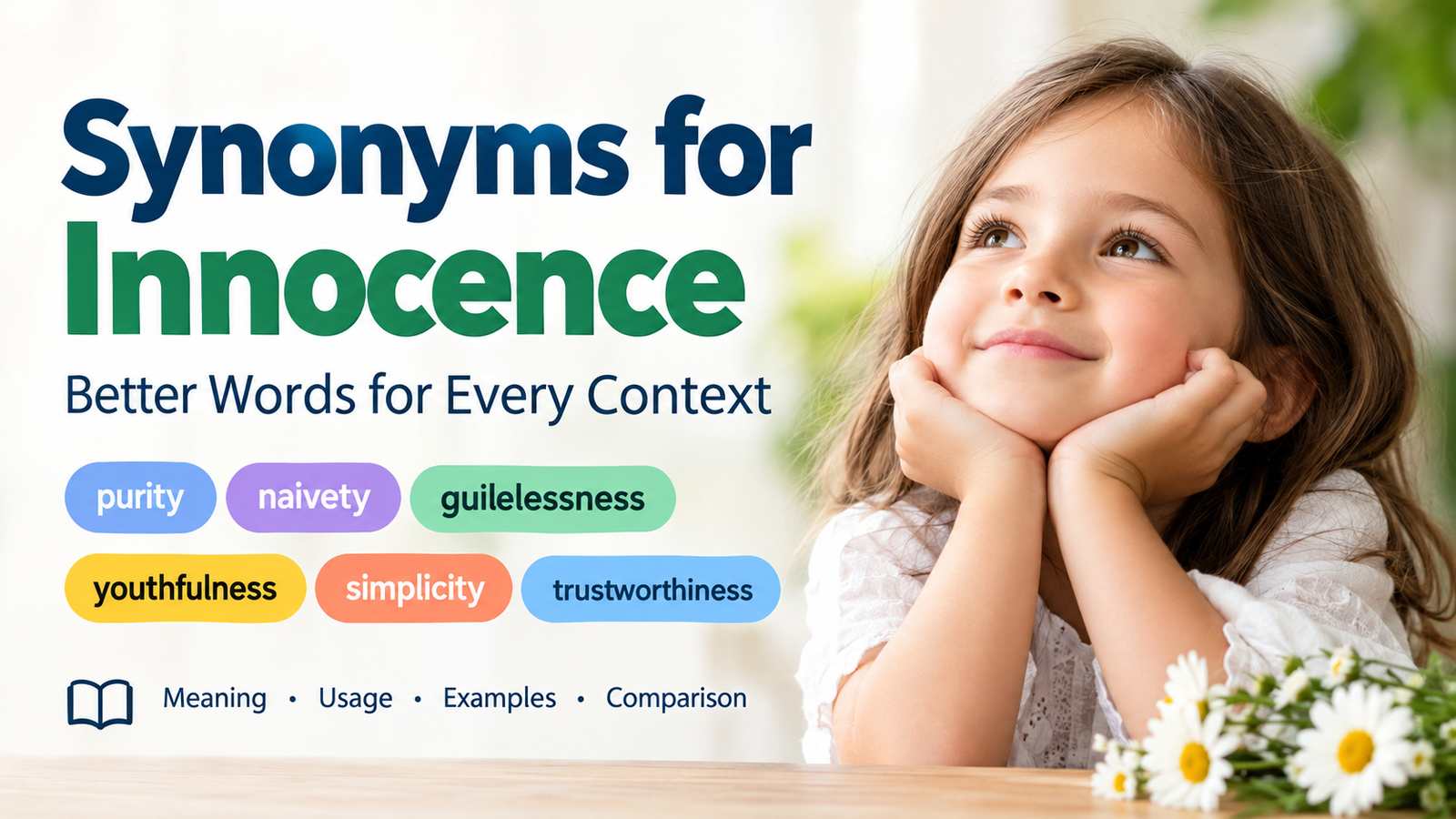
Finding the right synonym for innocence depends on what kind of innocence you mean. If you mean freedom from guilt, words such as guiltlessness and blamelessness are the closest choices. If you mean a lack of worldly experience, naivety, inexperience, and unworldliness may be better. For moral purity, purity or sinlessness can work, while guilelessness emphasizes an absence of deception or cunning.
Quick Answer: What Are the Best Synonyms for Innocence?
The closest synonyms for innocence include guiltlessness, blamelessness, purity, guilelessness, naivety, artlessness, simplicity, sinlessness, harmlessness, and inexperience. However, they are not interchangeable in every situation. Guiltlessness is best for freedom from blame or criminal guilt, while naivety emphasizes limited worldly experience and guilelessness emphasizes a lack of deceit or cunning.
Core Synonyms for Innocence
| Word | Relationship | Meaning | Best Context | Formality |
|---|---|---|---|---|
| Guiltlessness | Direct | Freedom from guilt | Legal or moral responsibility | Neutral/Formal |
| Blamelessness | Direct/Near | Freedom from blame | Conduct, responsibility | Neutral/Formal |
| Purity | Near | Freedom from moral or corrupting influence | Character, intentions, morality | Neutral |
| Guilelessness | Near | Lack of deceit or cunning | Personality, behavior | Formal |
| Naivety | Contextual | Lack of worldly experience | People, childhood | Neutral |
| Naiveté | Contextual | Lack of sophistication or experience | People, attitudes | Neutral |
| Artlessness | Contextual | Naturalness without deception or calculation | Manner, speech, personality | Neutral/Literary |
| Simplicity | Contextual | Lack of sophistication or complexity | Character, outlook | Neutral |
| Inexperience | Contextual | Lack of experience | Young or inexperienced people | Neutral |
| Unworldliness | Contextual | Lack of worldly knowledge | Personality, outlook | Neutral |
| Sinlessness | Near | Freedom from sin | Religious or moral contexts | Formal |
| Harmlessness | Contextual | Lack of intent or capacity to cause harm | Actions, people, remarks | Neutral |
| Impeccability | Near | Freedom from fault or wrongdoing | Conduct, morality | Formal |
| Faultlessness | Near | Absence of faults | Performance, behavior | Neutral/Formal |
| Chastity | Contextual | Sexual or moral purity | Sexual/moral contexts | Formal |
| Innocency | Related/rare | An archaic or formal form of innocence | Historical/literary use | Archaic/Formal |
Major dictionaries support several of these distinctions rather than treating them as universally interchangeable. Cambridge’s thesaurus, for example, groups guiltlessness, blamelessness, impeccability, sinlessness, purity, and chastity under different senses of innocence and separately lists simplicity, artlessness, ingenuousness, guilelessness, and naiveté for the innocence associated with lack of worldly sophistication.
What Does “Innocence” Mean?
Innocence is a noun referring to the state or quality of being innocent. Its meaning changes according to context.
It can mean:
- Freedom from guilt or blame — especially when someone has not committed a crime or wrongdoing.
- Lack of worldly experience — especially when someone does not understand the unpleasant or harmful aspects of life.
- Freedom from guile or cunning — a straightforward, trusting quality.
- Moral or sexual purity — in particular contexts.
- Harmlessness — when an action, remark, or person is not intended to cause harm.
Cambridge defines innocence both as not being guilty of a crime and as having little experience of life and limited knowledge of its unpleasant aspects. Merriam-Webster similarly identifies freedom from legal guilt, lack of knowledge, freedom from guile, lack of worldly sophistication, and chastity among its senses.
Pronunciation
US: /ˈɪn.ə.səns/
UK: /ˈɪn.ə.səns/
The Closest Synonyms for Innocence
1. Guiltlessness
Guiltlessness is one of the strongest direct alternatives when innocence means freedom from guilt or blame.
- The evidence supported his innocence.
- The evidence supported his guiltlessness.
It is especially appropriate in legal or moral contexts. Merriam-Webster lists guiltlessness and blamelessness among the principal words associated with freedom from guilt or blame.
Best for: criminal cases, accusations, wrongdoing, responsibility.
2. Blamelessness
Blamelessness means freedom from blame or responsibility for wrongdoing.
- Her blamelessness was eventually recognized.
- The investigation established his blamelessness.
It can sound more natural than guiltlessness when discussing someone’s conduct rather than a criminal charge.
Best for: behavior, responsibility, moral judgment.
3. Purity
Purity overlaps with innocence when the focus is on being free from corruption, harmful motives, or moral wrongdoing.
- The child’s innocence was reflected in the purity of her intentions.
- His motives were marked by purity rather than self-interest.
However, purity is broader than innocence. It can describe physical substances, motives, morality, or character, so it should not automatically replace innocence.
Best for: motives, character, morality, ideals.
4. Guilelessness
Guilelessness describes someone who lacks deceit, cunning, or a desire to manipulate others.
- His guilelessness made him easy to trust.
- She spoke with complete guilelessness.
This is particularly useful when innocence describes a person’s straightforward nature rather than their legal status.
Best for: personality, speech, trust, sincerity.
5. Sinlessness
Sinlessness means freedom from sin or moral wrongdoing.
- The doctrine emphasizes human sinlessness.
- The character is portrayed as an image of sinlessness.
It has a distinctly moral or religious flavor and is not a general substitute for innocence.
Best for: religious, theological, moral contexts.
Synonyms for Innocence Meaning Lack of Experience
Some of the most common alternatives apply to the “not worldly or experienced” sense of innocence.
Naivety / Naiveté
Naivety and naiveté describe a lack of worldly experience or sophistication.
- Her naivety made her trust the stranger.
- His youthful naiveté was obvious.
They can overlap strongly with innocence, but they may also imply that someone is too trusting or insufficiently aware.
Choose “naivety” when: you want to emphasize limited experience or sophistication.
Inexperience
Inexperience is more neutral and factual.
- His inexperience showed during the negotiation.
- The child’s innocence came partly from inexperience.
Unlike innocence, it does not necessarily imply moral purity or goodness.
Choose “inexperience” when: the central idea is simply a lack of experience.
Unworldliness
Unworldliness describes a person who has limited knowledge of how the world works.
- Her unworldliness made the city seem overwhelming.
- His innocence was partly the result of unworldliness.
It is less common than inexperience or naivety and has a more literary tone.
Artlessness
Artlessness describes natural behavior that lacks calculation, artificiality, or deception.
- The child’s artlessness charmed everyone.
- She answered with refreshing artlessness.
It is a good choice when innocence means natural, unaffected, and without guile.
Simplicity
Simplicity can overlap with innocence when it describes an uncomplicated, unsophisticated outlook.
- He admired the simplicity of her worldview.
- The character retains a childlike simplicity.
But simplicity has many other meanings, so it is not a universal synonym.
Synonyms for Innocence in Moral Contexts
When innocence refers to moral goodness, several alternatives become possible.
Purity
Emphasizes freedom from corruption or morally questionable motives.
Sinlessness
Emphasizes freedom from sin, especially in religious contexts.
Impeccability
Emphasizes freedom from fault or wrongdoing and tends to sound formal.
Virtue
Describes moral excellence rather than innocence itself.
Integrity
Describes strong moral principles and consistency between values and conduct.
These words are related rather than exact substitutes in many sentences. For example:
She maintained her innocence.
Replacing it with:
She maintained her integrity.
changes the meaning. The first concerns whether she was guilty; the second concerns her moral character.
Synonyms for Innocence Meaning Harmlessness
Sometimes innocence refers to an action, remark, or situation that is not intended to cause harm.
In this context, useful alternatives include:
- Harmlessness
- Inoffensiveness
- Innocuousness
For example:
He made the comment in innocence.
Depending on the intended meaning, this could become:
He made the comment without realizing it could cause offense.
Or:
The remark was completely innocuous.
Harmlessness is the clearest alternative when the important point is that something causes no harm.
Merriam-Webster and Collins both recognize harmlessness and related terms as part of the broader semantic range associated with innocence.
Which Word Should I Use?
The best synonym depends on the meaning you want.
Choose “guiltlessness” when:
Someone is free from guilt, especially in relation to an accusation or crime.
The evidence established his guiltlessness.
Choose “blamelessness” when:
You are emphasizing freedom from blame or responsibility.
Her blamelessness was clear to everyone involved.
Choose “purity” when:
You mean moral cleanliness, uncorrupted intentions, or a pure character.
The story celebrates the purity of her intentions.
Choose “naivety” when:
You mean limited worldly experience or sophistication.
His naivety made him easy to deceive.
Choose “guilelessness” when:
You mean a lack of cunning or deception.
Her guilelessness was immediately apparent.
Choose “inexperience” when:
You simply mean that someone has not encountered enough situations to know better.
His inexperience explained the mistake.
Choose “harmlessness” when:
You mean a lack of danger or harmful intent.
The harmlessness of the remark was obvious.
Choose “sinlessness” when:
You are discussing religious or explicitly moral ideas about freedom from sin.
The text presents the figure as an image of sinlessness.
Innocence vs. Guiltlessness
These words overlap closely, but guiltlessness is narrower.
Innocence can describe someone’s lack of guilt, lack of worldly experience, lack of guile, or moral purity.
Guiltlessness specifically focuses on being free from guilt or blame.
Compare:
The child had an appealing innocence.
Here, guiltlessness would sound unnatural.
But:
The defendant maintained his innocence.
Guiltlessness can work when the intended meaning is specifically freedom from guilt.
Innocence vs. Naivety
These words overlap when someone lacks worldly experience, but their connotations differ.
| Word | Main emphasis | Typical connotation |
|---|---|---|
| Innocence | Lack of worldly knowledge or corruption | Often positive or sympathetic |
| Naivety | Lack of experience or sophistication | Can suggest poor judgment |
| Inexperience | Lack of practical experience | Mostly neutral |
| Unworldliness | Limited knowledge of worldly affairs | Often literary |
Compare:
The child’s innocence was touching.
This presents innocence positively.
Her naivety made her vulnerable to the scam.
Here, naivety suggests a disadvantage.
Innocence vs. Purity
Innocence and purity can overlap, particularly in moral or religious contexts, but they are not identical. The word “innocence” often refers to an absence of guilt, experience, or worldly corruption.
Purity emphasizes freedom from contamination, corruption, or undesirable influences.
For example:
The child’s innocence was obvious.
does not necessarily mean:
The child’s purity was obvious.
The second statement has a stronger moral or idealized tone.
Innocence vs. Guilelessness
Guilelessness is a more precise word when innocence means lack of deception or cunning.
Her innocence made her trust everyone.
This could mean she lacked experience.
Her guilelessness made her trust everyone.
This specifically emphasizes her lack of cunning or suspicion.
So, use guilelessness when the contrast is with guile, manipulation, or deception.
Common Mistakes With Innocence Synonyms
Mistake 1: Treating “naivety” as an exact synonym
Naivety usually emphasizes lack of experience or sophistication. It can suggest poor judgment, whereas innocence may be entirely positive.
Mistake 2: Using “purity” in every context
Purity is related to innocence but is broader. It can refer to physical substances, morality, intentions, or character.
Mistake 3: Using “integrity” to mean innocence
Integrity concerns moral principles and honesty. It does not mean that someone is legally innocent.
Mistake 4: Using “acquittal” as a synonym
An acquittal is a legal outcome, not the state of being innocent. Someone can be acquitted without the word itself functioning as a synonym for innocence.
Mistake 5: Confusing innocence with gullibility
Gullibility means being too willing to believe things that may be untrue. It can result from innocence or naivety, but it is not inherently the same thing.
Antonyms of Innocence
The best antonym for innocence depends on the meaning you intend. When innocence refers to freedom from guilt, suitable antonyms include guilt, culpability, blame, and responsibility. If it describes a lack of worldly experience, words such as experience, worldliness, and sophistication are more appropriate.
When innocence refers to moral purity, stronger opposites include corruption, sinfulness, impurity, and depravity. Choosing the antonym based on context makes your writing more precise and natural.
Merriam-Webster identifies guilt and culpability among the principal opposites of innocence in its guilt-related sense.
Frequently Asked Questions
What is the closest synonym for innocence?
The closest synonym depends on the intended sense. Guiltlessness is one of the closest choices when innocence means freedom from guilt. Blamelessness works for freedom from blame, while guilelessness and naivety are better for innocence associated with lack of cunning or worldly experience.
What is another word for innocence in a legal context?
Guiltlessness or blamelessness can work, depending on the sentence. In legal writing, however, innocence is often the clearest and most natural term. Words such as acquittal and exoneration describe legal outcomes or processes rather than being exact synonyms for innocence.
What is a synonym for childlike innocence?
Depending on the intended nuance, useful choices include naivety, simplicity, artlessness, guilelessness, and unworldliness. Naivety emphasizes limited experience, while artlessness and guilelessness emphasize a natural lack of deception.
Is purity a synonym for innocence?
Purity can be a synonym for innocence in certain moral or ethical contexts, but it is not interchangeable in every sentence. Purity emphasizes freedom from corruption or contamination, whereas innocence can also mean freedom from legal guilt or lack of worldly experience.
Is naivety the same as innocence?
No. The words overlap, especially when innocence means lack of worldly experience. Naivety more strongly suggests a lack of sophistication or judgment and can sometimes carry a negative implication.
What is a formal synonym for innocence?
Depending on the meaning, guiltlessness, blamelessness, impeccability, sinlessness, and guilelessness can provide formal alternatives. The best choice depends on whether the context concerns guilt, morality, or lack of deception.
What is the difference between innocence and inexperience?
Inexperience simply means a lack of experience. Innocence can imply lack of experience, but it may also suggest purity, lack of guilt, or freedom from worldly corruption. Therefore, inexperience is narrower in some contexts and more neutral in tone.
What is the opposite of innocence?
The most direct opposite is guilt when innocence means freedom from criminal or moral blame. In other contexts, opposites can include corruption, sinfulness, worldliness, or sophistication, depending on the sense intended.
Conclusion
The best synonym for innocence depends on the idea behind the word. Use guiltlessness for freedom from guilt, blamelessness for freedom from blame, purity for moral cleanliness, guilelessness for a lack of deception, and naivety or inexperience for limited worldly experience. Choosing the right alternative means matching the synonym to the specific meaning, tone, and context rather than selecting the closest-looking word from a thesaurus.

Sarah Williams is an ESL teacher and content writer with a passion for simplifying English vocabulary. She creates easy-to-understand synonym guides and learning resources that help beginners and intermediate learners build strong language skills.