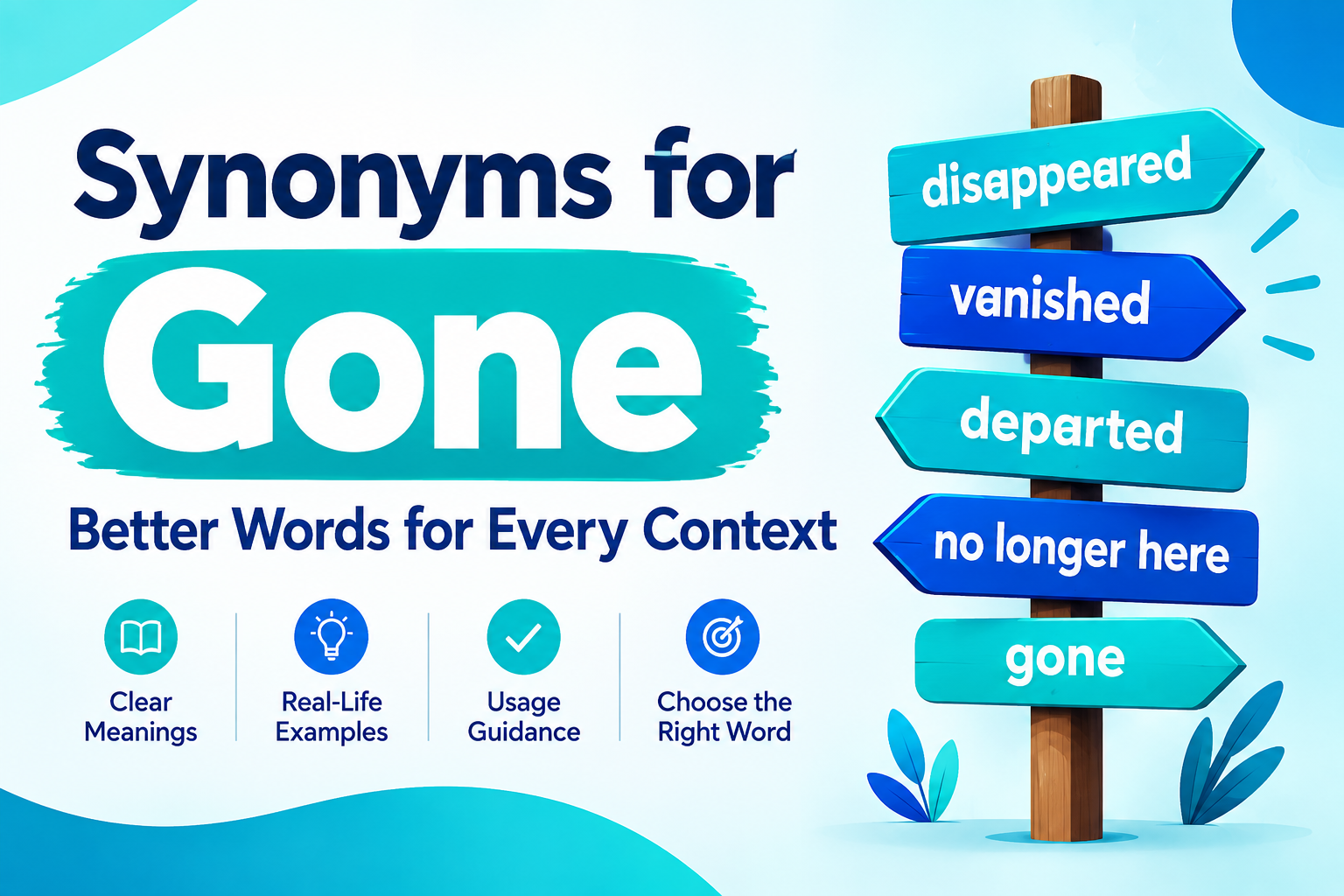
Looking for synonyms for gone can be surprisingly difficult because the word has several meanings.A person may be gone after leaving, a missing item may have disappeared, food may have run out, and a period of time may have ended. In some contexts, gone can also mean dead or no longer existing.
That means there is no single replacement that works in every sentence. The best synonym depends on what has gone, what happened to it, and what meaning you want to emphasize. The alternatives below separate the most useful meanings so you can choose a natural and precise word.
Quick Answer
The closest synonyms for gone include away, absent, departed, missing, disappeared, vanished, left, lost, finished, over, ended, deceased, dead, used up, and past. However, these words are not interchangeable in every context. For example, away usually describes someone who has left a place, missing suggests that someone or something cannot be found, and finished means that an activity or period has ended.
30 Synonyms and Alternatives for Gone
Gone Meaning No Longer Present or in Another Place
When gone means that someone or something is no longer present, several alternatives can fit. Away and absent describe a lack of presence, while left and departed emphasize movement from a place. For things that cannot be located, missing, lost, disappeared, and vanished are more precise. In specific contexts, removed, withdrawn, decamped, and absconded can also replace gone.
| Word | Relationship | Meaning / Use | Best Context |
|---|---|---|---|
| away | Direct synonym in context | Not present; at another place | People, locations |
| absent | Near synonym | Not present where expected | People, attendance |
| left | Contextual alternative | Departed from a place | People, places |
| departed | Near synonym | Left, often more formal | People, journeys |
| missing | Near synonym | Cannot be found or located | People, objects |
| lost | Near synonym | No longer in one’s possession or location | Objects, people |
| disappeared | Near synonym | Became impossible to see or find | People, objects |
| vanished | Near synonym | Disappeared completely or suddenly | People, things |
| removed | Contextual alternative | Taken away from a place | Objects, content |
| withdrawn | Contextual alternative | Moved or taken away | People, support, services |
| decamped | Contextual alternative | Left, often suddenly | People; formal/literary |
| absconded | Contextual alternative | Left secretly to avoid responsibility | People |
Gone Meaning Finished or Past
A different sense appears when gone refers to something that has reached its end. Finished, ended, and over work well for completed activities, events, or situations. When the subject involves time, elapsed, passed, past, and bygone provide more specific alternatives. For periods of validity or usefulness, expired may be the better choice.
| Word | Relationship | Meaning / Use | Best Context |
|---|---|---|---|
| finished | Direct synonym in context | Completed or brought to an end | Tasks, activities |
| ended | Direct synonym in context | Came to an end | Events, periods |
| over | Direct synonym in context | Finished or completed | Events, situations |
| elapsed | Contextual alternative | Time has passed | Time |
| passed | Contextual alternative | Time or a period has gone by | Time, occasions |
| past | Contextual alternative | No longer in the present | Time, historical periods |
| bygone | Contextual alternative | Belonging to an earlier time | Eras, traditions |
| expired | Contextual alternative | Reached its end or validity limit | Contracts, deadlines |
Gone Meaning Dead or No Longer Living
In some contexts, gone serves as a gentle euphemism for death. Deceased suits formal writing, while dead states the meaning directly. Departed can carry a respectful or literary tone, and perished often suggests a serious or tragic death. Meanwhile, extinct applies to living species or groups that no longer exist, whereas defunct describes organizations or businesses that have ceased to operate.
| Word | Relationship | Meaning / Use | Best Context |
|---|---|---|---|
| deceased | Near synonym | No longer living | People; formal |
| dead | Direct synonym in specific context | No longer alive | People, organisms |
| departed | Euphemistic/near synonym | Dead; also means left | People |
| perished | Contextual alternative | Died, often in a serious or tragic context | People, animals |
| extinct | Contextual alternative | No longer existing as a living species or group | Species, organisms |
| defunct | Contextual alternative | No longer operating or existing | Organizations, businesses |
Gone Meaning Completely Used
The word gone can also describe something that has been completely consumed or exhausted. Used up works naturally with supplies, food, and other resources. Consumed emphasizes complete use or eating, while spent commonly refers to money, energy, or resources. The phrase no longer present provides a broader alternative when something has disappeared from a particular situation.
| Word | Relationship | Meaning / Use | Best Context |
|---|---|---|---|
| used up | Direct synonym in context | Completely consumed | Food, money, supplies |
| consumed | Contextual alternative | Completely used or eaten | Resources, food |
| spent | Contextual alternative | Used, exhausted, or expended | Money, energy, resources |
| no longer present | Phrase-level alternative | Not there anymore | People, objects, situations |
The important point is that these are not 30 interchangeable synonyms. They represent different senses and contexts of gone. Cambridge, for example, groups away, absent, departed, disappeared, vanished, missing, dead, deceased, ended, finished, and over among words related to gone, while Oxford separately identifies meanings such as being away from a place, being used up, and referring to a situation that no longer exists.
What Does “Gone” Mean?
Gone is the past participle of go, and English speakers also commonly use it as an adjective.
As an adjective, it can describe something that is:
- no longer in a particular place
- no longer available
- completely used up
- no longer existing
- finished or ended
- dead
For example:
- Sarah has left.
- Someone has spent the money, or it is no longer available.
- The opportunity no longer exists.
- His grandparents have died.
Oxford specifically defines gone as meaning that something has run out, a person has left a place, or, in formal use, a situation no longer exists. Cambridge also records gone as a way to refer to someone who is dead.
The Closest Synonyms for “Gone”
1. Away
Away is one of the closest alternatives when gone means that someone is not at a particular place.
Tom is gone.
Tom is away.
However, away often emphasizes absence rather than the act of leaving.
Best for: people, locations, temporary absence
2. Absent
Absent means that someone or something is not present where expected.
Maria was absent from class.
It is more formal than away and is especially common in education, work, and official contexts.
Best for: attendance, formal writing, people
3. Left
Left is often the most natural alternative when gone means that someone departed.
James is gone.
James has left.
The two expressions are close, but left more clearly describes the action of departing.
Best for: people leaving places
4. Departed
Departed means left, but it has a more formal or literary tone.
The train has departed.
It can also refer euphemistically to someone who has died.
Best for: formal writing, travel, literary contexts
5. Missing
Missing means that someone or something is not currently where people expect to find them or it.
My phone is gone.
My phone is missing.
The second sentence strongly emphasizes the inability to locate the phone.
Best for: people and objects that you cannot find.
6. Disappeared
Disappeared means that someone or something became impossible to see or find.
The bird was gone before I could take a photograph.
The bird disappeared before I could take a photograph.
Unlike gone, disappeared emphasizes the process or result of becoming unseen or unavailable.
7. Vanished
Vanished is stronger and often more dramatic than disappeared.
The fog had vanished by noon.
It works especially well when something seems to disappear completely or suddenly.
Synonyms for “Gone” Meaning Finished
Sometimes gone refers to something that has ended rather than something that has physically left.
Finished
Use finished when you complete an activity, task, or process.
The meeting is finished.
Ended
Use ended when an event, period, or situation has come to an end.
The storm has ended.
Over
Over is natural and conversational when something has finished.
The exam is over.
Elapsed
Elapsed is mainly used to describe time that has passed.
Two hours have elapsed.
It is not a general replacement for gone. You would not normally say that a person has “elapsed.”
Passed
Passed can describe time that has moved by.
The summer has passed.
Therefore, passed works well for time but not as a universal replacement for gone.
Synonyms for “Gone” Meaning No Longer Available
When something disappears because people consume, use, or exhaust it, different vocabulary can describe the situation more precisely.
Used up
All the milk is gone.
All the milk has been used up.
Used up clearly means that nothing remains.
Consumed
Consumed is more formal and works well for food, energy, fuel, and resources.
The entire budget was consumed by the project.
Spent
Spent is particularly natural for money, time, or energy.
All our savings are gone.
All our savings have been spent.
However, spent does not work for every type of disappearance.
Synonyms for “Gone” Meaning Dead
Gone as a Euphemism for Death
When gone refers to someone who has died, it works as a gentle euphemism rather than a literal synonym for left or departed. The right replacement depends on the tone and situation.
For example, died is clear and neutral, while passed away sounds more respectful and sensitive. Deceased fits formal writing, whereas passed on and left us create a softer, more emotional tone.
Therefore, consider the context before replacing gone. In a factual sentence, died may be the clearest choice. In a condolence message, passed away may sound more appropriate.
Dead
Dead is direct and clear.
His old dog is gone.
His old dog is dead.
The first sentence may sound gentler; the second is explicit.
Deceased
Deceased is formal and commonly used in official or respectful contexts.
The deceased person’s family was notified.
Departed
Departed can be a euphemistic or literary reference to someone who has died.
She remembered her departed parents.
Perished
Perished usually suggests death under difficult, dangerous, or tragic circumstances.
Several people perished in the disaster.
Extinct
Extinct is generally used for species, organisms, or things that no longer exist.
The species is now extinct.
It is therefore not a normal synonym for a person who has died.
Synonyms for “Gone” Meaning No Longer Existing
Some uses of gone describe something that has disappeared from existence.
Extinct
Use extinct for a species or other biological group that no longer has living members.
Defunct
Use defunct for a business, organization, system, or institution that no longer operates.
The company is now defunct.
Bygone
Use bygone for something belonging to an earlier period.
The museum preserves traditions from a bygone era.
Past
Past works when something belongs to an earlier time.
Those days are past.
These words should not be treated as universal synonyms for gone. Their meanings are much narrower.
Which Word Should I Use Instead of “Gone”?
The best replacement depends on your sentence.
| If you mean… | Best choice |
|---|---|
| A person left | left / departed |
| Someone is not here | away / absent |
| Someone cannot be found | missing |
| Something cannot be found | missing / lost |
| Something disappeared | disappeared / vanished |
| An event finished | ended / over |
| A task was completed | finished |
| Time passed | elapsed / passed |
| Something was consumed | used up / consumed |
| Money was used | spent |
| Someone died | dead / deceased |
| A species no longer exists | extinct |
| A company no longer operates | defunct |
| An old period is being described | bygone / past |
Gone vs. Away
Gone and away overlap when someone is not present.
Is John here? No, he’s gone.
Is John here? No, he’s away.
However, away often sounds more neutral when describing temporary absence. Gone can simply state that the person has left.
Choose “away” when absence is the main idea.
Choose “gone” when you want to emphasize that the person has left.
Gone vs. Missing
These words are not always interchangeable.
Missing specifically emphasizes that a person or object cannot be found.
My keys are gone.
This could mean they were taken, misplaced, or simply are no longer there.
My keys are missing.
This more directly suggests that you cannot locate them.
Choose “missing” when the inability to locate something matters.
Gone vs. Disappeared
Disappeared focuses on the fact that someone or something became unseen or unavailable.
The wallet is gone.
This simply states the result.
The wallet disappeared.
This draws more attention to the disappearance itself.
Gone vs. Left
Left is usually clearer when describing departure.
Sarah is gone.
This tells us Sarah is no longer there.
Sarah left.
This explicitly tells us that Sarah departed.
Therefore, left is often the better choice when the action of departure is important.
Common Mistakes With “Gone” Synonyms
Mistake 1: Treating every thesaurus entry as interchangeable
Words such as dead, extinct, finished, missing, absent, and spent can relate to gone, but they describe different situations.
Mistake 2: Using “elapsed” for people
Elapsed is primarily associated with time.
Incorrect:
John has elapsed.
Natural:
Three hours have elapsed.
Mistake 3: Using “extinct” for ordinary disappearance
If your phone cannot be found, it is missing, not extinct.
Mistake 4: Using “deceased” in casual conversation
Deceased is formal. In ordinary conversation, dead or the softer gone may sound more natural depending on the context.
Mistake 5: Assuming “away” always means permanently gone
Away often suggests temporary absence.
She is away on vacation.
That does not imply that she has permanently left.
Antonyms of “Gone”
The opposite of gone depends on its meaning.
For physicWhen something is absent, useful antonyms include:
- present
- here
- available
- nearby
For something that has disappeared, consider:
- found
- present
- available
When something is finished, suitable antonyms include:
- ongoing
- unfinished
- continuing
For someone who has died, the opposite terms are:
- alive
- living
If something has been used up, suitable antonyms include:
- available
- remaining
- unused
- full
This is another reason a single antonym cannot cover every use of gone.
FAQ
What is the closest synonym for “gone”?
The closest synonym depends on the meaning. Away is very close when a person has left a place, while absent emphasizes non-presence. Missing works when someone or something cannot be found, and finished or over works when gone means completed.
What is a formal synonym for “gone”?
The appropriate formal alternative depends on context. Departed can mean left, absent means not present, deceased means dead, and elapsed describes time that has passed. There is no single formal synonym that replaces gone in every situation.
What is another word for “gone away”?
Away, departed, left, and absent can work depending on the sentence. Left emphasizes departure, while away usually emphasizes the person’s absence.
What is another word for “gone missing”?
Missing, disappeared, vanished, or lost may work. Missing is usually the most direct choice when someone or something cannot be found.
What is another word for “gone forever”?
Depending on the context, you might use lost, vanished, disappeared, extinct, or deceased. The correct choice depends on whether you are talking about an object, opportunity, species, or person.
Is “gone” the same as “dead”?
Not always. Gone can be a softer way of saying that someone has died, but it also commonly means that someone has left or that something is no longer available. Dead specifically means no longer living.
Is “gone” the same as “missing”?
Not necessarily. Missing means that someone or something cannot be found. Gone has a much wider range of meanings, including left, absent, used up, finished, or dead.
What is the difference between “gone” and “left”?
Gone describes a state of no longer being present, while left more directly describes departure. For example, “She is gone” focuses on her absence, whereas “She left” focuses on the fact that she departed.
Conclusion
The best synonym for gone depends on the exact meaning you want to express. When a person has left, left, away, or departed may fit the context. Something that cannot be found may be better described as missing, lost, or disappeared. If something has reached an ending, consider finished, ended, or over. In the context of something consumed, used up or spent may be more precise. When referring to death, dead or deceased may be appropriate.
Instead of choosing a synonym simply because it appears in a thesaurus, identify the meaning of gone in your sentence first. That small distinction leads to much more natural and precise English.

Daniel Carter is a professional content strategist and language enthusiast. He focuses on semantic SEO, keyword research, and creating structured vocabulary content that ranks well on search engines while remaining user-friendly.