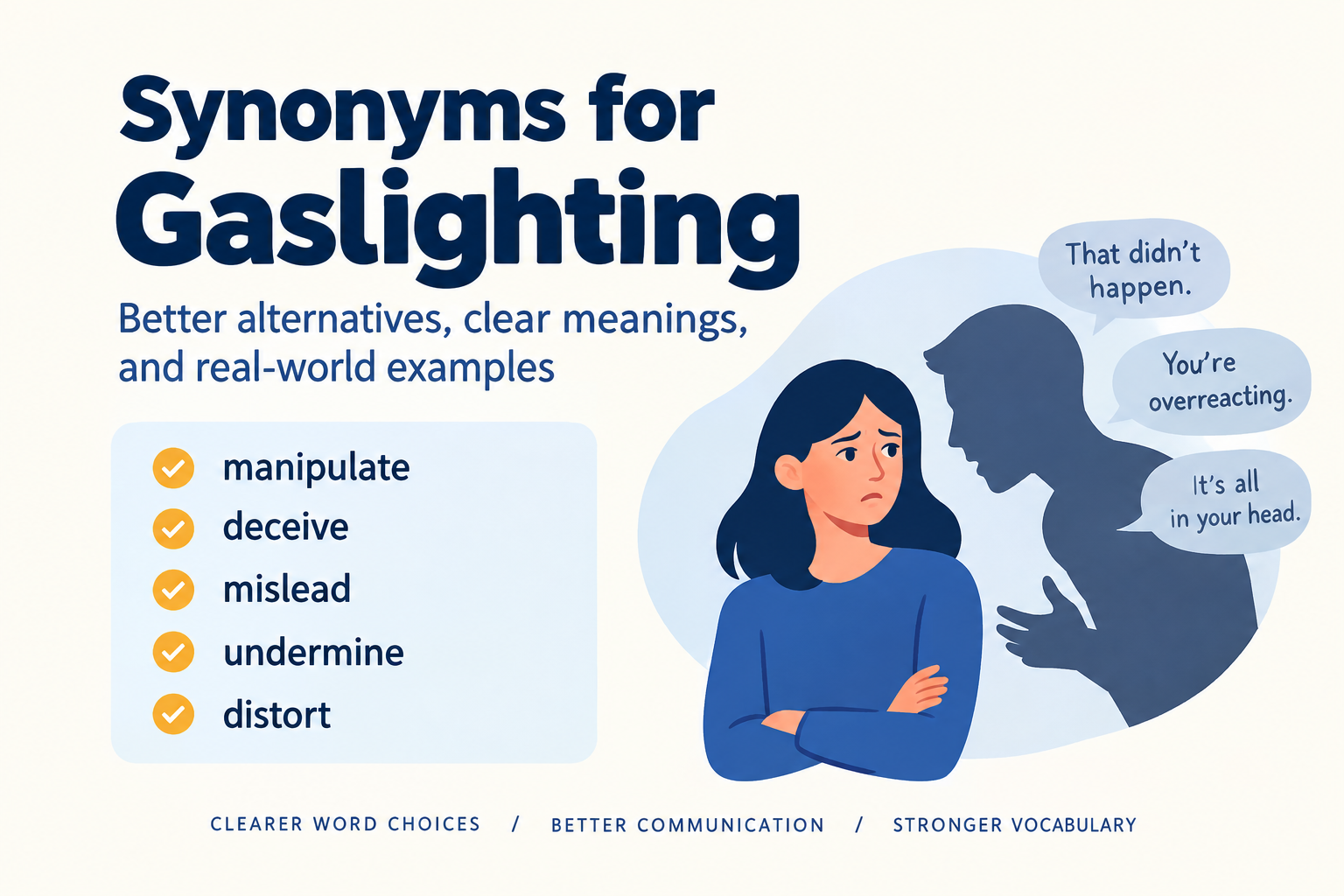
If you’re looking for synonyms for gaslighting, the closest alternatives include psychological manipulation, manipulation, reality distortion, emotional manipulation, deception, misleading, and mind games. However, these words are not interchangeable in every situation. Gaslighting specifically involves manipulating someone in a way that causes them to doubt their perceptions, memories, beliefs, or understanding of reality.
Quick Answer
The closest alternatives to gaslighting are psychological manipulation, reality distortion, emotional manipulation, manipulation, and deliberate deception. Depending on context, denial, invalidation, misleading, mind games, or coercive control may describe part of the behavior, but they are not exact synonyms. Choose the term that captures the specific kind of manipulation you mean.
Best Synonyms for Gaslighting
| Word or phrase | Relationship | Best context | Formality |
|---|---|---|---|
| Psychological manipulation | Very close | Making someone question their perceptions or beliefs | Formal |
| Manipulation | Close | General influence through deceptive or controlling tactics | Neutral |
| Reality distortion | Close/contextual | Altering or challenging someone’s perception of events | Formal |
| Emotional manipulation | Near synonym | Exploiting emotions to influence someone | Neutral |
| Deception | Near synonym | Deliberately making someone believe something false | Neutral |
| Misleading | Contextual alternative | Giving someone a false or distorted impression | Neutral |
| Denial | Technique | Rejecting events or facts that someone remembers | Neutral |
| Invalidation | Contextual alternative | Dismissing someone’s feelings, perceptions, or experiences | Formal |
| Mind games | Contextual alternative | Informal psychological tactics intended to confuse or control | Informal |
| Psychological abuse | Related/overlapping | Persistent harmful manipulation in an abusive context | Formal |
| Emotional abuse | Related/overlapping | Repeated behavior that harms or controls emotionally | Neutral |
| Coercive control | Related | A pattern of controlling another person’s behavior or autonomy | Formal |
| Brainwashing | Near/related | Intensive attempts to change beliefs or attitudes | Strong |
| Lying | Broader alternative | Simply telling something untrue | Neutral |
| Distortion | Contextual alternative | Presenting facts or events inaccurately | Neutral |
| Disinformation | Context-specific | Deliberately spreading false information | Formal |
| Confusion | Related result | Describing the effect rather than the manipulation | Neutral |
| Deceit | Near synonym | Dishonest behavior intended to mislead | Formal |
| Misrepresentation | Contextual alternative | Presenting something inaccurately or falsely | Formal |
| Psychological control | Close/related | Controlling another person’s thoughts or perceptions | Formal |
Important: not all 20 expressions are exact synonyms. That distinction matters because gaslighting has a narrower meaning than general manipulation or lying.
What Does Gaslighting Mean?
Gaslighting is the act of manipulating someone so that they begin to doubt their own thoughts, perceptions, memories, or understanding of reality. Cambridge defines it as tricking or controlling someone by making them believe things that are not true, particularly by suggesting that they may be mentally unwell.
Merriam-Webster similarly defines it as psychological manipulation, usually occurring over time, that causes a person to question their thoughts, perception of reality, or memories. The dictionary also recognizes a broader modern use involving grossly misleading someone for personal advantage.
So, gaslighting is more specific than simply lying.
For example:
“I never said that. You must be imagining things.”
If someone repeatedly uses statements like this to make another person doubt their own memory or perception, gaslighting may be an appropriate term.
1. Psychological Manipulation
Psychological manipulation is one of the closest formal alternatives to gaslighting.
It refers broadly to influencing someone’s thoughts, emotions, perceptions, or behavior through psychological tactics. Gaslighting is one particular form of psychological manipulation.
Example:
The repeated denial was a form of psychological manipulation designed to make him question his memory.
Use it when: you want a professional or academic expression and the specific behavior involves manipulating someone’s thinking.
2. Manipulation
Manipulation is a broader word than gaslighting.
It means influencing someone unfairly, deceptively, or strategically for your own advantage. Unlike gaslighting, manipulation does not necessarily involve making someone doubt reality.
Example:
She recognized the conversation as emotional manipulation.
Best for: general writing where the exact psychological mechanism is not important.
3. Reality Distortion
Reality distortion is a useful contextual alternative when the central idea is making someone perceive events differently from what actually happened.
It is particularly useful in analytical or professional writing.
Example:
The repeated rewriting of past events created a pattern of reality distortion.
It is closer to gaslighting than ordinary deception because it focuses on someone’s perception of reality.
4. Emotional Manipulation
Emotional manipulation describes attempts to influence someone by exploiting their emotions.
It overlaps with gaslighting but is not identical.
Someone can emotionally manipulate another person without causing them to doubt their memory or perception.
Example:
His guilt-tripping and emotional manipulation made it difficult for her to set boundaries.
Use it when: emotions are the primary tool.
5. Deception
Deception means deliberately causing someone to believe something that is false or misleading.
It is a useful broader alternative, but it does not automatically imply gaslighting.
Example:
The repeated deception damaged their trust.
Gaslighting vs deception
Deception focuses on making someone believe something false.
Gaslighting goes further when the deception is used to undermine the person’s confidence in their own perception, memory, or judgment.
6. Misleading
Misleading works well when you want a neutral way to describe giving someone a false or inaccurate impression.
Example:
The statement was misleading and caused readers to question what had actually happened.
It is especially useful in professional, journalistic, and formal contexts.
7. Denial
Denial is not an exact synonym for gaslighting, but it can be a gaslighting tactic.
A person may repeatedly deny something that happened in order to make another person question their memory.
Example:
His constant denial of conversations she clearly remembered contributed to the gaslighting.
Key distinction
Denial = rejecting or refusing to acknowledge something.
Gaslighting = manipulating someone so that they question their own perception or memory.
8. Invalidation
Invalidation means dismissing, rejecting, or treating someone’s feelings, perceptions, or experiences as unjustified or unimportant.
It overlaps with gaslighting when someone repeatedly dismisses another person’s perception of events.
Example:
Constantly telling her that her feelings were irrational became a form of emotional invalidation.
However, invalidation does not necessarily involve deception or deliberate attempts to alter someone’s sense of reality.
9. Mind Games
Mind games is an informal expression for psychological tactics intended to confuse, unsettle, influence, or control someone.
Example:
I don’t have time for his mind games.
It can work as a casual alternative to gaslighting, but it is less precise.
Use mind games when the context is conversational rather than academic or professional.
10. Psychological Abuse
Psychological abuse is a broader term describing harmful behavior that affects a person’s emotional or psychological well-being.
Gaslighting can be a form of psychological abuse, but psychological abuse includes many behaviors that are not gaslighting.
Example:
Repeated humiliation and psychological abuse can seriously damage a person’s confidence.
Cambridge explicitly describes gaslighting as a form of psychological abuse.
11. Emotional Abuse
Emotional abuse is another broader term.
It may include manipulation, intimidation, humiliation, threats, controlling behavior, or persistent emotional harm.
Example:
The relationship involved a pattern of emotional abuse and manipulation.
Don’t use emotional abuse as an exact replacement for gaslighting when you specifically mean making someone question reality.
12. Coercive Control
Coercive control describes a pattern of behavior intended to dominate or restrict another person’s freedom, choices, or autonomy.
It can overlap with gaslighting, particularly in abusive relationships, but it is conceptually broader.
Example:
The relationship involved coercive control, isolation, and psychological manipulation.
Choose this term when control and restriction are more important than challenging someone’s perception of reality.
13. Brainwashing
Brainwashing is a much stronger term and should not be used casually as a direct synonym.
It generally suggests intensive attempts to change someone’s beliefs, attitudes, or behavior.
Example:
The novel portrays an extreme system of ideological conditioning.
Although some thesaurus pages list brainwashing alongside gaslighting, the concepts are not interchangeable.
Use brainwashing only when the context genuinely involves intensive ideological or psychological conditioning.
14. Lying
Lying is one of the broadest possible alternatives.
A person who gaslights may lie, but not every lie is gaslighting.
Example:
He lied about where he had been.
Compare:
He repeatedly denied events that she remembered clearly and insisted that she was imagining them.
The second example better illustrates gaslighting because the deception targets her confidence in her own perception.
15. Distortion
Distortion can describe presenting information, events, or facts in a misleading or inaccurate way.
Example:
The repeated distortion of what happened made the situation difficult to understand.
It works especially well when discussing information, narratives, or public communication.
16. Disinformation
Disinformation means deliberately spreading false information.
It can overlap with the broader modern use of gaslighting, particularly in public or political contexts, but it is not an exact synonym.
Example:
The campaign deliberately spread disinformation to influence public opinion.
Merriam-Webster notes that modern gaslighting can be used in broader contexts involving deliberate misleading, including political contexts.
17. Deceit
Deceit is a formal word for dishonest behavior intended to mislead someone.
Example:
The investigation uncovered a pattern of deliberate deceit.
It is a good choice in formal prose when you want to emphasize dishonesty rather than psychological manipulation.
18. Misrepresentation
Misrepresentation means presenting something inaccurately or falsely.
It is especially useful in business, legal, academic, and professional contexts.
Example:
The report contained a serious misrepresentation of the events.
Use it when the issue is false presentation of information, rather than manipulation of someone’s sense of reality.
19. Psychological Control
Psychological control emphasizes attempts to control another person’s thoughts, perceptions, or behavior.
Example:
The pattern involved psychological control and repeated manipulation.
It is a useful formal alternative when gaslighting sounds too informal or too specific for the context.
20. Confusion
Confusion is not a synonym for gaslighting itself. It is often a result of gaslighting.
Example:
The contradictory explanations left her in a state of confusion.
This distinction is important: gaslighting can cause confusion, but confusion alone is not gaslighting.
Which Word Should I Use Instead of Gaslighting?
The best alternative depends on what you are actually describing.
Choose “psychological manipulation” when:
You want the closest formal, broad description of the behavior.
Choose “manipulation” when:
You are discussing unfair influence generally.
Choose “reality distortion” when:
The behavior specifically involves changing or challenging someone’s perception of events.
Choose “deception” when:
The main issue is deliberately making someone believe something false.
Choose “denial” when:
Someone repeatedly rejects an event, statement, or fact.
Choose “invalidation” when:
Someone dismisses another person’s feelings, experiences, or perceptions.
Choose “mind games” when:
You want an informal expression for confusing or psychologically manipulative behavior.
Choose “psychological abuse” when:
You are describing a broader pattern of harmful psychological behavior.
Choose “coercive control” when:
The central issue is domination, restriction, or control over another person’s autonomy.
Choose “lying” when:
You simply mean telling something untrue.
Gaslighting vs. Manipulation
| Gaslighting | Manipulation |
|---|---|
| A specific form of psychological manipulation | Broad category of influence |
| Often targets perception, memory, or reality | Can target emotions, decisions, behavior, or resources |
| May cause someone to doubt themselves | Does not necessarily cause self-doubt |
| Can involve repeated denial or distortion | Can involve many different tactics |
| More specific | More general |
Bottom line: Gaslighting is a type of manipulation, but manipulation is not necessarily gaslighting.
Gaslighting vs. Lying
The distinction is even clearer here.
Lying means deliberately saying something untrue.
Gaslighting can involve lying, but the manipulation typically has a further effect: it causes the other person to question their own memory, perception, judgment, or understanding of reality.
Example of lying:
“I didn’t take your keys.”
Example of gaslighting:
“I didn’t take your keys. You never left them there. You’re always forgetting where you put things.”
The second statement combines denial with an attempt to undermine the person’s confidence in their own memory.
Gaslighting vs. Deception
Deception is broader than gaslighting.
A company that hides important information may be deceptive, but that does not necessarily constitute gaslighting.
Gaslighting is more specifically associated with manipulating another person’s understanding of reality.
Common Mistakes When Using “Gaslighting” Synonyms
Mistake 1: Calling every lie gaslighting
Not every lie is gaslighting. The term is more specific.
Mistake 2: Treating manipulation and gaslighting as identical
Manipulation is a broader category. Gaslighting is one particular type.
Mistake 3: Using “brainwashing” casually
Brainwashing suggests intensive conditioning and is much stronger than ordinary gaslighting.
Mistake 4: Calling confusion gaslighting
Confusion may be an effect of gaslighting, not the behavior itself.
Mistake 5: Using “cognitive dissonance” as a synonym
Cognitive dissonance describes psychological discomfort arising from conflicting beliefs or attitudes. It is not another word for gaslighting.
Mistake 6: Calling every disagreement gaslighting
A disagreement, correction, or different memory of an event is not automatically gaslighting. The term should be used when the behavior actually fits its meaning.
What Is the Most Professional Word for Gaslighting?
The best professional alternative is usually psychological manipulation, although the exact choice depends on what happened.
For example:
- Psychological manipulation — formal and broad
- Reality distortion — emphasizes perception of events
- Misrepresentation — emphasizes inaccurate presentation
- Deception — emphasizes deliberate misleading
- Coercive control — emphasizes domination and restriction
In professional writing, choose the most precise term rather than replacing gaslighting automatically.
What Is a More Formal Way to Say Gaslighting?
Depending on the context, formal alternatives include:
psychological manipulation, reality distortion, deliberate deception, psychological control, invalidation, misrepresentation, and coercive control.
However, psychological manipulation is usually the safest broad formal alternative when you need to describe the underlying behavior without relying on the more specific term gaslighting.
FAQ: Synonyms for Gaslighting
What is another word for gaslighting?
The closest broad alternative is psychological manipulation. Depending on context, reality distortion, emotional manipulation, deception, invalidation, or mind games may also work. None is an exact substitute in every sentence because gaslighting has a specific meaning involving manipulation of someone’s perception, memory, or understanding of reality.
What is the closest synonym for gaslighting?
Psychological manipulation is one of the closest alternatives. Reality distortion can be even more specific when the behavior involves making someone question what actually happened. The best choice depends on whether you want to emphasize manipulation generally or distortion of someone’s perception.
Is manipulation the same as gaslighting?
No. Gaslighting is a type of manipulation, but manipulation is much broader. Someone can manipulate another person’s emotions, decisions, or behavior without causing them to question their memory or perception of reality.
Is lying another word for gaslighting?
Not exactly. Lying means deliberately saying something untrue. Gaslighting may involve lying, but it typically involves an additional attempt to undermine someone’s confidence in their own perception, memory, or judgment.
What is a professional synonym for gaslighting?
Psychological manipulation is usually a strong professional alternative. Depending on the situation, reality distortion, psychological control, misrepresentation, or coercive control may be more precise.
What is a casual synonym for gaslighting?
Mind games is a common informal expression for psychologically manipulative behavior. However, it is less precise than gaslighting and can describe many behaviors that do not involve manipulating someone’s perception of reality.
Is psychological abuse the same as gaslighting?
No. Gaslighting can be a form of psychological abuse, but psychological abuse is a broader category. It can include intimidation, humiliation, threats, controlling behavior, and other harmful patterns that are not necessarily gaslighting. Cambridge specifically identifies gaslighting as a form of psychological abuse.
Is brainwashing a synonym for gaslighting?
Not exactly. Brainwashing generally suggests intensive conditioning intended to change beliefs or behavior, while gaslighting specifically involves manipulating someone so they question their own perceptions, memories, or understanding of reality.
Conclusion
The best synonyms for gaslighting depend on the exact behavior you want to describe. Psychological manipulation is the closest broad formal alternative, while reality distortion emphasizes interference with someone’s perception of events. Deception and misrepresentation work when false information is central; invalidation fits dismissed experiences or feelings; and mind games works in informal conversation.
The key distinction is simple: gaslighting is more specific than lying, deception, or manipulation. It describes manipulation that undermines a person’s confidence in their own perceptions, memories, beliefs, or understanding of reality.

Daniel Carter is a professional content strategist and language enthusiast. He focuses on semantic SEO, keyword research, and creating structured vocabulary content that ranks well on search engines while remaining user-friendly.