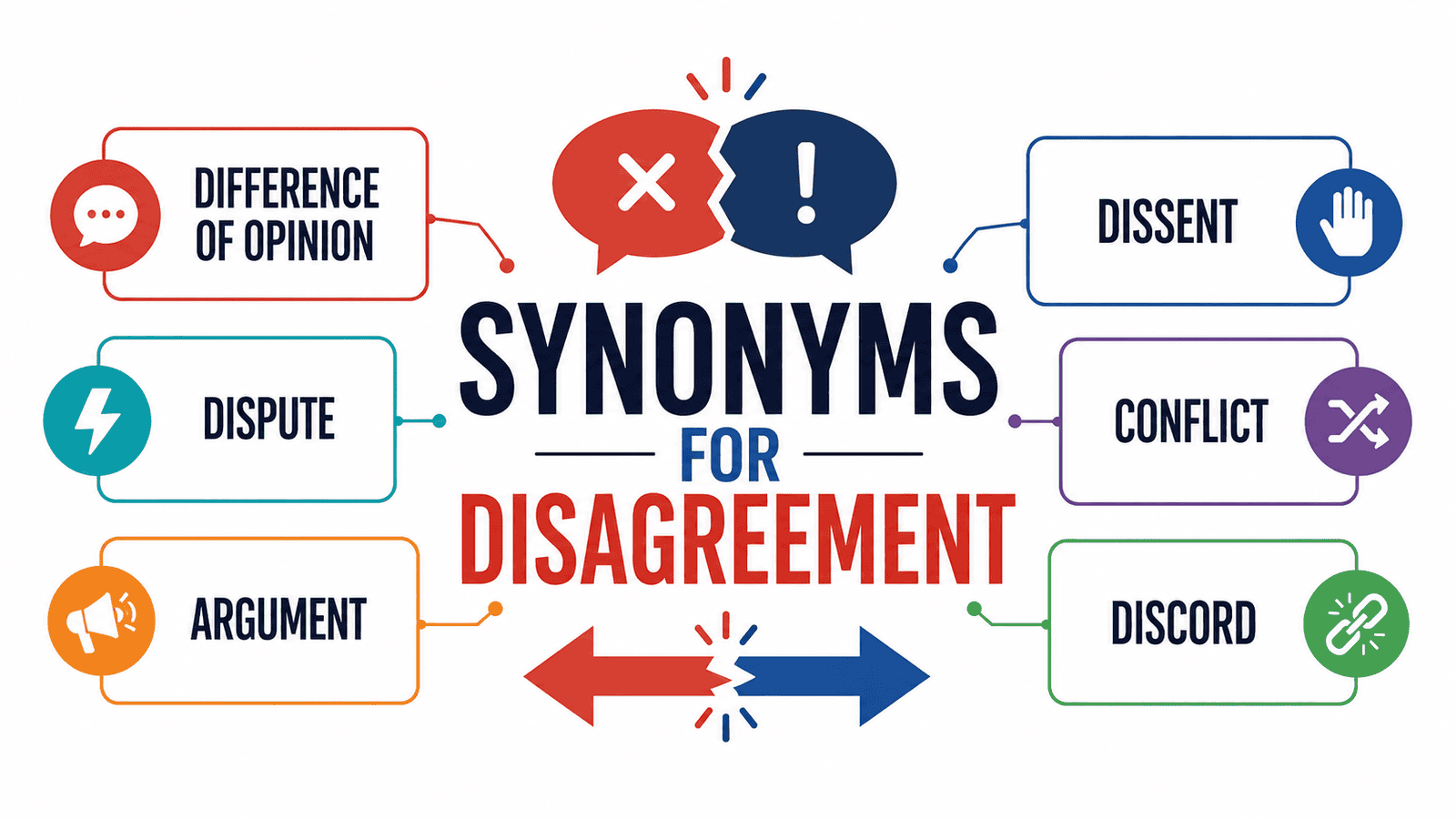
When you need a synonym for disagreement, the best choice depends on what kind of difference you mean. Difference of opinion is neutral, dispute often suggests a serious issue, argument emphasizes a verbal exchange, dissent focuses on opposing a prevailing view, and conflict suggests a broader or more serious clash. Other alternatives, such as discord, controversy, quarrel, and clash, add their own shades of meaning.
This guide explains the most useful synonyms for disagreement, how they differ, and which one sounds most natural in professional, academic, personal, and everyday contexts.
Quick Answer: What Are the Best Synonyms for Disagreement?
The best synonyms for disagreement include difference of opinion, dispute, argument, dissent, discord, conflict, dissension, controversy, quarrel, clash, and contention. However, they are not interchangeable in every sentence. Use difference of opinion for a neutral difference in views, dispute for a serious issue, argument for a verbal disagreement, and dissent for opposition to an accepted or official position.
Core Synonyms for Disagreement
The best synonym for disagreement depends on the type, tone, and context of the difference. Some alternatives are neutral, while others suggest a serious conflict, a public controversy, or opposition to an established view.
Neutral and Common Alternatives
| Word | Relationship | Meaning | Tone / Strength | Best Context |
|---|---|---|---|---|
| Difference of opinion | Direct alternative | People hold different views | Neutral, mild | General and professional |
| Difference | Direct/near alternative | A lack of agreement or similarity | Neutral | General discussion |
| Argument | Near synonym | A disagreement expressed through opposing statements | Neutral to strong | Conversations and personal situations |
| Debate | Related/contextual | A structured exchange of opposing views | Neutral | Academic, political, public |
These words are useful when people have different views but the situation does not necessarily involve serious hostility or conflict.
Stronger Synonyms for Disagreement
| Word | Relationship | Meaning | Tone / Strength | Best Context |
|---|---|---|---|---|
| Dispute | Near synonym | A serious disagreement that may need resolution | Moderate to strong | Business, legal, public issues |
| Conflict | Near synonym | A serious or sustained clash | Strong | People, groups, interests |
| Discord | Near synonym | Lack of harmony or agreement | Moderate | Groups, relationships, organizations |
| Dissension | Near synonym | Disagreement within a group | Formal | Organizations, politics |
| Quarrel | Contextual synonym | An angry or personal disagreement | Strong / personal | Relationships |
| Clash | Contextual synonym | A sharp conflict between opposing views or interests | Strong | Ideas, personalities, interests |
| Feud | Contextual alternative | A prolonged, bitter disagreement | Strong | Families, individuals, groups |
Use these words when the disagreement is more serious, persistent, emotional, or confrontational than an ordinary difference of opinion.
Formal and Context-Specific Alternatives
| Word | Relationship | Meaning | Tone / Strength | Best Context |
|---|---|---|---|---|
| Dissent | Contextual synonym | Open disagreement with an established view or decision | Formal | Politics, academia, organizations |
| Contention | Near synonym | A point or matter being disputed | Formal | Academic, legal, professional |
| Controversy | Contextual synonym | Public disagreement over an issue | Strong / public | Media, politics, social issues |
| Divergence | Contextual alternative | A difference between views or positions | Formal | Opinions, policies, approaches |
| Objection | Contextual alternative | An expression of opposition to something | Neutral to formal | Decisions, proposals, plans |
| Friction | Contextual alternative | Tension caused by continuing differences | Moderate | Teams, relationships, workplaces |
These alternatives are especially useful when the disagreement involves formal decisions, public issues, professional relationships, or opposing positions.
Related Words and Rare Alternatives
| Word | Relationship | Meaning | Tone / Strength | Best Context |
|---|---|---|---|---|
| Misunderstanding | Related word | A failure to understand correctly | Usually mild | Personal communication |
| Disaccord | Rare/formal alternative | Lack of agreement or harmony | Formal / uncommon | Formal or literary writing |
| Disharmony | Near synonym | Lack of harmony or unity | Moderate | Groups, relationships, systems |
These words should not automatically replace disagreement. For example, a misunderstanding may cause a disagreement, while disharmony describes a lack of harmony more broadly.
Merriam-Webster lists words such as dispute, controversy, debate, dissension, contention, conflict, discord, quarrel, and argument among related terms for disagreement. Cambridge likewise distinguishes between disagreement involving an argument and a simple difference of opinion. The important point is that these words have overlapping meanings but are not interchangeable in every context.
What Does “Disagreement” Mean?
Disagreement is a noun referring to a situation in which people have different opinions or fail to agree. It can describe something relatively mild, such as two coworkers having different ideas, or something more serious, such as a dispute between organizations. Cambridge lists the common patterns disagreement about, disagreement over, and disagreement with, while Oxford also gives examples of disagreement between and disagreement among.
Pronunciation
US: /ˌdɪs.əˈɡriː.mənt/
UK: /ˌdɪs.əˈɡriː.mənt/
The Most Useful Synonyms Explained
1. Difference of Opinion
Difference of opinion is one of the safest and most neutral alternatives to disagreement. It suggests that people simply see an issue differently without necessarily being angry.
Example:
We had a slight difference of opinion about how to organize the project.
Best for: professional communication, polite discussion, everyday situations.
Use this when you want to describe disagreement without making the situation sound hostile.
2. Dispute
A dispute usually suggests a more serious disagreement, especially one involving an issue that needs to be settled. It is common in business, legal, political, and property contexts. Merriam-Webster specifically gives examples such as landlord-tenant, legal, and labor disputes.
Example:
The two companies are involved in a dispute over the contract.
Best for: business, law, property, money, policy, and serious conflicts.
3. Argument
Argument can mean a disagreement in which people express opposing views, sometimes angrily. It is common in everyday English.
Example:
They had an argument about how to spend the money.
An argument is often more event-like than disagreement. You can have a disagreement without having an argument.
Best for: conversations, relationships, family situations, and everyday speech.
4. Dissent
Dissent is especially useful when someone openly disagrees with an established opinion, policy, authority, or majority position.
Example:
Several members expressed dissent during the committee meeting.
It is more formal than difference of opinion and is particularly natural in political, academic, legal, and organizational contexts.
Best for: formal opposition to a prevailing view.
5. Discord
Discord emphasizes a lack of harmony rather than simply two people holding different opinions.
Example:
The disagreement created discord within the team.
It can describe tension within groups, organizations, families, or communities.
Best for: situations where disagreement damages harmony or cooperation.
6. Conflict
Conflict is stronger and broader than ordinary disagreement. It can involve opposing interests, goals, values, or actions, not just different opinions.
Example:
The two departments are in conflict over how the budget should be allocated.
Use conflict when the situation has become more substantial than a simple difference in opinion.
7. Dissension
Dissension means disagreement, especially within a group or organization.
Example:
Growing dissension among the board members delayed the decision.
It is formal and works particularly well in organizational, political, and institutional writing.
8. Controversy
A controversy is a disagreement or dispute that attracts significant public attention.
Example:
The new policy sparked controversy across the country.
Not every disagreement is a controversy. The word normally implies that the issue is publicly debated or disputed.
9. Quarrel
A quarrel is generally a more personal or emotional disagreement.
Example:
The siblings had a quarrel over who should use the car.
It is more personal than dispute and often suggests an angry exchange.
10. Clash
A clash describes a sharp conflict between opposing people, ideas, interests, or positions.
Example:
The candidates clashed over healthcare policy.
It works especially well when two strongly opposed positions come into direct contact.
11. Contention
Contention is a formal word that can refer to a point of disagreement or a claim being argued.
Example:
The main point of contention was the proposed change in regulations.
The phrase point of contention is particularly useful in professional and academic writing.
12. Debate
A debate involves opposing views, but it is not automatically a synonym for disagreement. A debate can be organized, reasoned, and relatively civil.
Example:
The proposal prompted a lively debate among researchers.
Use debate when the emphasis is on an exchange of competing arguments rather than simply a lack of agreement.
13. Divergence
Divergence refers to views, approaches, or positions becoming different.
Example:
There is a growing divergence between the two parties on economic policy.
It is formal and particularly useful in academic, analytical, and professional writing.
14. Objection
An objection is an expression of opposition to a particular proposal, decision, action, or idea.
Example:
She raised an objection to the proposed schedule.
It is not a universal synonym for disagreement, but it is an excellent contextual alternative when someone actively opposes something.
15. Friction
Friction describes tension or difficulty caused by continuing differences between people or groups.
Example:
Differences over responsibilities created friction between the two managers.
Use it when the disagreement creates ongoing tension rather than one isolated argument.
16. Feud
A feud is a prolonged and often bitter disagreement.
Example:
The two families have been involved in a feud for years.
It is much stronger than an ordinary disagreement and should not be used for a minor difference of opinion.
Which Synonym Should You Use?
For a polite disagreement
Choose difference of opinion.
We have a slight difference of opinion about the proposal.
For a professional disagreement
Choose difference of opinion, dispute, contention, or dissent, depending on the situation.
The committee had a difference of opinion about the proposed changes.
For a serious disagreement
Choose dispute or conflict.
The companies became involved in a dispute over payment terms.
For a heated disagreement
Choose argument, quarrel, clash, or altercation, depending on the situation.
Their discussion turned into a heated argument.
For disagreement within a group
Choose dissension, discord, or conflict.
Internal dissension delayed the organization’s response.
For a public disagreement
Choose controversy, dispute, or debate.
The decision generated considerable controversy.
For disagreement with an established position
Choose dissent.
The report included several voices of dissent.
For a long-running disagreement
Choose feud, dispute, or conflict.
The two groups have been locked in a long-running dispute.
Disagreement vs. Dispute
Both words describe a lack of agreement, but dispute often sounds more serious and suggests an issue that requires resolution.
- Disagreement: We had a disagreement about the schedule.
- Dispute: The companies are involved in a dispute over the contract.
For ordinary differences of opinion, disagreement is usually more neutral. For legal, financial, commercial, or substantial issues, dispute is often more natural.
Disagreement vs. Argument
A disagreement does not necessarily involve an angry conversation. An argument often refers to the actual verbal exchange.
We had a disagreement about the decision.
We had an argument about the decision.
The second sentence makes the interaction sound more confrontational.
Disagreement vs. Conflict
Disagreement can be relatively mild. Conflict usually suggests a deeper or more serious clash.
The managers had a disagreement about the schedule.
The managers were in conflict over the company’s direction.
Use conflict when the opposing positions or interests have become more substantial.
Disagreement vs. Dissent
Dissent is more specialized. It usually describes opposition to an established, official, or majority position.
There was disagreement among the researchers.
One researcher expressed dissent from the prevailing view.
The first is general; the second emphasizes opposition to an accepted position.
Disagreement vs. Controversy
A controversy is generally public or widely discussed. A private disagreement between two coworkers is not normally called a controversy.
The coworkers had a disagreement.
The government decision caused a national controversy.
Words That Are Related but Not Exact Synonyms
Some words frequently appear in thesaurus lists but should be used carefully.
Misunderstanding
A misunderstanding is a failure to understand something correctly. It can cause a disagreement, but it is not the same thing.
Their disagreement resulted from a misunderstanding.
Debate
A debate involves opposing arguments, but it can be a formal and constructive exchange rather than a disagreement itself.
Objection
An objection expresses opposition to something specific. It is narrower than disagreement.
Divergence
Divergence describes a movement or difference between positions, approaches, or opinions. It is more analytical and formal.
Friction
Friction refers to tension resulting from differences. It describes the relationship or atmosphere more than the disagreement itself.
These distinctions matter because a good synonym should preserve the original meaning, not merely be associated with the same topic.
Common Collocations With “Disagreement”
The noun disagreement commonly appears with several prepositions and descriptive words. Cambridge gives examples such as disagreement over, disagreement about, and disagreement with, as well as collocations including area of disagreement, considerable disagreement, and deep disagreement.
Common patterns include:
- disagreement about something
- disagreement over something
- disagreement with someone
- disagreement between two people
- disagreement among members
- a difference of opinion
- a serious disagreement
- a heated disagreement
- a deep disagreement
- considerable disagreement
- an area of disagreement
- a point of disagreement
Examples
There was considerable disagreement about the proposed changes.
The two managers had a disagreement over the budget.
The issue remains a major area of disagreement between the parties.
They were in deep disagreement about how the project should proceed.
Common Mistakes When Choosing a Synonym
Mistake 1: Calling every argument a conflict
A brief disagreement does not necessarily constitute a conflict. Conflict is usually stronger and broader.
Mistake 2: Using “controversy” for a private disagreement
A controversy generally involves public attention or substantial public debate.
Mistake 3: Using “feud” for a minor difference
A feud suggests a prolonged and often bitter dispute.
Mistake 4: Treating “misunderstanding” as an exact synonym
A misunderstanding is usually a failure to understand, not simply an opposing opinion.
Mistake 5: Using “debate” when you mean an angry argument
A debate can be structured, reasoned, and respectful. If the exchange is heated, argument may be more appropriate.
Antonyms of Disagreement
The main opposites of disagreement are:
- agreement
- accord
- consensus
- harmony
- concord
- unanimity
- unity
The best antonym depends on the context. Agreement is the broadest opposite, while consensus emphasizes general agreement reached among a group.
Frequently Asked Questions
What is the closest synonym for disagreement?
Difference of opinion is one of the closest neutral alternatives. Dispute and argument can also be close synonyms, but they add different meanings: dispute often suggests a more serious issue, while argument can emphasize the verbal exchange.
What is a formal word for disagreement?
Formal alternatives include dissent, dissension, contention, divergence, discord, and dispute. The best choice depends on context. Dissent is especially appropriate for opposition to an established or majority position.
What is a professional synonym for disagreement?
For professional writing, difference of opinion, dispute, dissent, contention, or divergence may work well. Difference of opinion is often the safest when you want a neutral and diplomatic tone.
What is another word for a serious disagreement?
Dispute and conflict are strong general choices. Feud works when the disagreement is prolonged and bitter, while controversy is better when the issue is public.
What is a word for disagreement between two people?
Depending on the situation, use difference of opinion, argument, dispute, quarrel, or clash. For a neutral description, difference of opinion is usually the safest choice.
Is “dispute” a synonym for “disagreement”?
Yes. Dispute is a genuine near-synonym, but it often suggests a more serious or clearly defined disagreement that needs to be settled.
Is “conflict” the same as “disagreement”?
Not exactly. A disagreement can be mild and limited to different opinions, whereas conflict generally suggests a stronger clash involving people, groups, interests, goals, or positions.
Is “dissent” the same as “disagreement”?
Conclusion
Dissent is a specific type of disagreement. It usually involves openly opposing an established, official, or prevailing view. It is therefore more specialized and formal than the general word disagreement.
The best synonym for disagreement depends on the situation. Choose difference of opinion for a neutral difference in views, dispute for a serious issue, argument for a verbal disagreement, dissent for opposition to an established position, discord for a lack of harmony, and conflict for a deeper clash.
The key is not to choose the most sophisticated-sounding word. Choose the word that accurately communicates the type, intensity, tone, and context of the disagreement.

Emily Johnson is a linguistics graduate and vocabulary specialist. She writes detailed synonym explanations and helps readers understand subtle differences between words, improving both writing and speaking skills. Synonyms help express ideas more clearly and precisely in English.