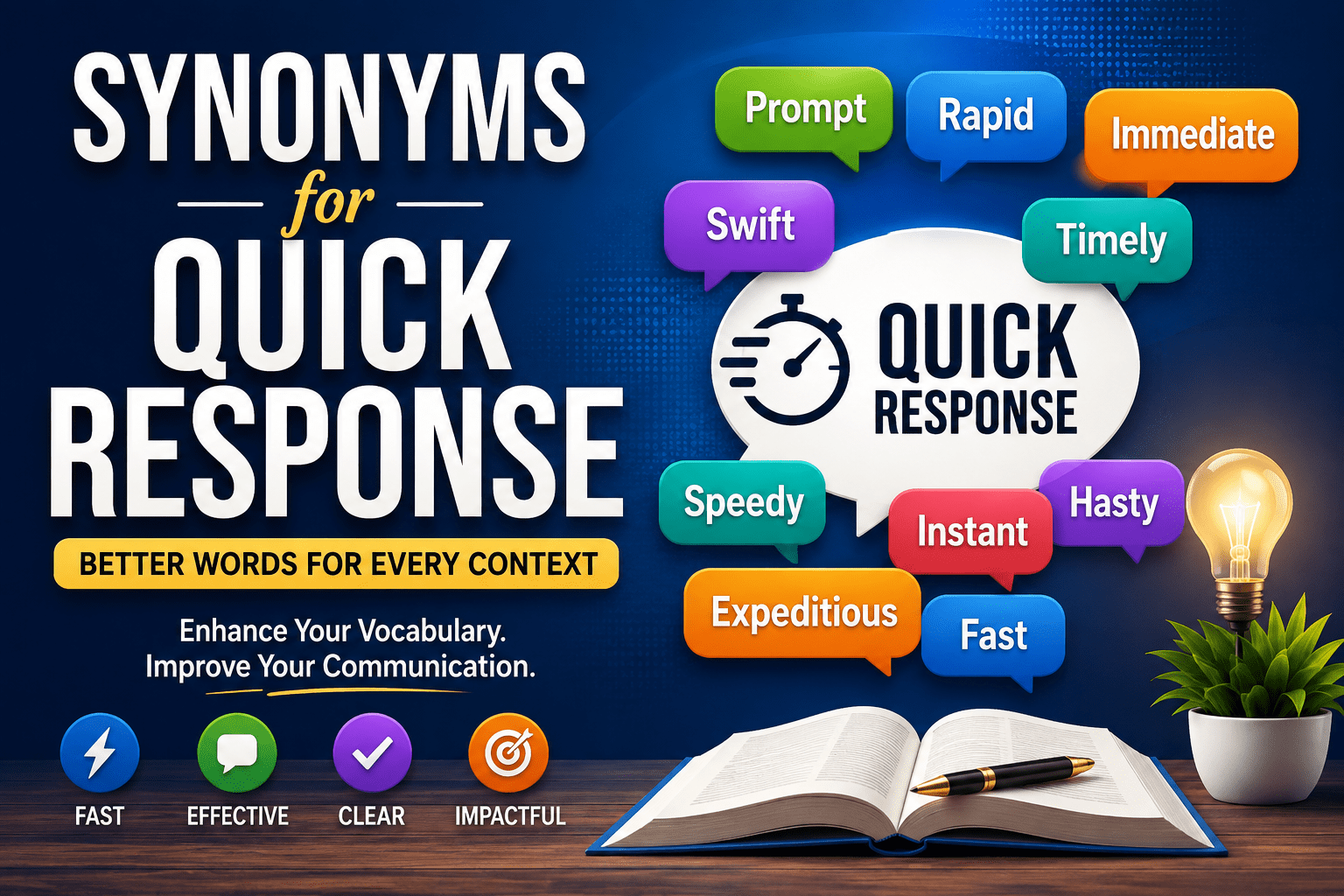
If you need a better way to say “quick response,” the best alternative depends on what kind of speed you mean. Prompt response is especially natural in professional communication, rapid response emphasizes speed, swift response sounds polished and decisive, and immediate response suggests very little or no delay.
The phrase quick response itself is completely natural English. Oxford gives “Thanks for the quick response” as a standard example, while Cambridge explains that quick commonly describes something done with great speed or in a short time.
Below are the most useful alternatives, with distinctions so you can choose the right one rather than simply replacing one phrase with another.
Quick Answer
The closest and most useful synonyms for quick response include:
prompt response, rapid response, swift response, immediate response, timely response, speedy response, fast response, quick reply, prompt reply, rapid reply, immediate answer, quick answer, swift reaction, prompt action, and fast reaction.
‘For emails and business writing, prompt response and timely response are usually the safest choices’. For emergencies or urgent situations, rapid response, immediate response, and swift response are stronger choices.
What Does “Quick Response” Mean?
Quick response is a noun phrase meaning an answer, reaction, or action that happens within a short time or without much delay.
The noun response can mean either an answer to something communicated or a reaction to something that has happened. Cambridge gives both senses, including the example “A quick response to our request would be appreciated.”
Part of speech
- Quick — adjective
- Response — noun
- Quick response — noun phrase
For example:
The customer service team gave a quick response to my complaint.
Here, the phrase describes how rapidly the team responded.
Important nuance
“Quick” does not necessarily mean instantaneous. It generally means that something happened in a short time or without much delay. Oxford specifically distinguishes quick from words such as fast and rapid: quick is frequently used for something done in a short time, while rapid is more often associated with the speed of change or development.
Pronunciation
Quick response
US: /kwɪk rɪˈspɑːns/
UK: /kwɪk rɪˈspɒns/
Individual words
- quick — /kwɪk/
- response — /rɪˈspɑːns/ (US), /rɪˈspɒns/ (UK)
The Best Quick Response Synonyms
Not every alternative is interchangeable in every sentence. The table below separates close synonyms from context-dependent alternatives.
| Word or phrase | Relationship | Strength | Formality | Best context |
|---|---|---|---|---|
| Prompt response | Direct/near synonym | Strong | Formal-neutral | Business, email, service |
| Rapid response | Near synonym | Very strong | Formal | Emergencies, systems |
| Swift response | Near synonym | Strong | Formal-neutral | Decisions, criticism, action |
| Immediate response | Near synonym | Very strong | Neutral-formal | Urgent situations |
| Timely response | Contextual alternative | Moderate | Formal | Business, deadlines |
| Speedy response | Near synonym | Strong | Neutral | Everyday, service |
| Fast response | Near synonym | Strong | Neutral | Technology, casual use |
| Quick reply | Contextual alternative | Strong | Neutral | Messages, email |
| Prompt reply | Near synonym | Strong | Formal-neutral | Email, correspondence |
| Rapid reply | Contextual alternative | Very strong | Formal | Written communication |
| Immediate answer | Contextual alternative | Very strong | Neutral | Questions, requests |
| Quick answer | Contextual alternative | Strong | Neutral | Questions, conversation |
| Swift reaction | Contextual alternative | Strong | Formal-neutral | Events, news |
| Prompt action | Contextual alternative | Strong | Formal | Workplace, problems |
| Fast reaction | Contextual alternative | Strong | Neutral | Sports, events, conversation |
The core distinction is supported by established dictionary usage: Cambridge lists rapid, speedy, swift, and expeditious among alternatives associated with quick, while Oxford notes that rapid, swift, and speedy are generally more formal than quick.
1. Prompt Response
Prompt response is probably the best professional alternative to quick response.
Meaning: A response given without unnecessary delay.
Best used for: Business emails, customer service, workplace communication, requests, and formal correspondence.
Thank you for your prompt response to my inquiry.
The important nuance is that prompt emphasizes responding without delay rather than simply moving at high speed. Oxford defines prompt as something done without delay, and Merriam-Webster distinguishes prompt from quick by associating it more strongly with readiness and disciplined response.
Best choice for: Professional writing.
2. Rapid Response
Rapid response emphasizes speed strongly.
Best used for:
- Emergencies
- Healthcare
- Technology
- Security
- Emergency services
- Operational systems
The emergency team mounted a rapid response to the incident.
Rapid commonly describes a high rate of activity, movement, succession, or occurrence.
Unlike prompt, which can simply mean “without delay,” rapid places greater emphasis on speed.
Best choice for: Urgent or technical situations.
3 Swift Response
Swift response is polished and slightly more forceful than ordinary quick response
The government promised a swift response to the crisis.
Swift suggests great speed and can also imply decisiveness. Merriam-Webster defines it as occurring suddenly or within a very short time and gives “a swift and accurate response” as a natural example.
Best choice for: Formal writing, news-style writing, decisions, criticism, and serious situations.
4. Immediate Response
Immediate response suggests that there was essentially no meaningful delay.
The alarm triggered an immediate response from the security team.
This is stronger than ordinary quick response.
Compare:
- quick response → fast enough
- prompt response → without unnecessary delay
- immediate response → essentially right away
Use immediate when the timing itself is important.
5. Timely Response
Timely response is different from quick response in an important way.
It means a response that comes at an appropriate or useful time, not necessarily the fastest possible response.
Thank you for your timely response to our request.
A response received after ten minutes may be quick. A response received after two days could still be timely if two days was an appropriate timeframe.
Best choice for: Professional communication, deadlines, business processes, and situations where appropriateness matters more than raw speed.
6. Speedy Response
Speedy response means a response that happens quickly.
We appreciate your speedy response to the issue.
It is natural English but generally less formal than prompt response.
Use it when you want to emphasize speed without making the sentence sound highly formal.
7. Fast Response
Fast response is straightforward and conversational.
The website provides a fast response to user requests.
It is particularly natural when talking about:
- computers
- software
- websites
- machines
- services
- reaction times
However, quick response is often more idiomatic than fast response when describing an answer or communication. Cambridge’s grammar guidance notes that quick is commonly used for something happening in a short time, including “a quick answer,” whereas fast is especially associated with high speed of movement.
8. Quick Reply
If you are talking specifically about email, texting, or messaging, quick reply can be more natural than quick response.
Thanks for the quick reply.
A reply normally refers to an answer to something someone has said, written, or sent. Therefore, it fits communication particularly well.
Compare:
Thanks for your quick response to the complaint.
Thanks for your quick reply to my email.
The second is more specifically about written communication.
9. Prompt Reply
Prompt reply is an excellent professional alternative to quick reply.
Thank you for your prompt reply.
It sounds polished without being excessively formal.
It is particularly useful in:
- business emails
- applications
- customer correspondence
- academic communication
- formal letters
10. Rapid Reply
Rapid reply emphasizes the speed of an answer.
We received a rapid reply from the support team.
It is grammatically fine, but in ordinary business email, prompt reply usually sounds more natural.
That distinction matters: a thesaurus may present two words as synonyms, but native usage depends heavily on the noun they modify and the communication context.
11. Immediate Answer
When the “response” is specifically an answer to a question, immediate answer can be more precise.
The customer wanted an immediate answer.
Use this when someone expects an answer right away.
It is not a universal substitute for quick response because a response can be an emotional or physical reaction rather than an answer.
12. Quick Answer
Quick answer is one of the most natural alternatives when someone is responding to a question.
I don’t have a quick answer to that question.
Cambridge specifically recognizes quick answer as a natural English collocation.
It can also introduce a simplified explanation:
The quick answer is yes.
Best choice for: Questions, explanations, interviews, discussions, and conversation.
13. Swift Reaction
Use swift reaction when the response is a reaction to an event rather than an answer to a message.
The company issued a swift reaction to the allegations.
This is particularly useful for:
- news
- political statements
- public criticism
- unexpected events
- emergencies
Reaction changes the meaning slightly. It describes how someone responds to an event or stimulus, not necessarily how quickly they answer a person.
14. Prompt Action
Sometimes the person does not merely respond—they do something.
In that case, prompt action may be the better expression.
The issue requires prompt action.
This means action taken without delay.
It is common in professional, administrative, legal, safety, and operational contexts.
15. Fast Reaction
Fast reaction emphasizes how quickly someone reacts.
Her fast reaction prevented the accident.
It is especially suitable for:
- sports
- physical situations
- driving
- games
- emergencies
- unexpected events
For formal writing, swift reaction or rapid response may sound more polished.
Quick Response Synonyms by Context
For Professional Emails
Best choices:
- Prompt response
- Prompt reply
- Timely response
- Quick reply
- Speedy response
Example:
Thank you for your prompt response to my inquiry.
For most business emails, prompt response is the strongest all-purpose replacement.
For Emergencies
Use:
- rapid response
- immediate response
- swift response
- prompt action
Example:
The firefighters’ rapid response helped contain the fire.
Here, rapid and immediate communicate urgency more strongly than ordinary quick.
For Questions
Use:
- quick answer
- immediate answer
- prompt reply
- quick reply
Example:
I don’t have an immediate answer, but I’ll check the records.
For Technology
Use:
- fast response
- rapid response
- quick response
- low-latency response — technical rather than a general synonym
Example:
The new interface provides a fast response to user commands.
Do not automatically replace quick response with rapid response in technical writing. The correct choice depends on what exactly is being measured.
For Reactions to Events
Use:
- swift response
- rapid response
- immediate response
- swift reaction
- fast reaction
Example:
The company issued a swift response to the criticism.
Quick Response vs. Prompt Response vs. Rapid Response
These three are close, but they are not identical.
| Word | Main emphasis | Typical tone | Example |
|---|---|---|---|
| Quick | Short time / speed | Neutral | Thanks for your quick response. |
| Prompt | No unnecessary delay | Professional | Thank you for your prompt response. |
| Rapid | High speed | Formal/technical | The team made a rapid response. |
Use quick when:
You want the simplest, most natural everyday expression.
Use prompt when:
You are writing professionally and want to emphasize that someone responded without delay.
Use rapid when:
Speed itself is especially important, particularly in technical, emergency, or operational contexts.
Oxford specifically notes that quick is commonly used for things done in a short time, while rapid, swift, and speedy tend to be more formal.
Quick Response vs. Timely Response
These are often confused.
Quick response focuses on how fast the response came.
Timely response focuses on whether it came at an appropriate or useful time.
Compare:
The support team gave a quick response.
This tells us the response was fast.
The support team gave a timely response.
This tells us the response arrived when it was needed.
A timely response does not have to be the fastest possible response.
Quick Response vs. Quick Reply
These phrases overlap, but reply is narrower.
Quick response
Can refer to:
- an email
- a reaction
- an action
- an answer
- a response to an event
Quick reply
Usually refers to:
- an email
- a text
- a message
- a verbal question
For example:
The company had a quick response to the crisis.
But:
Thanks for the quick reply to my email.
The second sentence is more specifically about communication.
Natural Collocations With “Quick Response”
Some common combinations include:
- quick response to a request
- quick response to an email
- quick response to a problem
- quick response to an emergency
- quick response from customer service
- quick response time
- quick response team
- quick response system
Examples:
We appreciate your quick response to our request.
The company is known for its quick response to customer complaints.
The emergency service provided a quick response.
Which synonym fits?
| Collocation | Natural alternative |
|---|---|
| quick response to an email | prompt reply |
| quick response to a request | prompt response |
| quick response to an emergency | rapid response |
| quick response to a crisis | swift response |
| quick response from support | prompt response |
| quick response time | fast response time |
| quick response to a question | quick answer |
| quick response to criticism | swift response |
Which Word Should I Use?
Use prompt response when:
You are writing a professional email or business message.
Thank you for your prompt response.
Use rapid response when:
You are emphasizing speed in an urgent or technical situation.
The system requires a rapid response.
Use swift response when:
You want a polished expression suggesting speed and decisiveness.
The company took swift response to the allegations.
Note: In this last example, “swift action” or “swiftly responded” is often more idiomatic than swift response. Better:
The company took swift action.
or:
The company issued a swift response.
Use timely response when:
The response arrived at an appropriate point in time.
Thank you for your timely response.
Use quick reply when:
You are specifically discussing an email or message.
Thanks for the quick reply.
Use quick answer when:
Someone has answered a question.
I need a quick answer before the meeting.
Common Mistakes
1. Treating every synonym as interchangeable
A thesaurus may group quick, prompt, rapid, and swift together, but their natural contexts differ.
Prompt response → excellent for business email
Rapid response → excellent for emergencies
Quick answer → excellent for questions
The meaning overlaps, but the collocation changes.
2. Using “fast answer” everywhere
Fast answer is understandable, but quick answer is usually more idiomatic.
I need a quick answer.
This is the natural choice in ordinary English. Cambridge explicitly distinguishes quick answer from combinations where fast is more appropriate.
3. Confusing “response” with “reply”
A reply is generally an answer to communication.
A response has a wider range and can describe a reaction or action in response to something.
Her response to the news was unexpected.
You would not normally replace response with reply here.
4. Using “immediate” when you only mean “fairly fast”
Immediate is stronger than quick.
We received a quick response within an hour.
does not necessarily mean:
We received an immediate response.
Use immediate when the lack of delay is important.
FAQ
What is another word for quick response?
The best alternatives include prompt response, rapid response, swift response, immediate response, timely response, and speedy response. The most suitable choice depends on context.
What is the closest synonym for quick response?
Prompt response is one of the closest and most useful alternatives, especially in professional communication. Quick response and prompt response both describe a response made without much delay.
What is a formal synonym for quick response?
Prompt response, rapid response, and swift response can all work in formal contexts. Prompt response is particularly natural in business correspondence.
What is a professional alternative to quick response?
Prompt response is usually the best professional alternative.
Thank you for your prompt response.
It sounds polished without being unnecessarily complicated.
What is the difference between quick response and rapid response?
Quick response is a broad, everyday expression for a response that happens in a short time. Rapid response puts stronger emphasis on speed and is especially common in emergency, technical, and operational contexts.
What is the difference between quick response and timely response?
A quick response is fast. A timely response arrives at an appropriate or useful time. A timely response does not necessarily have to be extremely fast.
What is the best synonym for quick response in an email?
For most professional emails, use prompt response or prompt reply.
Thank you for your prompt response.
If the message is informal, Thanks for the quick reply sounds natural.
What is the opposite of a quick response?
Common opposites include slow response, delayed response, late response, and delayed reply. The best choice depends on whether you are describing communication, reaction, or action.
Conclusion
The best quick response synonym depends on the situation. For professional communication, prompt response is usually the strongest choice. For emergencies, rapid response or immediate response communicates urgency. Swift response adds a polished, decisive tone, while timely response emphasizes appropriate timing rather than maximum speed. For messages, quick reply is often more natural, and for questions, quick answer is usually the better phrase.
The goal is not simply to replace quick response with a more complicated expression. Choose the word that communicates the exact kind of speed and context you mean.

Sarah Williams is an ESL teacher and content writer with a passion for simplifying English vocabulary. She creates easy-to-understand synonym guides and learning resources that help beginners and intermediate learners build strong language skills.