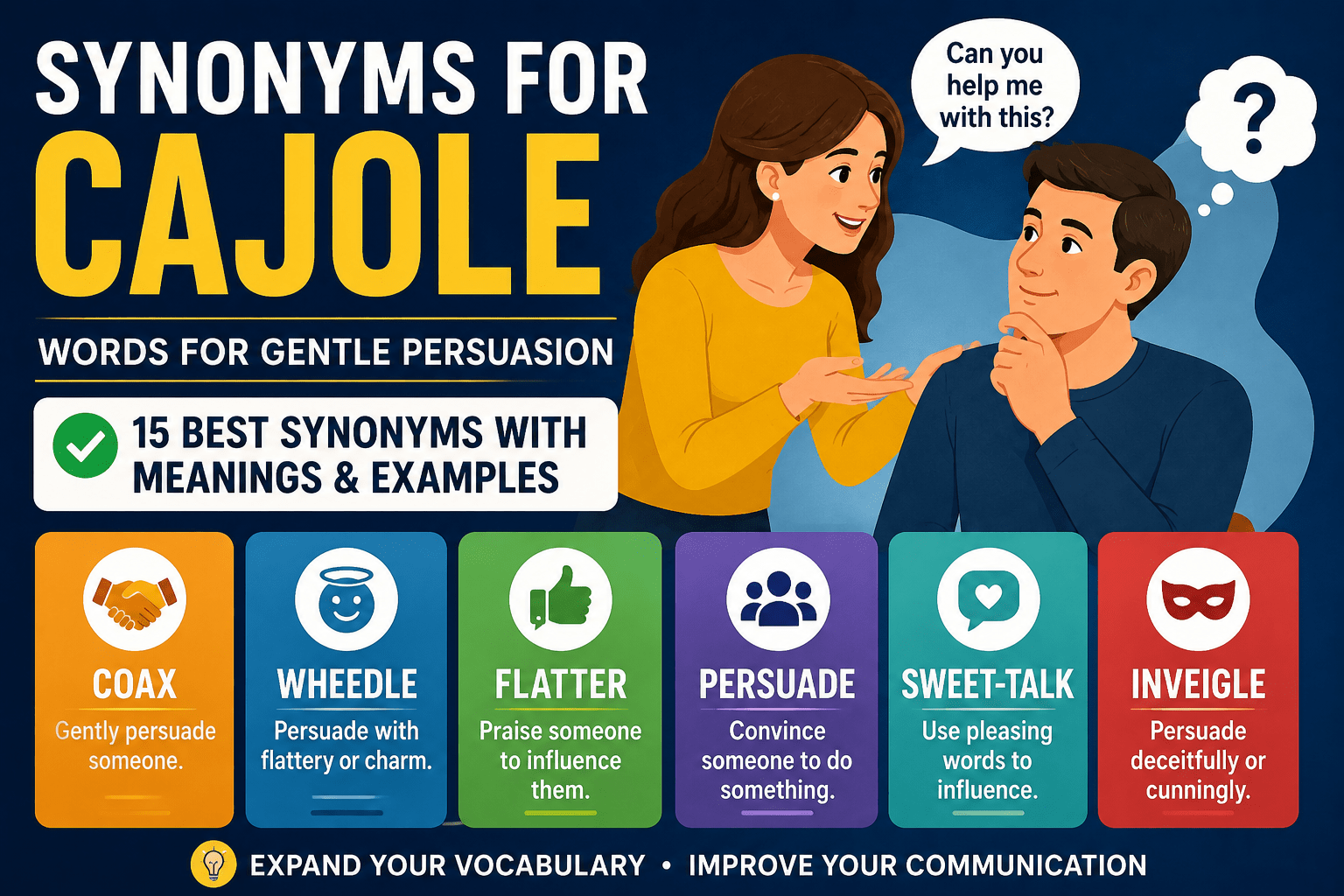
If you need a synonym for cajole, the best choice depends on how the persuasion happens. Coax is usually the closest neutral alternative because both words describe gently persuading someone who may be reluctant. Wheedle suggests more persistent or artful persuasion, often with a slightly negative tone, while blandish emphasizes flattery. Sweet-talk is more informal, and inveigle suggests clever or deceptive persuasion.
The important distinction is that cajole often involves pleasant talk, flattery, or gentle urging used to persuade someone to do something they may not initially want to do. Cambridge, Oxford, and Merriam-Webster all connect the word with persuasion, coaxing, flattery, or reluctance.
Quick Answer: What Are the Best Synonyms for Cajole?
The closest synonyms for cajole include coax, wheedle, blandish, sweet-talk, persuade, flatter, soft-soap, inveigle, urge, entice, and beguile. The best choice depends on the nuance: use coax for gentle persuasion, wheedle for persistent or artful persuasion, blandish for praise and flattery, and inveigle when the persuasion is especially crafty or deceptive.
What Does “Cajole” Mean?
Cajole is a verb meaning to persuade someone to do something through pleasant talk, flattery, gentle urging, or similar appealing behavior.
It is especially common when the person being persuaded is reluctant.
For example:
She cajoled her brother into helping with the move.
This suggests that her brother was not immediately willing to help, so she used friendly persuasion to change his mind.
The most common grammatical patterns are:
- cajole someone into doing something
- cajole someone into something
- cajole something out of someone
- cajole someone out of doing something
Examples:
We finally cajoled him into joining us.
She managed to cajole the information out of him.
They cajoled her out of quitting.
Cambridge defines cajole as persuading someone to do something they might not want to do through pleasant talk and promises, sometimes false ones. Oxford similarly describes making someone do something through friendly or pleasant conversation.
Pronunciation
- US: /kəˈdʒoʊl/
- UK: /kəˈdʒəʊl/
The stress falls on the second syllable: ca-JOLE.
15 Synonyms and Alternatives for Cajole
Not every word below is a perfect substitute in every sentence. Some are direct synonyms, while others are near synonyms or contextual alternatives.
| Word | Relationship | Tone | Formality | Best Context |
|---|---|---|---|---|
| Coax | Direct synonym | Gentle | Neutral | Reluctant people, gentle persuasion |
| Wheedle | Near synonym | Slightly negative | Neutral | Persistent, artful persuasion |
| Blandish | Near synonym | Flattering | Formal/literary | Winning someone over with praise |
| Sweet-talk | Contextual alternative | Informal | Casual | Friendly or flattering persuasion |
| Persuade | Near synonym | Neutral | Neutral | General persuasion |
| Flatter | Contextual alternative | Often positive/strategic | Neutral | Praise used to influence |
| Soft-soap | Near synonym | Insincere | Informal | Smooth talk for personal gain |
| Inveigle | Near synonym | Negative | Formal | Clever or deceptive persuasion |
| Urge | Near synonym | More forceful | Neutral | Strong encouragement |
| Entice | Contextual alternative | Appealing | Neutral | Attracting someone with an incentive |
| Beguile | Contextual alternative | Charming/deceptive | Literary | Charm or persuasion |
| Induce | Contextual alternative | Neutral/formal | Formal | Causing someone to act |
| Woo | Contextual alternative | Persuasive | Literary/neutral | Winning favor or support |
| Beseech | Contextual alternative | Earnest | Formal | Urgent or emotional requests |
| Tempt | Contextual alternative | Appealing | Neutral | Encouraging action through attraction |
Cambridge’s thesaurus groups coax, wheedle, inveigle, and related expressions with cajole, while Merriam-Webster identifies blandish, coax, soft-soap, and wheedle as especially close alternatives.
1. Coax
Coax is generally the closest neutral synonym for cajole.
Meaning: To persuade someone gently and patiently to do something.
How it differs: Coax emphasizes gentle and persistent encouragement. Cajole more strongly suggests flattery or pleasing words.
Example:
She coaxed the nervous child into getting on the stage.
Use coax when the persuasion is gentle rather than manipulative.
Merriam-Webster specifically distinguishes coax by emphasizing gentle and persistent words or actions.
2. Wheedle
Wheedle means to persuade someone through persistent, clever, or appealing talk.
Example:
He wheedled his parents into letting him stay out late.
How it differs: Wheedle often has a more negative or manipulative flavor than coax. It can suggest that the speaker is skillfully working on someone’s weaknesses or desires.
Best for:
- getting favors
- obtaining something
- persistent requests
- clever persuasion
Merriam-Webster notes that wheedle suggests seductive appeal or artful words more strongly than cajole.
3. Blandish
Blandish means to persuade or influence someone through flattering or affectionate behavior.
Example:
The manager blandished the committee with generous promises.
How it differs: The central idea is flattery. If praise is the main tool of persuasion, blandish can be more precise than cajole.
It is considerably less common in everyday conversation and has a formal or literary flavor.
Merriam-Webster distinguishes blandish by emphasizing an open desire to win someone over through effusive praise or affectionate actions.
4. Sweet-talk
Sweet-talk is an informal expression meaning to persuade someone with pleasant, flattering, or charming words.
Example:
She sweet-talked the receptionist into finding her an earlier appointment.
How it differs: Sweet-talk is more conversational than cajole and often suggests that the speaker is using charm strategically.
Use it in:
- conversation
- informal writing
- dialogue
- personal situations
Avoid it in highly formal academic or professional prose.
5. Persuade
Persuade is the broadest neutral alternative.
Example:
She persuaded him to reconsider the proposal.
How it differs: Persuade does not necessarily involve flattery, gentle pressure, or reluctance.
Compare:
She cajoled him into accepting the offer.
This suggests pleasant or flattering pressure.
She persuaded him to accept the offer.
This simply says that she successfully changed his decision.
Therefore, persuade is broader than cajole.
6. Flatter
Flatter means to praise someone, often in a way that makes them feel pleased or important.
It can overlap with cajole when praise is being used as a method of persuasion.
Example:
He flattered his manager in hopes of getting approval for the project.
How it differs: Flatter describes the praise itself, whereas cajole describes the broader act of persuading someone.
So:
She flattered him.
does not necessarily mean:
She persuaded him.
But:
She flattered him into accepting the proposal.
clearly combines praise with persuasion.
7. Soft-soap
Soft-soap means to persuade someone through smooth, flattering, or somewhat insincere talk.
Example:
The salesperson soft-soaped the customer into buying the more expensive package.
How it differs: It strongly suggests smooth talk used for personal advantage.
Merriam-Webster describes soft-soap as using smooth and somewhat insincere talk, usually for personal gain.
It is therefore a useful alternative when cajole has a manipulative undertone.
8. Inveigle
Inveigle is a formal word meaning to persuade or obtain something through clever, artful, or deceptive means.
Example:
The scammer inveigled the victim into revealing confidential information.
How it differs: Inveigle is considerably more negative than ordinary cajole. It often suggests craftiness, deception, or entrapment.
Cambridge labels inveigle as formal, while its thesaurus places it among alternatives associated with cajole.
9. Urge
Urge means to strongly encourage someone to do something.
Example:
Her colleagues urged her to apply for the position.
How it differs: Urge can be more direct and forceful than cajole. It does not require flattery.
Compare:
She cajoled him into applying.
suggests friendly or flattering persuasion.
She urged him to apply.
suggests strong encouragement.
10. Entice
Entice means to attract or persuade someone by offering something appealing.
Example:
The restaurant enticed customers with a special discount.
How it differs: Entice emphasizes the attraction or incentive rather than conversational persuasion.
It works particularly well with:
- offers
- rewards
- discounts
- opportunities
- attractive possibilities
11. Beguile
Beguile can mean to charm, captivate, or deceive through charm.
Example:
The salesman beguiled customers with his confident manner.
How it differs: Beguile emphasizes charm or enchantment, and in some contexts deception. It is more literary than cajole.
It should therefore be treated as a contextual alternative rather than a universal replacement.
12. Induce
Induce means to cause someone to do something, often through persuasion or influence.
Example:
The financial incentive induced employees to work additional hours.
How it differs: Induce is more formal and broader. It does not specifically imply flattery or gentle persuasion.
It is useful in:
- academic writing
- business writing
- formal reports
- analytical prose
13. Woo
Woo means to try to win someone’s support, approval, affection, or favor.
Example:
The candidate tried to woo undecided voters.
How it differs: Woo emphasizes winning favor or support, rather than simply getting someone to perform an action.
It is especially common in political, romantic, and competitive contexts.
14. Beseech
Beseech means to ask someone earnestly or urgently for something.
Example:
She beseeched him to reconsider his decision.
How it differs: Beseech emphasizes urgent pleading, not flattery.
Therefore, it can replace cajole only when the original sentence involves strong pleading rather than gentle persuasion.
15. Tempt
Tempt means to attract someone toward an action by making it appealing.
Example:
The discount tempted customers to buy immediately.
How it differs: Tempt focuses on the attractiveness of the opportunity, reward, or action. It does not necessarily involve talking someone into something.
Closest Synonyms for Cajole
If you want the words with the smallest semantic distance from cajole, prioritize:
- Coax — closest neutral alternative
- Wheedle — persistent or artful persuasion
- Blandish — persuasion through praise
- Soft-soap — smooth, often insincere persuasion
- Sweet-talk — informal flattering persuasion
- Persuade — broader neutral alternative
- Inveigle — crafty or deceptive persuasion
The distinction matters because cajole itself specifically suggests deliberate persuasion in the face of reluctance, often through flattery.
Formal Synonyms for Cajole
For formal or professional writing, consider:
- inveigle — if crafty persuasion is intended
- blandish — if flattery is central
- induce — if causing someone to act through influence
- persuade — for neutral formal writing
- urge — for strong encouragement
In many professional contexts, however, persuade is preferable to an unusually literary word such as blandish or inveigle.
For example:
The consultant persuaded the board to reconsider the proposal.
is usually more natural in professional writing than:
The consultant blandished the board into reconsidering the proposal.
Casual Synonyms for Cajole
For everyday conversation, these are particularly natural:
- coax
- sweet-talk
- wheedle
- talk into
- butter up
Examples:
I finally coaxed him into coming with us.
She sweet-talked me into helping her.
He wheedled his way into getting another chance.
They talked me into staying for dinner.
These expressions are more conversational than cajole.
Cajole Synonyms by Context
Persuading a reluctant person
Best choices:
- coax
- cajole
- wheedle
- persuade
She coaxed the child into trying the new food.
Using praise or compliments
Best choices:
- flatter
- blandish
- sweet-talk
- butter up
He flattered his supervisor into approving the request.
Using clever or deceptive persuasion
Best choices:
- inveigle
- wheedle
- soft-soap
- beguile
The fraudster inveigled the customer into providing personal information.
Using a reward or attractive opportunity
Best choices:
- entice
- tempt
- lure
- woo
The company enticed new customers with a free trial.
Strong encouragement
Best choices:
- urge
- press
- exhort
- persuade
These are generally less gentle than cajole.
Cajole vs Coax: What Is the Difference?
Cajole and coax are extremely close.
Coax emphasizes gentle, persistent persuasion.
Cajole often adds the idea of flattery or pleasing talk, especially when the other person is reluctant.
Compare:
She coaxed the frightened dog out from under the bed.
This sounds gentle and patient.
She cajoled her brother into lending her his car.
This suggests that she used persuasive or flattering conversation to overcome his reluctance.
Merriam-Webster makes a similar distinction: coax emphasizes gentle and persistent words or actions, whereas cajole suggests deliberate flattery in the face of reluctance.
Cajole vs Wheedle: What Is the Difference?
Both words describe persuasion, but wheedle is usually more manipulative.
Cajole: gentle or flattering persuasion.
Wheedle: persistent, artful, or seductive persuasion.
She cajoled him into attending the meeting.
She wheedled him into giving her the information.
The second sentence can suggest that she skillfully manipulated the situation to get what she wanted.
Cajole vs Persuade: What Is the Difference?
Persuade is much broader.
You can persuade someone through:
- reasoning
- evidence
- argument
- explanation
- emotional appeal
- encouragement
- negotiation
Cajole specifically suggests a softer, more personal approach involving pleasant words, flattery, or gentle pressure.
The lawyer persuaded the jury.
Natural.
The lawyer cajoled the jury.
This is possible in a figurative sense but changes the meaning substantially because cajole is not the normal word for evidence-based persuasion.
Cajole vs Convince: What Is the Difference?
Convince usually focuses on changing someone’s belief, opinion, or judgment.
The evidence convinced me that she was right.
Cajole focuses on getting someone to do something, often despite reluctance.
She cajoled me into attending the meeting.
Although persuade and convince can overlap, cajole is much more strongly associated with getting someone to take an action through personal influence.
Which Word Should I Use?
Use “coax” when:
You want to emphasize gentle and patient persuasion.
Use “wheedle” when:
You want to suggest persistent or artful persuasion.
Use “blandish” when:
Flattery is the main method of influence.
Use “sweet-talk” when:
You want an informal expression for charming or flattering persuasion.
Use “persuade” when:
You need a broad, neutral word without implying flattery.
Use “inveigle” when:
The persuasion is clever, crafty, or deceptive.
Use “urge” when:
You want to emphasize stronger encouragement rather than gentle persuasion.
Use “entice” when:
Someone is being attracted by a reward, offer, or appealing possibility.
Natural Collocations with Cajole
Common patterns include:
- cajole someone into doing something
- cajole someone into something
- cajole someone out of doing something
- cajole something out of someone
- cajole someone into agreeing
- cajole someone into helping
- cajole someone into accepting
- cajole someone into joining
- cajole someone into staying
- cajole someone into talking
Examples:
She cajoled him into accepting the offer.
We cajoled the children into going to bed.
He cajoled the information out of his colleague.
The construction “cajole someone into doing something” is especially important for learners because it is one of the most natural grammatical patterns for the verb. Oxford explicitly gives examples using this structure.
Common Mistakes
Mistake 1: Treating “cajole” as exactly the same as “persuade”
Cajole is more specific.
She persuaded him to accept the offer.
does not tell us how she persuaded him.
She cajoled him into accepting the offer.
suggests gentle, flattering, or pleasing persuasion.
Mistake 2: Using “convince” when an action is the focus
Convince often concerns beliefs or opinions.
The evidence convinced me.
For getting someone to act:
She cajoled me into signing the form.
is more natural than using convince when the intended meaning is specifically gentle, flattering pressure.
Mistake 3: Assuming “coax” and “cajole” are identical
They overlap heavily, but cajole has a stronger association with flattery, while coax emphasizes gentleness and persistence.
Mistake 4: Using “inveigle” as a neutral synonym
Inveigle usually carries a more negative suggestion of clever or deceptive persuasion.
Do not replace every instance of cajole with it.
Mistake 5: Assuming cajoling is always dishonest
Cajole can have a negative or manipulative implication, but it does not necessarily mean outright deception.
The context determines how strongly the word implies manipulation.
Merriam-Webster records both persuasion through flattery or gentle urging and a stronger sense involving soothing words or false promises.
Antonyms of Cajole
Useful opposites and contrasting words include:
- coerce
- force
- compel
- intimidate
- threaten
- order
- demand
The semantic contrast is important:
Cajole → persuade through pleasant or flattering influence.
Coerce → make someone act through force, threats, or pressure.
Merriam-Webster lists coerce, compel, force, intimidate, and related terms among the antonyms or near-antonyms of cajole.
Word Origin and Etymology
Cajole entered English in the 17th century from French cajoler, meaning to give someone much attention, make a fuss over them, flatter them, or persuade them through flattery. Merriam-Webster dates its first known English use to 1630. The deeper origin of the French word is uncertain, with competing historical explanations.
Because the ultimate etymology is uncertain, it is better to avoid presenting speculative theories as established fact. The established French connection, however, helps explain the modern association between cajole and flattering or pleasing persuasion.
FAQ: Synonyms for Cajole
What is the closest synonym for cajole?
Coax is usually the closest neutral synonym. Both words describe gently persuading someone who may be reluctant, although cajole more strongly suggests flattery or pleasing talk.
What is another word for cajole?
Depending on context, alternatives include coax, wheedle, persuade, blandish, sweet-talk, flatter, soft-soap, and inveigle.
What is a formal synonym for cajole?
Blandish, inveigle, and induce can work in formal contexts, but they are not interchangeable. Persuade is usually the safest formal alternative when no special nuance is intended.
Is “coax” the same as “cajole”?
They are very close, but not identical. Coax emphasizes gentle and persistent persuasion, while cajole often emphasizes flattery or pleasing talk used to overcome reluctance.
Is “wheedle” a synonym for cajole?
Yes, wheedle is a close synonym, but it generally has a stronger suggestion of persistent, artful, or manipulative persuasion.
What is the difference between cajole and persuade?
Persuade is a broad term for changing someone’s mind or getting them to act. Cajole specifically suggests using pleasant, flattering, or gentle persuasion, often when the person is reluctant.
What is the opposite of cajole?
Common contrasting words include coerce, force, compel, intimidate, and threaten. These imply pressure or force rather than the pleasant persuasion associated with cajole.
How do you use cajole in a sentence?
A common structure is “cajole someone into doing something.”
She cajoled her friends into staying for dinner.
You can also use “cajole something out of someone”:
He managed to cajole the truth out of her.
Conclusion
The best synonym for cajole depends on the exact kind of persuasion you mean. Coax is the closest neutral alternative; wheedle suggests persistent or artful persuasion; blandish emphasizes flattery; sweet-talk is informal; persuade is broader and more neutral; and inveigle adds a stronger sense of craftiness or deception.
For precise word choice, focus on the method of persuasion: gentleness → coax, flattery → blandish, persistence → wheedle, smooth talk → sweet-talk, general persuasion → persuade, and crafty persuasion → inveigle.

Michael Thompson is an English language specialist and experienced editor who focuses on vocabulary development and clear communication. He creates high-quality synonym guides, word comparisons, and writing tips to help students and professionals express their ideas more effectively. His work combines linguistic knowledge with practical SEO strategies to make learning both useful and engaging.