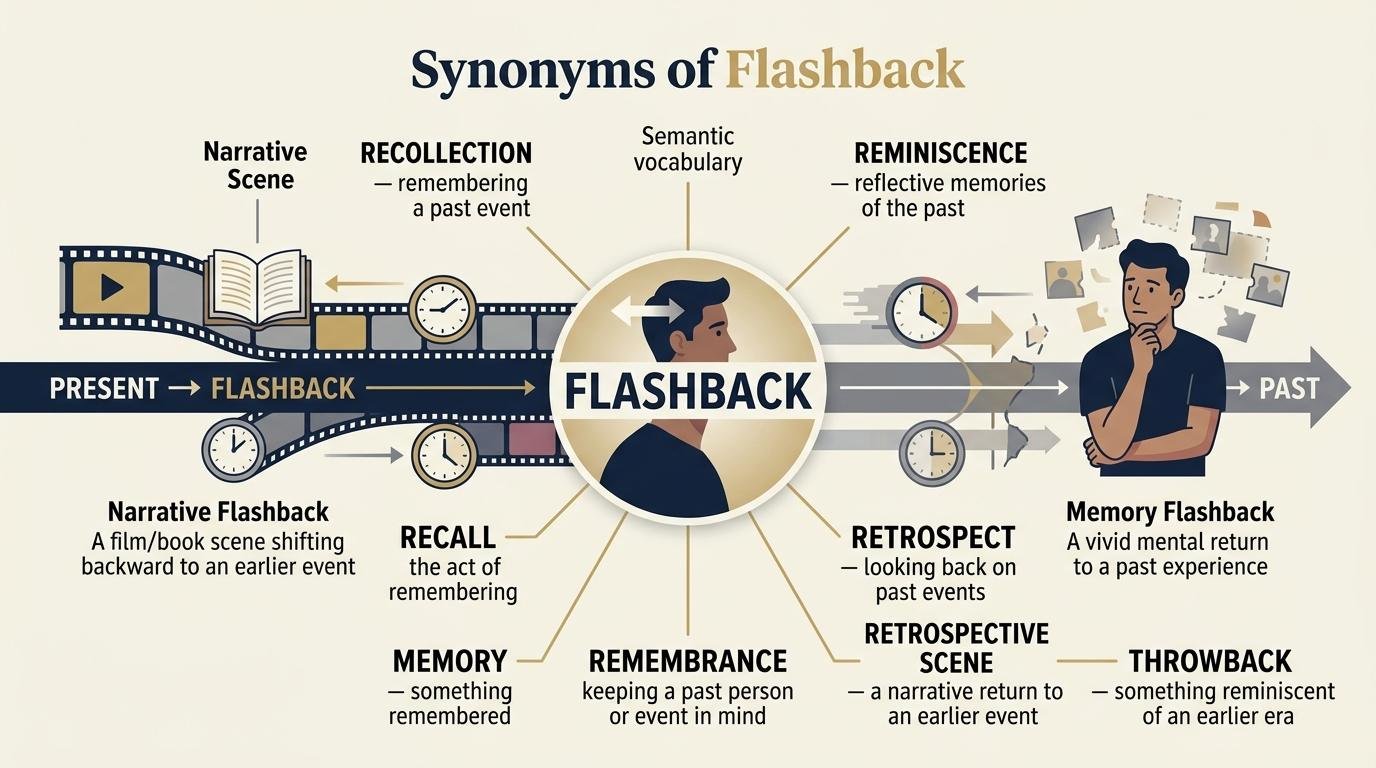
Finding a synonym for flashback is more complicated than replacing one word with another. Flashback has two major modern uses: it can describe a scene in a film, novel, or play that takes the story back to an earlier event, or it can describe a sudden, vivid recollection of something that happened in the past.
The best alternative therefore depends on what you mean. Recollection, memory, and reminiscence can work when flashback refers to remembering the past. In storytelling, however, terms such as retrospective scene, return to the past, or backward shift in time are often more precise descriptions rather than true one-word synonyms.
This guide separates genuine synonyms from contextual alternatives so you can choose the word that actually fits your sentence.
Quick Answer
The closest synonyms for flashback depend on the sense. For a sudden memory, use recollection, reminiscence, memory, recall, or remembrance. For a story or film, retrospective scene, return to the past, or earlier scene may describe the technique, but they are contextual alternatives rather than exact synonyms. Throwback is related but is not a general replacement for flashback.
What Does “Flashback” Mean?
Flashback is primarily a noun.
It has two important meanings.
1. Flashback in stories and films
In literature, film, television, and drama, a flashback is a scene or passage that interrupts the chronological progression of a story and presents an event that happened earlier. Cambridge defines it as a short part of a movie, story, or play that goes back to events in the past.
For example:
The final chapter contains a flashback to the protagonist’s childhood.
A flashback is therefore not simply “the past.” It is a narrative technique involving a return to an earlier point in the story. Oregon State University’s literary guide similarly describes it as an interruption of the chronological sequence to show a meaningful event from the past.
2. Flashback as a sudden memory
A flashback can also mean a sudden and vivid recurrence of a past experience or memory. This use is especially common when discussing emotionally intense or traumatic experiences.
For example:
The smell of smoke triggered a flashback to the accident.
This sense is much closer to words such as recollection, memory, and reminiscence.
The Best Synonyms of Flashback at a Glance
| Word or phrase | Relationship | Strength | Formality | Best context |
|---|---|---|---|---|
| Recollection | Near synonym | Neutral | Neutral/formal | Remembering a past event |
| Reminiscence | Near synonym | Neutral | Neutral/formal | Recalling past experiences, often warmly |
| Memory | Near synonym | Broad | Neutral | General reference to the past |
| Recall | Near synonym | Neutral | Neutral/formal | Act of remembering |
| Remembrance | Near synonym | Neutral | Formal/literary | Remembering a person or past event |
| Retrospect | Related/near synonym | Reflective | Formal | Looking back on the past |
| Retrospection | Related/near synonym | Reflective | Formal | Deliberate examination of the past |
| Retrospective scene | Contextual alternative | Neutral | Formal/technical | Literary and film analysis |
| Return to the past | Contextual alternative | Neutral | Neutral | Explaining narrative structure |
| Earlier scene | Contextual alternative | Neutral | Neutral | Film and storytelling |
| Throwback | Contextual alternative | Informal | Casual | Something that evokes an earlier period |
The important distinction is that these words do not all replace flashback equally well. Merriam-Webster’s thesaurus groups words such as recollection, memory, reminiscence, recall, and remembrance around the memory-related sense of flashback.
Closest Synonyms for a Flashback as a Memory
Recollection
Recollection is one of the strongest alternatives when flashback means remembering something from the past.
It refers to the act or result of remembering a previous experience.
Example:
Her recollection of the evening was surprisingly detailed.
Best used when: you want a neutral or somewhat formal word for a remembered event.
Difference from flashback: Recollection does not necessarily imply that the memory arrives suddenly or vividly. A flashback often carries that stronger sense.
Reminiscence
Reminiscence refers to a memory or recollection of the past, often with an emotional, reflective, or nostalgic quality.
Example:
His reminiscences of childhood filled the memoir with warmth.
Best used when: discussing memories of earlier experiences, particularly in storytelling, memoir, or reflective writing.
Difference from flashback: a reminiscence can be gradual and reflective. A flashback often suggests a sudden return of a vivid memory.
Memory
Memory is the broadest and most natural alternative.
Example:
The song brought back a childhood memory.
Best used when: you simply mean something remembered from the past.
Difference from flashback: memory is much broader. A memory does not have to be sudden, vivid, or intrusive.
Recall
Recall emphasizes the act or ability of remembering.
Example:
I have no recall of what happened after midnight.
It is also useful in formal, academic, and professional writing.
Difference from flashback: recall generally describes remembering rather than the vivid re-experiencing implied by flashback.
Merriam-Webster lists remember, recall, and think of as synonyms associated with the verb flash back.
Remembrance
Remembrance is a more formal or literary word for remembering or something remembered.
Example:
The photograph remained as a remembrance of their journey.
It is particularly natural when referring to people, events, memorials, or meaningful moments from the past.
Difference from flashback: it lacks the sudden, vivid quality that flashback can convey.
Synonyms and Alternatives for Flashback in Literature
There is no perfect one-word synonym for the narrative-device sense of flashback.
That matters because replacing flashback with recollection can change the meaning.
Consider:
The novel uses a flashback to reveal what happened ten years earlier.
You could describe the same technique as:
- a retrospective scene
- a return to the past
- a shift to an earlier period
- an earlier scene
- a backward shift in the narrative
- a scene set in the past
These are best treated as contextual alternatives, not universal synonyms.
Retrospective scene
A retrospective scene is a useful formal description for a scene that looks back at an earlier point in the narrative.
The director introduces a retrospective scene near the end of the film.
This works particularly well in literary criticism, film analysis, and academic writing.
Return to the past
Return to the past is a clear explanatory phrase rather than a technical synonym.
The novel makes a sudden return to the past before revealing the character’s motivation.
It is useful when clarity matters more than terminology.
Earlier scene
Earlier scene is simple and natural when discussing film or television.
The episode cuts to an earlier scene showing the detective’s first meeting with the suspect.
It describes the result of the narrative technique without necessarily labeling it as a flashback.
Words Related to Flashback That Are Not Exact Synonyms
Several words frequently appear in synonym lists but should not automatically replace flashback.
Throwback
Throwback refers to something reminiscent of an earlier time, style, or period.
The restaurant is a throwback to the 1950s.
It does not normally mean a narrative scene that moves backward in time.
Nostalgia
Nostalgia describes a sentimental or wistful longing for the past.
The old photographs filled her with nostalgia.
A flashback can evoke nostalgia, but nostalgia is not a synonym for flashback.
Retrospect
Retrospect means looking back on past events, usually from a later point in time.
In retrospect, he realized that he had made the wrong decision.
It is more about reflection on the past than a sudden memory or a narrative scene.
Hindsight
Hindsight means understanding a situation more clearly after it has happened.
With hindsight, the warning signs were obvious.
It is not a synonym for flashback. Hindsight involves later understanding or judgment, not simply returning mentally to an earlier event.
Reverie
A reverie is a state of dreamy or absorbed thought.
She drifted into a reverie while looking through the old photographs.
A reverie may involve memories, but it does not specifically mean a flashback.
Flashback Synonyms by Context
For a sudden memory
Use:
- recollection — neutral and precise
- memory — broad and natural
- reminiscence — reflective or emotional
- recall — emphasizes remembering
- remembrance — formal or literary
For a novel or film
Use:
- flashback — the standard term
- retrospective scene — formal/analytical
- return to the past — clear explanatory phrase
- earlier scene — simple and descriptive
- shift to an earlier period — analytical
For formal or academic writing
Prefer:
- recollection
- retrospect
- retrospection
- retrospective scene
- earlier narrative sequence
The best choice depends on what you are actually describing. Academic prose should not replace the established technical term flashback merely to avoid repetition.
For casual conversation
Depending on meaning, natural choices include:
- memory
- remembering
- recollection
- throwback — only when talking about something reminiscent of an earlier period
“Flashback” vs. “Recollection” vs. “Reminiscence”
These three are especially easy to confuse.
| Word | Core idea | Sudden/vivid? | Emotional tone | Narrative technique? |
| Flashback | Return to a past event or vivid recurrence of memory | Often | Variable | Yes |
| Recollection | Something remembered | Not necessarily | Neutral | No |
| Reminiscence | Memory of past experiences | Not necessarily | Often reflective | No |
Flashback vs. recollection
A flashback can feel immediate and vivid. A recollection is simply something remembered.
The smell triggered a flashback.
She had a clear recollection of the conversation.
The first sentence emphasizes an experience of being suddenly brought back to the past. The second simply describes memory.
Flashback vs. reminiscence
A reminiscence often suggests reflection on earlier experiences, sometimes with affection or nostalgia.
His reminiscences of university life became the centerpiece of the memoir.
A flashback is more immediate and can be emotionally neutral, frightening, or traumatic.
Flashback vs. retrospect
Retrospect concerns looking back on past events from the present.
In retrospect, the decision seems obvious.
A flashback, by contrast, can be a specific memory or a deliberate narrative movement into an earlier event.
Common Mistakes
Mistake 1: Treating “nostalgia” as a direct synonym
Incorrect:
The movie contains several nostalgia scenes.
Better:
The movie contains several flashback scenes.
Nostalgia describes a feeling or longing associated with the past, not the narrative device itself.
Mistake 2: Using “throwback” for every flashback
Incorrect:
The director uses a throwback to show the hero’s childhood.
Better:
The director uses a flashback to show the hero’s childhood.
Throwback normally describes something reminiscent of an earlier period.
Mistake 3: Assuming “recollection” means “flashback”
A recollection can be calm, deliberate, incomplete, or distant. A flashback often implies a more immediate return to a past experience.
Mistake 4: Calling “hindsight” a synonym
Hindsight involves understanding something after the fact. It does not simply mean remembering a past event.
Mistake 5: Replacing the technical term unnecessarily
In literary analysis, flashback is already the standard and precise term. Using a more obscure alternative does not automatically make the writing more sophisticated.
Natural Examples
Literature
The novel opens with a flashback to the protagonist’s childhood.
Film analysis
The retrospective scene explains why the character refuses to return home.
Everyday conversation
That song brought back a vivid memory of high school.
Formal writing
The narrator’s recollection of the event conflicts with the testimony of the other characters.
Memoir
Her reminiscences of village life give the memoir its reflective tone.
Narrative analysis
The story shifts to an earlier period to reveal information that was previously withheld.
Pronunciation
Flashback
- US IPA: /ˈflæʃˌbæk/
- UK IPA: /ˈflæʃ.bæk/
Cambridge gives the same basic pronunciation in both varieties.
Etymology
Flashback is a relatively modern English compound formed from flash and back. Merriam-Webster records the noun’s first known use as 1903 and the verb as 1944. Collins likewise traces the noun to the use of the verb phrase flash back.
The modern literary and cinematic sense developed around the idea of a sudden movement backward in narrative time, while the word also came to describe vivid returns of past experiences in the mind.
Antonyms and Contrasting Terms
There is no single perfect antonym for every sense of flashback.
For narrative structure, the clearest contrast is flash-forward, in which a story moves ahead to events that occur later.
For memory, possible conceptual contrasts include:
- forgetfulness
- amnesia
- loss of memory
These are not exact grammatical antonyms, but they describe the opposite semantic territory of remembering.
FAQ
What is another word for flashback?
For the memory sense, recollection, memory, reminiscence, recall, and remembrance are useful alternatives. For a narrative flashback, retrospective scene or return to the past can work as contextual descriptions.
What is the closest synonym for flashback?
There is no single synonym that works equally well for both major meanings. Recollection is one of the closest alternatives when flashback means a vivid memory, while retrospective scene is a useful formal description of the literary or cinematic technique.
What is a formal synonym for flashback?
For a memory, recollection or reminiscence can sound more formal. In literary analysis, retrospective scene or retrospective sequence can describe a flashback more formally.
Is “reminiscence” the same as “flashback”?
Not exactly. A reminiscence is a memory or recollection of the past, often with a reflective quality. A flashback can be much more sudden and vivid and can also refer to a deliberate narrative technique.
Is “throwback” a synonym for “flashback”?
No. Throwback usually describes something that resembles or evokes an earlier period. A flashback takes a narrative or a person’s mental experience back to an earlier event.
What is the difference between a flashback and a memory?
A memory is any retained or recalled experience. A flashback generally suggests a vivid or sudden recurrence of a past experience, or a narrative technique that presents an earlier event.
What is the literary term for going back in time?
Flashback is the standard term for inserting an earlier event into the chronological sequence of a story. Retrospective scene is a more formal descriptive alternative.
What is the opposite of a flashback in a story?
The usual contrasting term is flash-forward, which moves the narrative ahead to a later event rather than returning to an earlier one.
Conclusion
The best synonym for flashback depends on the meaning you intend. When you mean a vivid memory, recollection, reminiscence, memory, recall, and remembrance are the most useful alternatives. When you mean the literary or cinematic device, retrospective scene, return to the past, and earlier scene can describe the technique, but flashback remains the clearest standard term.
The key is not to choose the most unusual synonym. Choose the word that preserves the exact meaning, tone, and context of the original.

Emily Johnson is a linguistics graduate and vocabulary specialist. She writes detailed synonym explanations and helps readers understand subtle differences between words, improving both writing and speaking skills. Synonyms help express ideas more clearly and precisely in English.