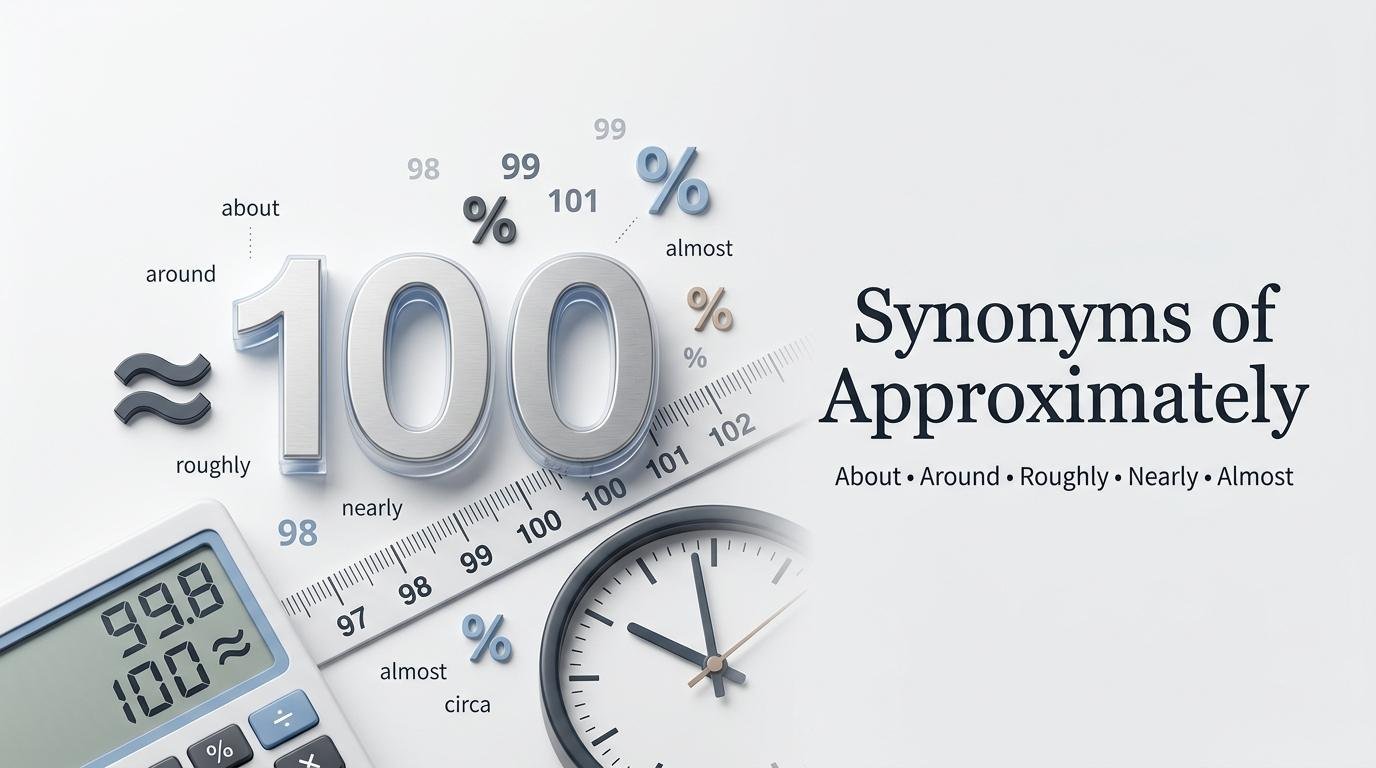
If you need another word for approximately, the most natural choices are about, around, and roughly. Other alternatives include nearly, almost, more or less, close to, circa, and in the region of, but these words are not interchangeable in every sentence.
The important distinction is that approximately simply indicates that a number, time, amount, distance, or measurement is close to a stated value but not exact. Cambridge lists about, around, and roughly as direct synonyms, while Merriam-Webster likewise identifies roughly, about, and around among the closest alternatives.
The best replacement depends on context, formality, sentence structure, and whether you mean close to a number or almost reaching a particular amount or state.
Table of Contents
- Quick Answer
- What Does “Approximately” Mean?
- Closest Synonyms
- Formal and Professional Alternatives
- Important Contextual Alternatives
- Approximately vs. About vs. Around vs. Roughly
- Approximately vs. Nearly vs. Almost
- Which Word Should You Use?
- Common Mistakes
- Examples in Real-World Writing
- FAQ
- Conclusion
Quick Answer
The closest synonyms of approximately are about, around, and roughly. Use about for everyday and general writing, around especially for conversational estimates of numbers or times, and roughly when emphasizing that a figure is an estimate. Nearly and almost are different: they usually mean not quite reaching a particular point, rather than simply giving an approximate figure.
What Does “Approximately” Mean?
Approximately is an adverb meaning close to a particular number, amount, time, distance, or degree, but not exactly that value. Cambridge gives examples involving periods of time, money, percentages, distances, and quantities.
For example:
The journey takes approximately three hours.
This means the journey takes close to three hours, but the speaker is not claiming that the exact duration is three hours.
Similarly:
Approximately 500 people attended the event.
The actual number could be somewhat above or below 500.
Part of speech
Approximately is an adverb.
Related forms include:
- approximate — adjective or verb
- approximately — adverb
- approximation — noun
- approx. — written abbreviation of approximately
Pronunciation
Approximately
- US: /əˈprɑːk.sə.mət.li/
- UK: /əˈprɒk.sɪ.mət.li/
The Closest Synonyms of Approximately
| Word | Relationship | Strength | Formality | Best Context |
|---|---|---|---|---|
| about | Direct synonym | Neutral | Neutral | Everyday and general writing |
| around | Direct synonym | Neutral | Neutral | Numbers, times, quantities |
| roughly | Direct synonym | Neutral | Neutral | Estimated figures |
| more or less | Near synonym | Neutral | Neutral/informal | General estimates |
| close to | Near synonym | Neutral | Neutral | Numbers, amounts, measurements |
| nearly | Near synonym | Stronger implication | Neutral | Almost reaching a number or point |
| almost | Near synonym | Stronger implication | Neutral | Not quite reaching a state or amount |
| circa | Contextual alternative | Neutral | Formal | Dates and historical periods |
| in the region of | Contextual alternative | Neutral | Formal | Large quantities and estimates |
| in the vicinity of | Contextual alternative | Neutral | Formal | Approximate amounts or locations |
| or so | Contextual alternative | Neutral | Informal | Casual numerical estimates |
| just about | Contextual alternative | Variable | Informal | Almost or approximately |
| something like | Contextual alternative | Approximate | Informal | Casual estimates |
| somewhere around | Contextual alternative | Approximate | Informal | Casual numerical estimates |
| plus or minus | Contextual alternative | Explicit range | Neutral | Numerical tolerance |
| practically | Contextual alternative | Strong | Neutral | Nearly/completely in effect |
| virtually | Contextual alternative | Strong | Neutral/formal | Almost completely |
| loosely | Contextual alternative | Broad | Neutral | Approximate rather than exact description |
| generally | Contextual alternative | Broad | Neutral/formal | Approximate characterization |
| nominally | Contextual alternative | Specialized | Formal | Stated or official figure rather than exact practical value |
The first three—about, around, and roughly—are the clearest general-purpose alternatives. Cambridge explicitly identifies those three as synonyms, and Merriam-Webster’s thesaurus places them among the most relevant alternatives.
About
About is probably the most versatile everyday substitute for approximately.
Meaning: Close to a stated number, amount, or time.
How it differs: It is generally less formal and more conversational than approximately.
Best used for: Everyday speech, emails, general writing, estimates.
Example:
The meeting will last about an hour.
Compare:
The meeting will last approximately an hour.
Both are natural, but approximately sounds more formal or deliberately precise.
Around
Around is another extremely natural alternative.
Meaning: Approximately a particular number or time.
Best used for: Quantities, ages, times, prices, and distances.
Example:
There were around 200 people at the event.
I’ll arrive around six o’clock.
Cambridge specifically gives around as a synonym of approximately and illustrates its use with time.
Roughly
Roughly emphasizes that the number is an estimate rather than an exact figure.
Example:
The project cost roughly $50,000.
It is particularly natural when discussing estimated quantities, measurements, proportions, and calculations.
The building is roughly 100 years old.
Merriam-Webster lists roughly first among its closest synonyms for approximately.
More or Less
More or less means approximately or generally, but it is often more conversational than approximately.
The two versions are more or less identical.
The work is more or less complete.
It can refer to a numerical estimate, but it also commonly means approximately in degree or condition.
Close To
Close to is useful when emphasizing proximity to a particular figure.
The repair cost close to $2,000.
However, there is an important nuance. Close to can imply that the actual value is very near the stated number, whereas approximately can be broader.
The temperature was approximately 30°C.
is simply an approximate figure.
The temperature was close to 30°C.
more strongly suggests that 30°C was actually quite near the measured value.
Collins includes close to among its alternatives for approximately.
Nearly
Nearly is related to approximately, but it is not always a direct replacement.
The population is approximately 10 million.
means the figure is around 10 million.
The population is nearly 10 million.
usually suggests that the figure is just below 10 million.
For example, nearly 10 million naturally suggests something like 9.8 or 9.9 million, whereas approximately 10 million could mean somewhat below or above 10 million.
This is one of the most important distinctions for accurate word choice.
Almost
Almost behaves similarly to nearly.
The bottle contains approximately one liter.
This simply gives an approximate measurement.
The bottle contains almost one liter.
This normally suggests that the amount is just under one liter.
So almost should not automatically replace approximately.
Circa
Circa, often abbreviated c. or ca., is particularly associated with dates and historical periods.
The building was constructed circa 1850.
This means the date is approximately 1850.
It is much less natural for ordinary measurements:
❌ The box weighs circa 5 kilograms.
✓ The box weighs approximately 5 kilograms.
✓ The box weighs about 5 kilograms.
Collins specifically identifies circa as an approximate alternative particularly in relation to dates.
In the Region of
In the region of is a formal phrase meaning approximately or around a particular amount.
The project required an investment in the region of $10 million.
It is particularly useful in formal, financial, business, and journalistic contexts.
It is more elaborate than about:
The project cost about $10 million.
The project cost in the region of $10 million.
The second version sounds more formal and emphasizes estimation.
In the Vicinity of
In the vicinity of can express an approximate quantity, although it is also commonly used for physical location.
The investment was in the vicinity of $5 million.
It has a formal or somewhat bureaucratic tone.
For straightforward writing, about, around, or approximately is usually clearer.
Or So
Or so is an informal way to indicate an approximate amount.
There were 50 people or so.
This means approximately 50 people.
It is natural in conversation and informal writing but usually less appropriate in formal academic or technical prose.
Compare:
Approximately 50 participants completed the survey.
with:
Fifty participants or so completed the survey.
The first is more suitable for a research report.
Plus or Minus
Plus or minus is useful when an approximate figure involves an understood or stated range.
The package weighs 10 kilograms, plus or minus 0.5 kilograms.
This is more specific than approximately. It tells the reader that the estimated value may vary within a defined tolerance.
Therefore, it should not be treated as a universal synonym.
Approximately vs. About vs. Around vs. Roughly
These four words are the most useful general alternatives.
| Word | Typical Tone | Main Nuance | Example |
| approximately | Formal/neutral | General approximation | Approximately 500 people attended. |
| about | Neutral/informal | General estimate | About 500 people attended. |
| around | Neutral/informal | Approximate number or time | Around 500 people attended. |
| roughly | Neutral | Estimated figure | Roughly 500 people attended. |
Use “approximately” when:
You want a neutral or formal expression suitable for reports, academic writing, business documents, and factual descriptions.
Use “about” when:
You want the most natural everyday alternative.
Use “around” when:
You are talking naturally about numbers, times, ages, quantities, or distances.
Use “roughly” when:
You want to make clear that the figure is an estimate.
Approximately vs. Nearly vs. Almost
This distinction deserves special attention.
| Word | Core Meaning | Typical Implication |
| approximately | Close to a stated value | Could be above or below |
| nearly | Almost reaching a value | Usually just below |
| almost | Not quite reaching a state/value | Usually short of the point |
Compare:
The stadium holds approximately 50,000 people.
This gives an approximate capacity.
The stadium holds nearly 50,000 people.
This suggests the capacity is close to but probably below 50,000.
Nearly 50,000 people attended.
This normally suggests an attendance figure just below 50,000.
The difference is subtle but important for precise writing.
Which Word Should I Use?
Use “approximately” for formal precision
The treatment lasted approximately six months.
Best for reports, academic writing, statistics, technical writing, and formal explanations.
Use “about” for everyday English
I’ll be there in about ten minutes.
Natural and conversational.
Use “around” for times and casual estimates
She arrived around noon.
Especially natural in speech.
Use “roughly” for estimated figures
The repair will cost roughly $3,000.
Useful when the figure is intentionally approximate.
Use “nearly” when the actual figure is close to but short of a target
Nearly 1,000 students applied.
Use “circa” for approximate historical dates
The manuscript dates from circa 1400.
Contextual Usage
Academic Writing
Approximately is particularly useful in academic, scientific, and research writing when reporting estimated measurements or quantities.
Approximately 65% of respondents supported the proposal.
It has a neutral, objective tone.
Roughly can also work:
Roughly 65% of respondents supported the proposal.
But approximately is often preferable when the prose is deliberately formal.
Business Writing
The company employs approximately 2,000 people.
Other suitable options include:
- about 2,000
- around 2,000
- roughly 2,000
- in the region of 2,000
The choice depends on the desired level of formality.
Everyday Conversation
There were about 30 people there.
It takes around 20 minutes.
These are generally more natural in conversation than approximately.
Historical Writing
For approximate dates:
The temple was built circa 900 BCE.
Here circa is especially appropriate.
Technical Writing
Approximately is useful when measurements are estimates:
The device weighs approximately 2.4 kg.
If a specific tolerance is known, plus or minus may provide more useful information:
The device weighs 2.4 kg ± 0.1 kg.
The latter communicates a defined range rather than merely saying the measurement is approximate.
Common Collocations
Natural combinations include:
- approximately 10 minutes
- approximately 100 people
- approximately $5 million
- approximately 20%
- approximately three years
- approximately 500 miles
- approximately the same
- approximately equal to
- approximately half
- approximately one-third
Common alternatives can be substituted naturally in many of these:
approximately 100 people
about 100 people
around 100 people
roughly 100 people
But context matters.
For example:
approximately equal to
is common in formal and technical writing, while about equal to is more conversational.
Common Mistakes
1. Treating “nearly” as an exact synonym
Approximately 100 can mean somewhat above or below 100.
Nearly 100 normally suggests a number just below 100.
2. Using “circa” for ordinary quantities
Circa is strongly associated with approximate dates and historical dating.
Use:
approximately 50 kilograms
rather than:
circa 50 kilograms.
3. Overusing “approximately”
Although correct, approximately can make ordinary conversation sound unnecessarily formal.
I’ll arrive approximately at six.
More naturally:
I’ll arrive around six.
4. Using “about” when a defined tolerance is required
If a technical document needs an explicit error range, about may be too vague.
The measurement is 25 mm ± 1 mm.
is more informative than:
The measurement is about 25 mm.
5. Confusing “approximately” with “exactly”
These words express opposite levels of numerical precision.
approximately 100
means close to 100.
exactly 100
means the precise number is 100.
Real-World Examples
Workplace
The project will take approximately eight weeks.
More conversational:
The project will take about eight weeks.
Academic
Approximately 42% of participants reported similar results.
Natural alternative:
Roughly 42% of participants reported similar results.
Everyday Conversation
It takes around fifteen minutes to get there.
Less conversational:
It takes approximately fifteen minutes to get there.
Both are grammatical; around sounds more natural in casual speech.
Financial Writing
The investment was in the region of $20 million.
Here the longer phrase gives the sentence a formal, report-like tone.
Historical Writing
The manuscript was produced circa 1200.
Here circa is more appropriate than about or around.
Antonyms
The clearest opposites of approximately are words expressing exactness or precision:
- exactly
- precisely
- accurately — in contexts involving correctness rather than approximation
For example:
The distance is approximately 20 miles.
versus:
The distance is exactly 20 miles.
Merriam-Webster lists precisely and exactly among the antonymous or near-antonymous terms associated with approximately.
FAQ
What is the closest synonym for approximately?
The closest general synonyms are about, around, and roughly. Cambridge explicitly lists these three as synonyms, while Merriam-Webster similarly identifies them among the closest alternatives.
What is another word for approximately?
Common alternatives include about, around, roughly, more or less, and close to. The best choice depends on the sentence and level of formality.
What is the formal synonym for approximately?
Approximately is already appropriate for formal writing. Other formal alternatives include in the region of, in the vicinity of, and, for dates, circa.
Is “about” the same as “approximately”?
Usually, yes when referring to an estimated number, amount, or time. About is generally more conversational, while approximately often sounds more formal.
Is “roughly” a synonym for approximately?
Yes. Roughly is a strong general synonym when you mean that a number or measurement is an estimate rather than an exact figure.
Is “nearly” the same as “approximately”?
Not always. Approximately 100 can indicate a value above or below 100. Nearly 100 usually suggests that the actual figure is just below 100.
What is the difference between approximately and almost?
Approximately indicates closeness to a stated value. Almost generally means that something has not quite reached a particular amount, point, or state.
What is the abbreviation for approximately?
The standard written abbreviation is approx.
Conclusion
The strongest everyday synonyms of approximately are about, around, and roughly. They can replace approximately in many sentences with little change in meaning.
For more specific situations, choose nearly or almost when something has not quite reached a point, circa for approximate dates, in the region of for formal estimates, and or so for informal numerical approximations.
The safest rule is simple: use approximately for clear, neutral approximation; about or around for natural everyday English; and roughly when you want to emphasize that a figure is an estimate.

Sarah Williams is an ESL teacher and content writer with a passion for simplifying English vocabulary. She creates easy-to-understand synonym guides and learning resources that help beginners and intermediate learners build strong language skills.