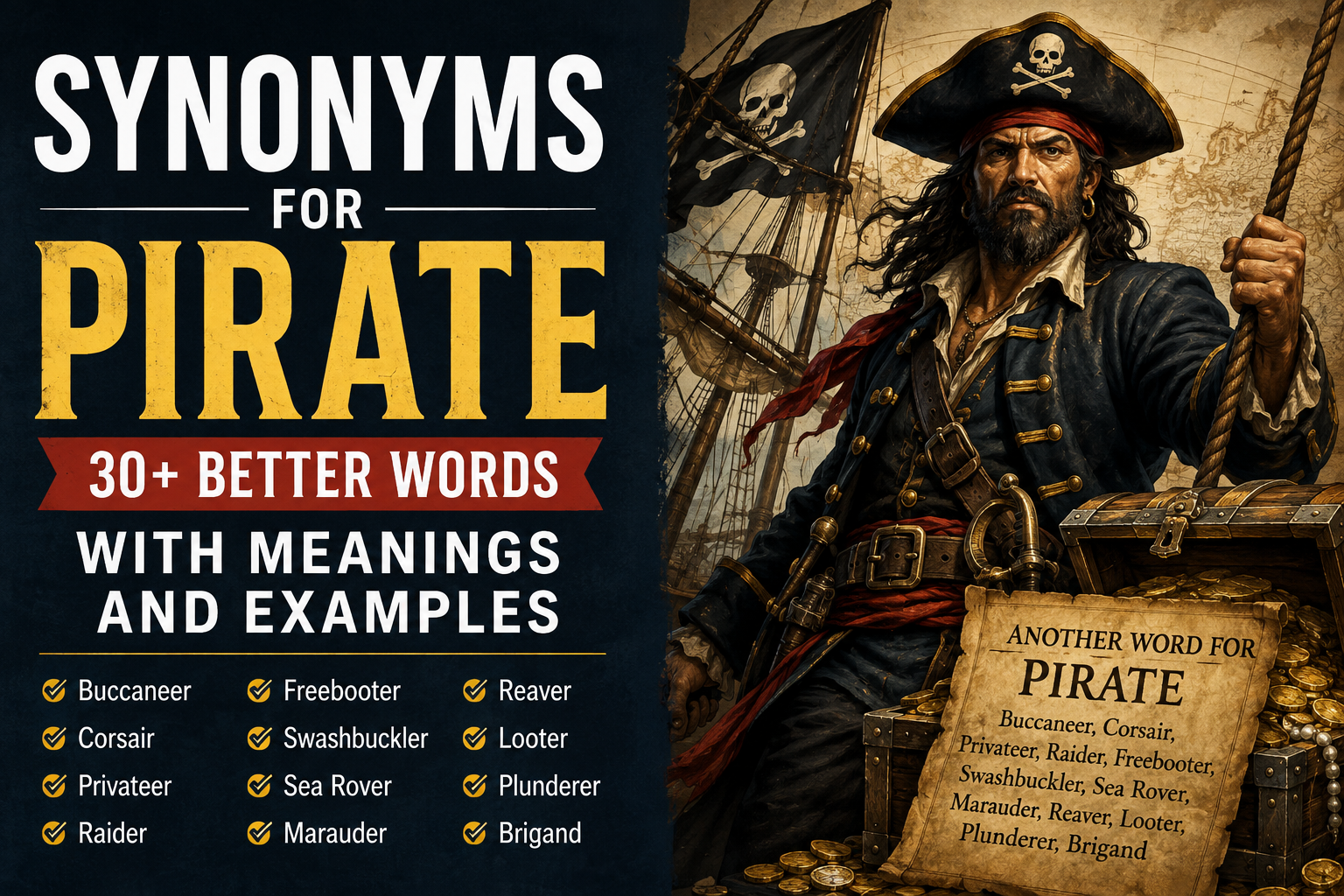
If you’re looking for synonyms for pirate, the best choices include buccaneer, corsair, freebooter, sea robber, sea rover, raider, marauder, and rover. However, these words are not interchangeable in every context. Buccaneer and corsair have strong historical or maritime associations, while raider and marauder are broader terms for someone who attacks or plunders. The right synonym depends on whether you are describing a historical sailor, a fictional character, or someone involved in modern illegal copying.
Quick Answer: What Are the Best Synonyms for Pirate?
The closest and most useful synonyms for pirate include:
- Buccaneer — a pirate, especially one associated with the Caribbean.
- Corsair — a pirate or privateering sailor, especially historically in the Mediterranean.
- Freebooter — someone who takes plunder, often with a historical or literary tone.
- Sea robber — a direct descriptive term for a pirate.
- Sea rover — a literary or historical alternative.
- Raider — someone who makes a sudden attack to steal or seize something.
- Marauder — someone who roams around attacking or plundering.
- Rover — a wanderer or marauder; less precise than pirate.
- Filibuster — a historical term that can refer to an adventurer or pirate, but has other modern meanings.
- Picaroon — an old-fashioned term for a pirate or plunderer.
For modern copyright contexts, however, words such as copyright infringer, plagiarist, or bootlegger may be more appropriate depending on exactly what the person has done.
What Does “Pirate” Mean?
A pirate is traditionally a person who attacks ships and steals from them. Cambridge defines the noun as someone who sails on a ship and attacks other ships to steal from them. The word also has a modern meaning: someone who illegally copies and distributes material such as music, movies, or computer programs.
Pirate can therefore refer to two substantially different ideas:
- A maritime criminal who attacks ships and steals property.
- A copyright violator who illegally copies, reproduces, or distributes protected material.
That distinction matters when choosing a synonym.
Core Synonyms for Pirate
| Word | Relationship | Meaning | Best Context | Register |
|---|---|---|---|---|
| Buccaneer | Direct/near synonym | Historical pirate, especially associated with the Caribbean | Historical fiction, maritime history | Neutral/literary |
| Corsair | Near synonym | Historical seaborne raider or pirate, especially associated with the Mediterranean | History, literature | Formal/historical |
| Freebooter | Near synonym | A person who takes plunder or acts independently | Historical/literary writing | Literary |
| Sea robber | Descriptive synonym | Someone who robs at sea | Clear definitions, historical writing | Neutral |
| Sea rover | Descriptive/near synonym | A pirate or seaborne raider | Literature, historical fiction | Literary |
| Raider | Contextual alternative | Someone who attacks suddenly to seize or steal | Military, historical, maritime contexts | Neutral |
| Marauder | Contextual alternative | Someone who roams around attacking or plundering | Historical or general conflict | Formal |
| Rover | Broad near synonym | A wandering or roaming person; historically can suggest a pirate | Literary/historical contexts | Literary |
| Picaroon | Historical synonym | An old-fashioned term for a pirate or plunderer | Historical/literary writing | Archaic |
| Filibuster | Historical/near synonym | Historically, an adventurer or irregular participant in foreign expeditions; can refer to a pirate in older usage | Historical contexts | Archaic/historical |
Collins specifically lists buccaneer, raider, rover, filibuster, marauder, corsair, sea wolf, freebooter, sea robber, and sea rover among its British English synonym results, while its American English thesaurus includes buccaneer, corsair, freebooter, marauder, and raider.
1. Buccaneer
Buccaneer is probably the strongest alternative when you want a word that immediately evokes a historical pirate.
It is especially associated with pirates operating around the Caribbean during the colonial era.
Example:
The young buccaneer searched the island for buried treasure.
Choose “buccaneer” when:
- the setting is historical;
- the character is a seafaring pirate;
- you want a vivid literary alternative to pirate.
Pirate vs. buccaneer:
Pirate is the general term. Buccaneer has a more specific historical flavor and is particularly associated with Caribbean pirates.
2. Corsair
Corsair is another strong historical alternative, but it carries a different geographic and historical flavor.
The word is commonly associated with seaborne raiders, particularly those operating in and around the Mediterranean.
Example:
The merchant vessel was attacked by corsairs near the Mediterranean coast.
Choose “corsair” when:
You are writing about historical maritime raiders and want a more specialized or literary term.
Pirate vs. corsair:
A pirate is the broad category. Corsair has stronger historical associations and can refer to maritime raiders operating within particular historical contexts.
3. Freebooter
A freebooter is someone who takes plunder, especially an adventurer or raider acting independently.
It sounds much more literary and old-fashioned than pirate.
Example:
The legendary freebooter became feared along the coast.
Best for:
- historical fiction;
- fantasy;
- adventure writing;
- deliberately old-fashioned language.
It is usually less natural in ordinary modern conversation.
4. Sea Robber
Sea robber is a straightforward descriptive alternative to pirate.
It emphasizes the central act: robbing people at sea.
Example:
The sea robbers attacked the merchant ship before dawn.
Best for:
- explanatory writing;
- historical descriptions;
- contexts where clarity matters more than stylistic variety.
Unlike buccaneer or corsair, it does not carry the same specialized historical associations.
5. Sea Rover
Sea rover is a literary way to describe someone who travels the seas and engages in piracy or maritime raiding.
Example:
The old sea rover had spent decades sailing beyond the known trade routes.
It is evocative, but it is not as precise or common as pirate.
Best for:
Creative writing, historical fiction, and descriptive prose.
6. Raider
Raider is a useful broader alternative, but it is not an exact synonym in every situation.
A raider is someone who makes a sudden attack to steal, seize, or damage something. A raider may operate on land or sea.
Example:
The raiders attacked the merchant vessel under cover of darkness.
Pirate vs. raider
A pirate specifically suggests piracy, traditionally at sea.
A raider emphasizes the act of attacking or seizing something.
So if the maritime context is important, pirate is more precise.
7. Marauder
A marauder is someone who roams around attacking or plundering.
Example:
The coastal villages were vulnerable to marauders.
Marauder is broader than pirate and can describe attackers operating on land as well as at sea.
Choose “marauder” when:
The emphasis is on roaming, attacking, and plundering, rather than specifically on piracy.
8. Rover
Rover can mean a person who wanders or travels widely. Historically or poetically, it can also refer to a pirate or seaborne adventurer.
Example:
The sea rover disappeared beyond the horizon.
Because rover has several meanings, it is less precise than pirate.
Best for:
- poetry;
- historical fiction;
- fantasy;
- literary descriptions.
9. Picaroon
Picaroon is an old-fashioned word for a pirate or plunderer.
It is much less common in contemporary English, so it should not normally replace pirate in everyday writing.
Example:
The novel follows a notorious picaroon who sails from port to port.
Choose “picaroon” when:
You deliberately want an archaic or historical atmosphere.
10. Filibuster
Filibuster requires caution.
Historically, the word has been used for adventurers or irregular fighters and can appear in older synonym lists for pirate. However, in modern American English, filibuster is strongly associated with a legislative procedure used to delay or block action in a deliberative body.
Therefore, it is not a good general-purpose modern synonym for pirate.
Better choice:
Use buccaneer, corsair, freebooter, or raider when describing a pirate.
Pirate Synonyms by Context
The best synonym depends heavily on what kind of pirate you mean.
For a Historical Pirate
Use:
- buccaneer
- corsair
- freebooter
- picaroon
- sea rover
Example:
The historical novel follows a ruthless buccaneer across the Caribbean.
For a Pirate in Fiction
Good choices include:
- buccaneer
- corsair
- freebooter
- sea rover
- sea robber
Example:
The fictional freebooter commands a fast ship and a loyal crew.
For Someone Who Attacks and Steals
Consider:
- raider
- marauder
- plunderer
- sea robber
These are broader terms and do not always specifically mean a pirate.
Example:
The coastal settlement was attacked by marauders.
For Someone Who Illegally Copies Content
This is a different sense of pirate.
Possible alternatives include:
- copyright infringer
- plagiarist
- plagiarizer
- bootlegger
- infringer
But these terms are not interchangeable.
Cambridge defines a pirate in the modern copyright sense as someone who illegally copies material such as music, films, or computer programs, while Collins separately identifies synonyms such as plagiarist, plagiarizer, cribber, and copyright infringer.
Pirate vs. Plagiarist
These words overlap in some situations, but they do not mean exactly the same thing.
A pirate illegally reproduces, distributes, or uses protected material.
A plagiarist presents another person’s words, ideas, or work as their own, usually without proper acknowledgment.
Example:
The company was accused of pirating software.
versus:
The student was accused of plagiarizing the essay.
Key difference
Piracy focuses on unauthorized use or reproduction.
Plagiarism focuses on taking another person’s work or ideas and presenting them improperly as one’s own.
Do not automatically replace pirate with plagiarist.
Pirate vs. Privateer
This is one of the most important distinctions in maritime vocabulary.
A privateer was a privately owned vessel or sailor authorized by a government to attack enemy ships during wartime.
A pirate, by contrast, operated without that kind of lawful authorization.
Therefore:
Pirate = unauthorized maritime raider
Privateer = government-authorized private maritime raider
Calling every historical privateer a pirate can therefore erase an important legal and historical distinction.
Pirate vs. Buccaneer
| Pirate | Buccaneer |
|---|---|
| Broad general term | More historically specific |
| Can describe pirates generally | Strongly associated with the Caribbean |
| Common in modern English | More historical/literary |
| Neutral term | Often evokes adventure and historical fiction |
Example:
The pirate attacked several merchant ships.
The Caribbean buccaneer became a legend.
Pirate vs. Corsair
| Pirate | Corsair |
|---|---|
| General term | Historical maritime term |
| Broad geographic use | Strong Mediterranean/historical associations |
| Common modern word | More specialized and literary |
| Neutral | Historical flavor |
If you simply need the ordinary word for someone who robs ships, pirate is usually the safest choice.
Pirate vs. Raider
A raider is broader.
Someone can be a raider without being a pirate.
For example:
Viking raiders attacked the settlement.
The word raider emphasizes the attack itself rather than a particular type of criminal identity.
Use pirate when piracy is central; use raider when the emphasis is on a sudden attack or seizure.
Pirate vs. Marauder
Both words can describe someone who attacks and plunders, but marauder is not specifically maritime.
The pirates attacked the ship.
The marauders attacked the village.
The second sentence does not imply that the attackers were sailors or pirates.
Words That Are Related to Pirate but Are Not Exact Synonyms
Some words frequently appear in thesaurus results but should be treated carefully.
Privateer
Historically distinct because of government authorization.
Plunderer
Describes someone who takes property by force, but does not specifically imply piracy.
Thief
A general term for someone who steals. A pirate can be a thief, but most thieves are not pirates.
Smuggler
Someone who moves goods illegally, often across borders. Smuggling and piracy are different activities.
Bootlegger
Someone involved in unauthorized production, distribution, or sale, especially historically with illegal alcohol or unauthorized recordings. It is not a general synonym for a maritime pirate.
Plagiarist
Someone who improperly presents another person’s work or ideas as their own. This overlaps with some copyright-related uses of pirate but is not equivalent to the maritime meaning.
This distinction is important because a thesaurus may return semantically related words that cannot naturally replace pirate in every sentence.
Common Mistakes When Choosing a Pirate Synonym
1. Using “privateer” as if it means “pirate”
This can be historically inaccurate. A privateer operated under government authorization, particularly during wartime.
2. Using “marauder” only for sea criminals
Marauder is much broader and can refer to attackers on land.
3. Using “filibuster” in modern everyday English
Modern readers are likely to understand filibuster in its political sense. It is therefore a poor replacement for pirate outside historical contexts.
4. Calling every copyright offender a plagiarist
Copyright infringement and plagiarism overlap but are not identical concepts.
5. Using “buccaneer” in every pirate sentence
Buccaneer carries historical associations, particularly with the Caribbean. It is not simply a stylistic replacement for pirate in every modern context.
Which Word Should I Use?
Pirate is the closest general word for someone who attacks or robs ships at sea.
Buccaneer adds a historical Caribbean flavor and is especially associated with privateering in the Caribbean.
Corsair is more appropriate for a Mediterranean or historical maritime context.
Freebooter and picaroon have a more literary, historical, or old-fashioned tone.
Raider emphasizes attacking and seizing rather than specifically engaging in piracy.
Marauder emphasizes roaming around and plundering, so it can be used more broadly than pirate. In a modern copyright context,
copyright infringer is usually more precise than using a maritime synonym for pirate.
Examples of Pirate Synonyms in Sentences
Buccaneer
The famous buccaneer sailed through the Caribbean in search of Spanish treasure.
Corsair
The merchant ship encountered corsairs near the Mediterranean coast.
Freebooter
The freebooter became a legendary figure in the old sailor’s tales.
Raider
The raiders boarded the vessel before the crew could respond.
Marauder
Coastal villages feared attacks from marauders.
Sea robber
The sea robbers disappeared into the fog after taking the cargo.
Sea rover
The old sea rover had spent most of his life at sea.
Picaroon
The historical novel portrays its hero as a daring picaroon.
Pronunciation of “Pirate”
US: /ˈpaɪrət/
UK: /ˈpaɪrət/ or /ˈpaɪrɪt/
Cambridge lists the American pronunciation as /ˈpaɪr.ət/ and the British pronunciation as /ˈpaɪ.rət/, with dictionary resources also showing the British variant /ˈpaɪrɪt/.
Frequently Asked Questions
What is the closest synonym for pirate?
Buccaneer is one of the closest and most recognizable historical alternatives to pirate. Corsair, freebooter, and sea robber can also work, depending on context. However, buccaneer and corsair carry historical associations that the general word pirate does not necessarily have.
What is another word for a pirate at sea?
Useful alternatives include buccaneer, corsair, sea robber, sea rover, freebooter, and raider. For historical writing, buccaneer and corsair can provide more specific atmosphere.
Is buccaneer another word for pirate?
Yes, buccaneer can function as a synonym for pirate, especially in historical contexts. It is particularly associated with Caribbean pirates and therefore is not completely interchangeable with pirate in every setting.
What is a formal word for pirate?
There is no single universally “formal” replacement. Corsair, freebooter, and marauder can sound more literary or historical, but each has a somewhat different meaning. In formal modern writing, pirate is often the clearest and most precise word.
What is the difference between a pirate and a privateer?
A pirate traditionally attacks and robs ships without lawful authorization. A privateer historically operated under government authorization to attack enemy vessels, particularly during wartime. The distinction is important in historical writing.
What is a synonym for a software pirate?
Depending on the situation, copyright infringer, software infringer, or software pirate may be appropriate. Plagiarist is not automatically equivalent because plagiarism specifically involves presenting another person’s work or ideas improperly as one’s own.
Is “raider” a synonym for pirate?
Raider is a near-synonym rather than an exact replacement. A raider attacks to seize or steal something, but raiders can operate on land or sea. Pirate specifically identifies a person involved in piracy.
Is “marauder” another word for pirate?
Sometimes, but only contextually. A marauder is someone who roams around attacking or plundering and does not have to operate at sea. Therefore, marauder is broader than pirate.
Conclusion
The best synonym for pirate depends on the context. Buccaneer is an excellent historical alternative, particularly for Caribbean settings; corsair works well for specialized historical maritime contexts; freebooter and picaroon add an old-fashioned literary tone; and raider or marauder work when the emphasis is on attacking and plundering rather than piracy itself.
For modern copyright contexts, avoid forcing maritime vocabulary into the sentence. Terms such as copyright infringer or plagiarist may be more precise, depending on the behavior being described. The key is not simply finding a different word for pirate, but choosing the word that preserves the intended meaning, tone, and historical context.

Michael Thompson is an English language specialist and experienced editor who focuses on vocabulary development and clear communication. He creates high-quality synonym guides, word comparisons, and writing tips to help students and professionals express their ideas more effectively. His work combines linguistic knowledge with practical SEO strategies to make learning both useful and engaging.