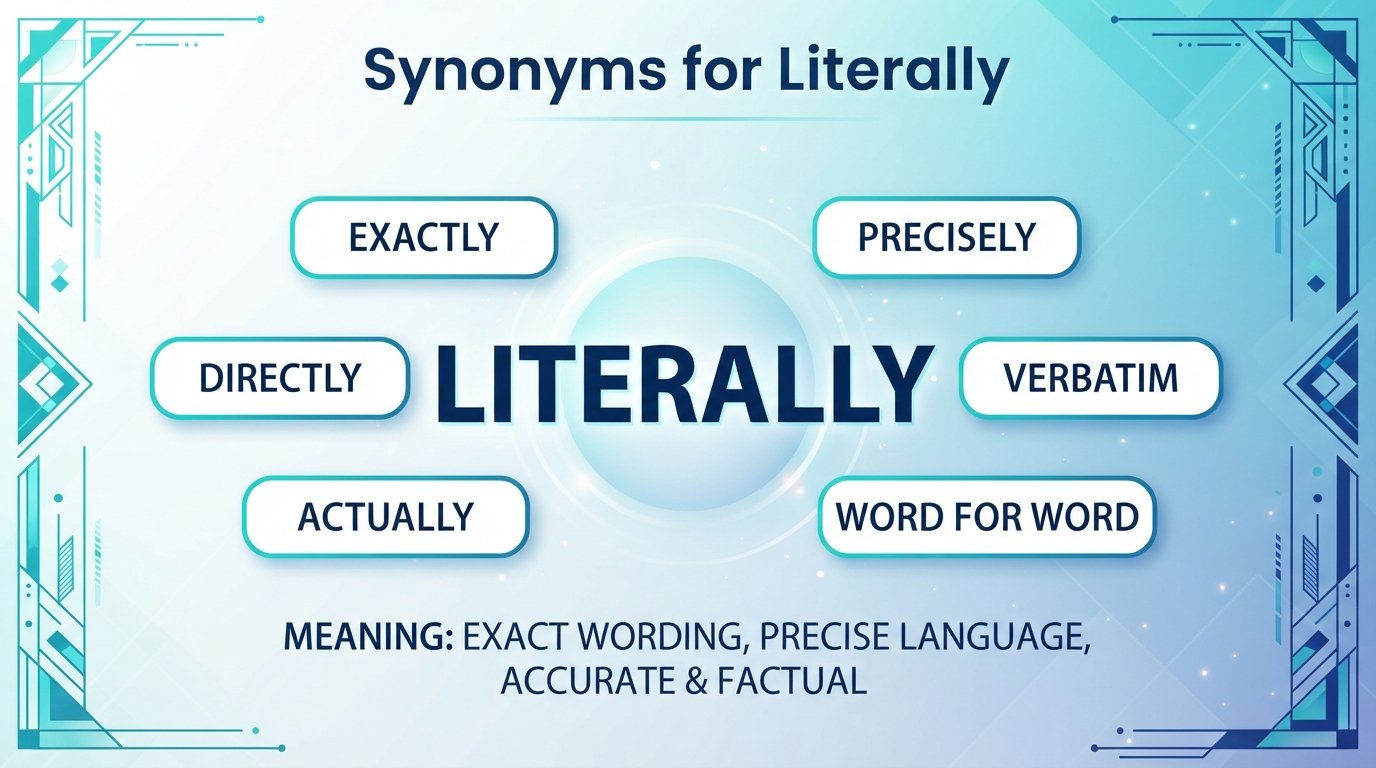
The best synonym for literally depends on what you mean. When literally means “in the exact or original sense,” strong alternatives include exactly, precisely, word for word, verbatim, and to the letter. When it is used to emphasize that something is genuinely true, actually, truly, really, or in fact may work better. Because literally also has an informal use as an intensifier, no single synonym replaces it in every sentence.
Quick Answer: What Are the Best Synonyms for Literally?
The closest alternatives to literally include exactly, precisely, actually, truly, word for word, verbatim, to the letter, strictly, and accurately. However, these words are not interchangeable in every context. Exactly and precisely emphasize exactness, while verbatim and word for word are especially useful for quotations or translations. Actually and truly work better when literally means that something is genuinely or factually true.
30 Synonyms and Alternatives for Literally
| Word or phrase | Relationship | Meaning / use | Best context |
|---|---|---|---|
| exactly | Direct / near synonym | In the exact sense or form stated | Precise statements, instructions |
| precisely | Direct / near synonym | With exact accuracy | Formal and precise writing |
| word for word | Contextual alternative | Using the exact words | Quotations, translations |
| verbatim | Contextual alternative | Using exactly the same words | Speech, quotations, records |
| to the letter | Contextual alternative | Exactly as instructed or required | Rules, instructions |
| strictly | Near synonym | According to an exact or narrow meaning | Definitions, rules |
| accurately | Near synonym | Correctly and without error | Facts, descriptions |
| faithfully | Contextual alternative | Closely preserving the original | Translation, reproduction |
| directly | Contextual alternative | Without figurative or indirect meaning | Statements, explanations |
| plainly | Contextual alternative | In a clear, straightforward sense | Explanations |
| correctly | Near synonym | In the right or proper sense | Interpretation, usage |
| rightly | Near synonym | In the correct sense | Interpretation, judgment |
| actually | Near synonym | In fact; genuinely | Factual emphasis |
| really | Near synonym | In reality; genuinely | Everyday speech |
| truly | Near synonym | Genuinely or sincerely | Emphasis, personal statements |
| indeed | Contextual alternative | In fact; certainly | Formal or emphatic writing |
| in fact | Contextual alternative | As a matter of fact | Factual clarification |
| genuinely | Contextual alternative | In a real or authentic way | Feelings, reactions |
| factually | Contextual alternative | According to facts | Academic or analytical writing |
| in reality | Contextual alternative | In actual circumstances | Contrast and clarification |
| in truth | Contextual alternative | According to the truth | Formal or literary writing |
| in actual fact | Contextual alternative | Emphatically, as a matter of fact | Formal emphasis |
| for real | Contextual alternative | Really; genuinely | Informal speech |
| seriously | Contextual alternative | Used to emphasize sincerity or truth | Informal conversation |
| completely | Contextual alternative | To the fullest degree | Intensification |
| totally | Contextual alternative | Completely or entirely | Informal emphasis |
| entirely | Contextual alternative | Completely | Formal and neutral writing |
| absolutely | Contextual alternative | Completely or emphatically | Strong emphasis |
| simply | Contextual alternative | Just; in a straightforward way | Explanation, informal speech |
| just | Contextual alternative | Simply or only | Everyday speech |
Important: These 30 options are not all exact substitutes. Literally has several meanings and functions, so the correct replacement depends on the sentence. Dictionaries specifically distinguish its literal meaning from its emphatic and informal uses.
What Does Literally Mean?
Literally is an adverb. In its traditional sense, it means that something should be understood according to its real, original, or exact meaning, rather than as a metaphor or figure of speech.
For example:
The phrase was translated literally.
Here, literally means that the translation followed the actual words or direct meaning rather than interpreting the expression figuratively.
Oxford gives exactly as a synonym for this sense, while Cambridge describes literally as using the real or original meaning of a word or phrase.
Literally Can Also Emphasize a Statement
Modern English also uses literally to emphasize something that is true, surprising, or extreme:
There were literally hundreds of people waiting.
In this use, alternatives such as actually, really, or truly may fit better.
Cambridge recognizes this emphatic use, while Oxford also records an informal use in which literally intensifies a figurative expression even though the statement is not literally true.
Closest Synonyms for Literally
1. Exactly
Exactly is one of the strongest alternatives when literally means “in precisely the stated sense.”
The instructions should be followed literally.
The instructions should be followed exactly.
Use exactly when precision is the main idea.
2. Precisely
Precisely emphasizes exactness and often sounds slightly more formal than exactly.
The word means literally “to wander.”
The word means precisely “to wander.”
It works especially well in academic, technical, and professional writing.
3. Strictly
Strictly works when something must be interpreted according to a precise rule, definition, or limitation.
Literally speaking, that isn’t what the contract says.
Strictly speaking, that isn’t what the contract says.
However, strictly can emphasize rules or limitations rather than literal meaning, so it is not a universal replacement.
4. Accurately
Accurately focuses on correctness rather than literal interpretation.
The report does not literally describe what happened.
The report does not accurately describe what happened.
These words overlap when the intended meaning is “correctly,” but they are not identical.
5. Correctly
Correctly is useful when the issue is whether something has been interpreted or understood properly.
You interpreted his words literally.
You interpreted his words correctly.
The second sentence changes the emphasis from literal interpretation to correctness.
Alternatives for “Literally” in Quotations and Translation
Some alternatives are particularly useful when literally refers to preserving exact wording.
Word for Word
Word for word means that the same words are retained in the same order or reproduced individually.
The passage was translated literally.
The passage was translated word for word.
This phrase is especially natural when discussing translations.
VerbatimVerbatim means using exactly the same words as the original.
The witness repeated the statement literally.
The witness repeated the statement verbatim.
Because verbatim specifically emphasizes exact wording, it is generally the better choice when the original words must remain unchanged.
To the Letter
To the letter means exactly according to instructions, rules, or requirements.
She followed the instructions literally.
She followed the instructions to the letter.
The phrase is especially natural with follow, obey, and similar verbs.
Faithfully
Faithfully can describe something that accurately preserves the original meaning, form, or character.
The translator rendered the passage literally.
The translator rendered the passage faithfully.
Unlike verbatim, faithfully does not necessarily mean that every individual word was preserved.
Alternatives for Literally When You Mean “Actually”
Sometimes literally is being used to emphasize that something is real or factual.
Actually
Actually is often the most natural replacement when the intended meaning is “in fact.”
I literally had no idea.
I actually had no idea.
Cambridge specifically identifies an emphatic use of literally that can correspond to “really.”
Really
Really is common in conversational English.
I literally don’t know what happened.
I really don’t know what happened.
However, really can express degree or emotion as well as truth, so the meaning is sometimes less precise.
Truly
Truly emphasizes genuine truth or sincerity.
She was literally grateful for his help.
She was truly grateful for his help.
It can sound more deliberate or expressive than really.
In Fact
In fact is useful when correcting, clarifying, or emphasizing information.
He wasn’t literally responsible for the entire project.
In fact, he only managed one department.
It does not replace literally in every grammatical position, but it can express the factual emphasis behind some uses.
Indeed
Indeed can emphasize that something is true or confirm a previous statement.
The result was literally remarkable.
The result was indeed remarkable.
It is generally more formal and does not preserve every meaning of literally.
Which Word Should You Use Instead of Literally?
Choosing the right alternative depends on the intended meaning.
| If you mean… | Best choice | Example |
|---|---|---|
| Exactly as stated | exactly | Take the instruction exactly as written. |
| With exact precision | precisely | That is precisely what she said. |
| Exact wording | verbatim | The quote was reproduced verbatim. |
| Every word separately | word for word | He translated it word for word. |
| Exactly according to instructions | to the letter | They followed the rules to the letter. |
| According to the facts | actually / in fact | He actually completed the task. |
| Genuinely | truly / genuinely | She was genuinely surprised. |
| Completely | entirely / completely | The plan was completely different. |
| Informal strong emphasis | really / totally | I really need some help. |
| Clear, straightforward meaning | plainly / directly | The statement plainly says otherwise. |
Literally vs Exactly
Literally and exactly overlap when both refer to an exact meaning.
The phrase should be interpreted literally.
The phrase should be interpreted exactly.
However, exactly is broader. It can refer to numerical accuracy, time, location, similarity, or agreement.
The train arrived at exactly 8:00.
You generally would not replace exactly with literally here.
Choose “literally” when you want to contrast a literal meaning with a figurative one.
Choose “exactly” when you simply mean precise or identical.
Literally vs Actually
These words are sometimes interchangeable, but their core meanings differ.
Literally traditionally indicates a literal interpretation.
He took my words literally.
Actually means “in fact” or “in reality.”
He actually came to the meeting.
A sentence containing actually may emphasize reality, while one containing literally may emphasize how a statement should be interpreted.
Literally vs Figuratively
These are generally opposites when discussing meaning.
Literally means that words are being understood in their actual or original sense.
Figuratively indicates that words are being used in a nonliteral, metaphorical, or symbolic sense.
Compare:
She literally ran ten miles.
This means she physically ran ten miles.
She figuratively ran circles around her competitors.
Here, “ran circles around” is not describing actual physical running.
Oxford and Cambridge both distinguish literal interpretation from figurative or emphatic usage.
Common Mistakes With Literally
Using a weak synonym as if it were exact
Not every word listed by a thesaurus can replace literally.
For example, absolutely, totally, and completely can express strong emphasis, but they do not normally mean “in the literal sense.”
Assuming actually always means literally
These words can overlap, but actually means “in fact,” while literally can indicate that something should be understood according to its literal meaning.
Using verbatim for every use of literally
Verbatim refers specifically to exact wording.
She quoted the speaker verbatim.
It would not normally replace literally in:
The dog literally jumped over the fence.
Treating figuratively as a synonym
Figuratively is generally an antonym of literally, not a synonym.
Assuming modern emphatic usage is always a mistake
The informal emphatic use of literally is documented by major dictionaries. Oxford explicitly records its use to emphasize a word or phrase even when the expression is not literally true, while noting that some people object to this usage.
Is Literally Overused?
Literally is frequently used as an intensifier in informal English. In some sentences, removing it makes the statement clearer and more concise.
For example:
I literally waited for three hours.
If the three-hour wait is simply a factual statement, the sentence may be stronger without an unnecessary intensifier:
I waited for three hours.
However, literally can be useful when the writer needs to distinguish an actual event from a figurative expression.
The building was literally on fire.
Here, the word helps make the physical meaning explicit.
Merriam-Webster’s current example material also shows literally appearing in both straightforward literal contexts and modern emphatic constructions.
Common Collocations With Literally
The best alternative depends heavily on the phrase surrounding literally.
Literally + translated language
Use:
- word for word
- verbatim
- faithfully
- exactly
Example:
The sentence was translated word for word.
Literally + interpretation
Use:
- exactly
- strictly
- precisely
- in the literal sense
Example:
The statement should not be interpreted literally.
Literally + factual emphasis
Use:
- actually
- really
- truly
- in fact
Example:
I actually saw the event happen.
Literally + strong informal emphasis
Depending on the sentence, alternatives may include:
- really
- completely
- totally
- absolutely
- entirely
These are alternatives for the emphatic function, not exact synonyms of the traditional meaning.
Antonyms of Literally
The clearest antonyms are:
- figuratively
- metaphorically
- loosely
- symbolically
- nonliterally
For example:
She was literally drowning.
means she was actually in water and unable to breathe normally.
She was figuratively drowning in paperwork.
means she was overwhelmed by a large amount of work.
Figuratively is therefore the most important opposite to understand.
Frequently Asked Questions
What is the closest synonym for literally?
Exactly is one of the closest synonyms when literally means “in the exact or original sense.” Precisely is another strong choice. For exact wording, verbatim or word for word may be more appropriate.
What is another word for literally in formal writing?
Depending on the meaning, use precisely, exactly, accurately, strictly, actually, or in fact. For formal writing, choose the word that expresses the intended meaning rather than replacing literally automatically.
What is a synonym for literally meaning “exactly”?
The best options are exactly, precisely, strictly, and to the letter. Verbatim and word for word are better when you specifically mean that the original wording has been reproduced.
Is actually a synonym for literally?
Sometimes, but not always. Actually means “in fact” or “in reality,” while literally traditionally means “in the literal or exact sense.” They overlap when literally is used for factual emphasis, but they are not interchangeable in every sentence.
Is really a synonym for literally?
Really can replace literally when the word is being used to emphasize that something is genuinely or actually true. It does not replace the literal-meaning sense in every context.
What is the opposite of literally?
The clearest opposite is figuratively. Metaphorically can also work when something is expressed through a metaphor rather than in its literal sense.
Can literally mean figuratively?
Yes. In informal modern English, literally is sometimes used as an intensifier before an expression that is not literally true, such as “I literally died laughing.” Oxford records this use, although it also notes that some people consider it incorrect.
Should I avoid using literally?
No. Literally is a standard English adverb with several established uses. The important point is to use it when its meaning is clear and to choose a more precise alternative when another word communicates your intended meaning better.
Conclusion
The best synonym for literally depends on the sense you need. Use exactly or precisely for exact meaning, verbatim or word for word for exact wording, and to the letter for strict adherence to instructions. When literally simply emphasizes that something is true, actually, really, truly, or in fact may be more natural.
The key is not to replace literally with the first thesaurus entry you find. Choose the alternative that matches the intended meaning, context, tone, and level of precision.

Emily Johnson is a linguistics graduate and vocabulary specialist. She writes detailed synonym explanations and helps readers understand subtle differences between words, improving both writing and speaking skills. Synonyms help express ideas more clearly and precisely in English.